This blog feature amusing and heartwarming stories about our late Leonberger dog Bronco, as well as other Leonbergers. It also has a lot of information about the Leonberger breed, the history, care, training, Leonberger organizations, etc. I also wrote a Leonberger book, which I am featuring in the sidebar.
This is a Leonberger blog, but I also post book reviews of books that I love and want to promote but are not about Leonbergers. With this post I would like to promote a truly wonderful poetry book that also feature a lot of photos, art, information and links to videos about African wildlife. This book is a masterpiece just like this wonderful book from the same author: Lion Scream.
Below is an overview of the two formats of Burning Butterflies: Poetry About Southern African Flora and Fauna Paperback – April 22, 2025, by Robbie Cheadle
Paperback – Independently published April 22, 2025, ASIN : B0F2VCXZZV, ISBN-13 : 979-8315273431, 92 pages, Item Weight : 6.7 ounces, dimensions : 6 x 0.22 x 9 inches, it cost $12.50 on US Amazon. Click here to order it from Amazon.com.
Kindle – Publication date : April 22, 2025, ASIN : B0F2SDF2GW, 94 pages. It is currently $5.99 on Amazon.com and free with Kindle unlimited. Click here to order it from Amazon.com.
Front cover of Burning Butterflies. Click on the image to go to the Amazon page for the paperback version of the book.
Amazon’s Description of Burning Butterflies
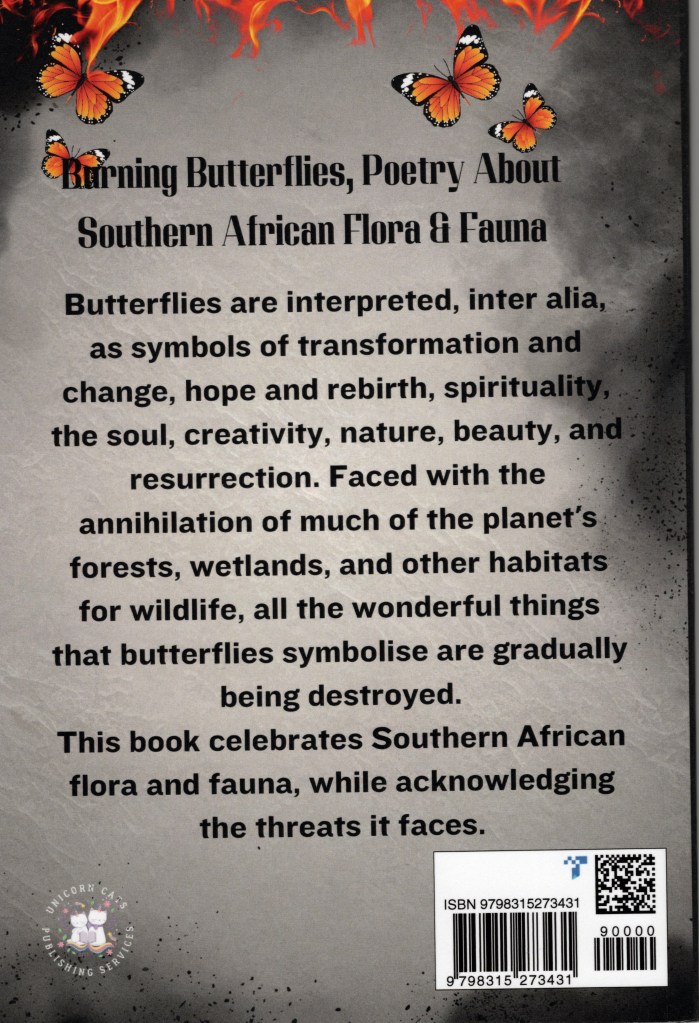
Butterflies are interpreted, inter alia, as symbols of transformation and change, hope and rebirth, spirituality, the soul, creativity, nature, beauty, and resurrection. Faced with the annihilation of much of the planet’s forests, wetlands, and other habitats for wildlife, all the wonderful things that butterflies symbolise are gradually being destroyed.
This book celebrates Southern African flora and fauna, while acknowledging the threats it faces.
This is another masterpiece from author, poet, artist, wildlife photographer and naturalist Robbie Cheadle. I bought both the paper version and the kindle version. I prefer reading a real paper book, but it was easier to view all the beautiful YouTube videos using the Kindle. With only the paperback I would have to type in the url. The book features hundreds of beautiful poems, more than 90 colors photos and paintings, other kinds of art, dozens of YouTube videos and informational links. The focus is on African wildlife.
The author touches on important subjects such as the threats to wildlife and our planet from human development, climate change, and trophy hunting. The author’s love for wildlife and nature shines through in her poems, in her art, in her photos, and videos. More than anything I think this book is a beautiful tribute to the natural world. You also learn about African wildlife and various animals. I found it interesting that there are no bears in Africa. The last bear in Africa, an Atlas bear was killed in Morocco in 1870. Did you know that cheetah cubs have whitish fuzzy back that look like the back of honey badgers, a fierce animal. It is believed that it protects them.
The author is using the Butterfly as a symbol of transformation. She also expresses a special love for elephants. They are magnificent and intelligent animals. I felt that this book has so much to offer in terms of beauty, symbolism, art and wisdom. I highly recommend this book.
Back cover of Burning Butterflies. Click on the image to go to the Amazon page for the Kindle version of the book.
About the Author of Burning Butterflies
South African author, photographer, and artist, Robbie Cheadle, has written and illustrated seventeen children’s books, illustrated a further three children’s books, and written and illustrated four poetry books. Her work has also appeared in poetry and short story anthologies.
Robbie also has two novels and a collection of short stories published under the name of Roberta Eaton Cheadle and has horror, paranormal, and fantasy short stories featured in several anthologies under this name.
Robbie’s blog includes recipes, fondant and cake artwork, poetry, and book reviews.
I’ve been missing in action for a bit more than a week because of a family trip to Paris, France. We visited my wife’s eldest sister and her family, and we celebrated our nephew’s 40th birthday, my wife’s sister’s husband’s birthday, and we got too meet our nephew’s and his wife’s 16-month-old daughter for the first time. We also spent time with an ex-pat friend of my wife and our niece and a friend of hers. She lives in Berlin, but she came to Paris to see us. Naturally we also visited several tourist attractions including several museums, Notre Dame, Montmartre, Sacré Coeur, the Eiffel Tower, and we took a river cruise with dinner and a few of Paris’ 44,000 restaurants. We also went to an opera.
From left to right, my wife’s sister, my wife, me (in the back), and my daughter. This photo was taken in an opera house called Palais Opéra Garnier. I should mention that this was not opera where we saw a performance.
Paris is a fascinating city with so much to offer and so much life. Paris proper/inner-city is 40+ square miles featuring large several hundred years old beautiful buildings, gorgeous esplanades and narrow streets, thousands of restaurants, cafés, bakeries, pastry shops, small stores, thousands of statues, and hundreds of museums, monuments, tourist attractions and parks. Paris is the city in the world with the most restaurants, and the food is great. Italy has been voted to have the best food in the world. I must disagree; it is France. There is culture everywhere and the streets are filled with people long after midnight, and the restaurants are open long after midnight. Paris never sleeps.
The city of Paris (Paris proper) only has 2 million people, but you must add the millions of people working there but living in the suburbs. Paris metropolitan has 13 million people, and the region of Paris called Île-de-France has 12 million people. The city I live in, Dallas, Texas, also has 2 million people (8 million people in the metro) but it has almost nothing to offer in comparison. Dallas has some tourist attractions and offers some culture, it is not bad at all, but Paris has about a hundred times more of that. In Dallas almost all restaurants close before 10PM, which is when Paris really wakes up. That is not to put down Dallas, but to point out that Paris is indeed one of the greatest cities in the world to visit.
Aerial view of the Seine River in Paris. The island Île de la Cité is in the center of the picture and Notre Dame can be seen in the back.
I’ve been to Paris several times before, in 1986 after my Swedish army service, then in 2003 and in 2018. This time was different because I could converse in French with waiters and taxi drivers, read signs and instructions, and newspapers. However, unlike in 1986 and 2003 a lot of French now speak English, at least the younger generation, and they want to speak English. In 1986 even the French who knew how to speak English were kind of offended when you could not speak French. Now they want to practice speaking English, and I want to practice speaking French. The problem I had in 1986 has been reversed. I was so happy when I started talking to a taxi driver in English and he said “Je suis désolé, je ne parle pas anglais. Anglais non. Anglais non.”
I heard a lot of different languages spoken, in addition to French, English, German, Italian, Dutch, Chinese, Japanese, Arabic, Spanish, Swedish, Danish and many other languages, and it was all welcome. When I visited Italy in 1986 someone angrily shouted at us that this is Italy and we speak Italian, not English. In 1986 the same thing almost happened in Paris, but I don’t think that is likely to happen in Paris now. The current US government is not popular for understandable reasons. However, there were signs reminding people that the US government is different from US visitors, and I felt that people treated us in a friendly manner.
Anyway, below is an overview of what we did this time with the focus on my photos. In the past we’ve visited Moulin Rouge, Versailles and Le Louvre, which is the world’s largest museum. I highly recommend those attractions but since we have seen them a few times already we did not visit them on this trip.
The Eiffel Tower
The Eiffel tower is one of the main attractions in Paris. We’ve visited the Eiffel tower before. We’ve eaten at the restaurant on the first floor, and we’ve visited the second floor (halfway up), but I’ve been to the third floor (the top) only once before, in 1986. Unfortunately, it has become difficult to visit the Eiffel Tower top. You must buy the tickets beforehand in good time. My wife’s sister was able to get us all tickets from Paris City Vision (guided tours).
Eiffel Tower from the other side of Seine (my photo)Aerial view of Paris featuring the Eiffel Tower and the Seine River. Stock photo (not my photos). Asset id: 2281050257 by Open Films.Scenery from the second floor of the Eiffel Tower. The garden you see is called Champ de Mars and there’s a dog park.This is a view from the third floor (the top) of the Eiffel Tower. If I were to take a photo of every view angle I would end up with dozens of photos, which is too much. If I were to take a panorama photo you would not be able to see any details. If you look carefully, you can see Notre Dame about 60% up and slightly to the left. The impressive buildings and garden in the middle is the Jardin Du Luxembourg.This is another view from the third floor (the top) of the Eiffel Tower. In the distance (zoomed in) you can see some skyscrapers. That is NOT “downtown” Paris. It is La Défense de Paris, a business area in a suburb of Paris and it is not considered a tourist attraction. However, the first time I visited Paris in 1986 we visited La Défense de Paris because being from the north Swedish countryside we had never seen a skyscraper before.
Notre Dame
Notre Dame is a very large cathedral located on the island Île de la Cité. The construction of it began in 1163 and it was completed in 1260, 865 years ago. It was severely damaged by a fire in 2019. We’ve visited Notre Dame many times before, but this was the first time we visited Notre Dame since the fire. It looked the same except the big, beautiful pipe organs were missing, and Notre Dame was still being renovated on the outside. We bought tickets beforehand, but you can buy tickets there, but the line is long.
Photo I took of Notre Dame before entering.Inside the Notre Dame cathedral, on the left side.Inside the Notre Dame cathedral, the perpendicular view.
River Cruise on the Seine
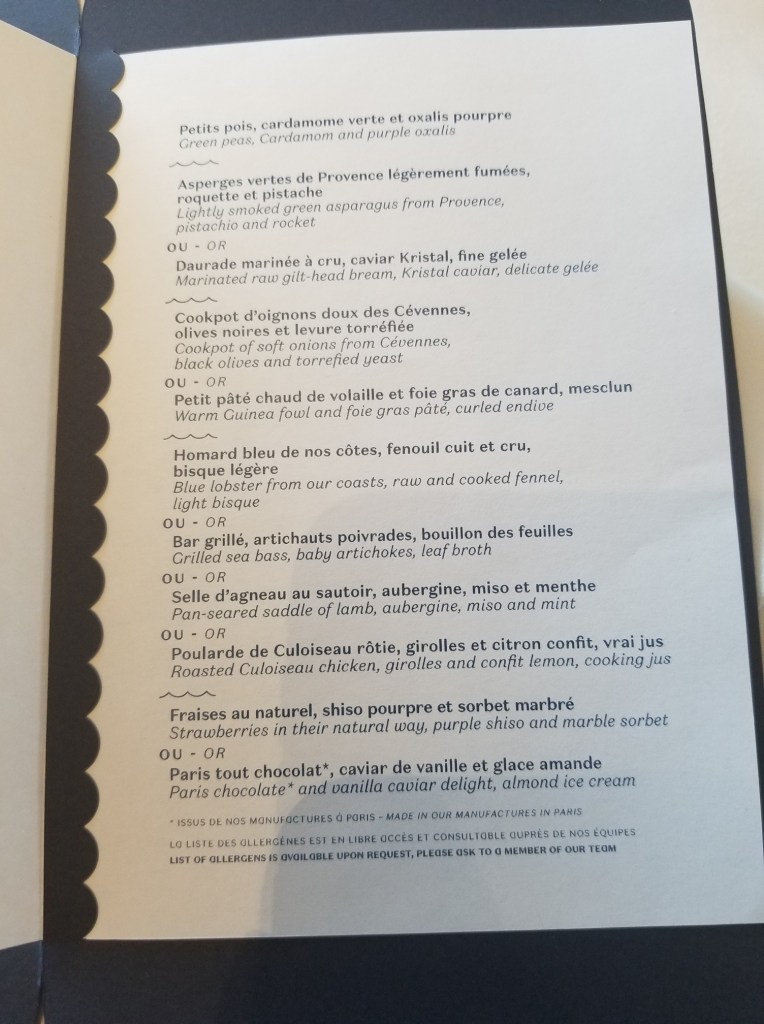
We also took a dinner cruise on the Seine. The boat / cruise was called La Seine Ducasse. I started right across from the Eiffel Tower and went a few miles up, passing by the island Île de la Cité and Notre Dame and then turning around. The cruise was a couple of hours long and the sun set during the cruise. The food was amazing (see the menu below). Unfortunately, the beer options weren’t that great, so I had wine.
A photo of the river Seine.The menu at La Seine Ducasse. I had Marinated raw gilt-head bream, Kristal caviar, and delicate gelée. I also had Warm Guinea fowl and foie gras paté and curled endive. After that I had Roasted Culoiseau chicken, girolles and confit lemon, cooking jus. For dessert I had Strawberries in their natural way, purple shiso and marble sorbet.Our table as when we arrived.The Eiffel Tower as seen from the cruise boat at night.
Opera Rigoletto
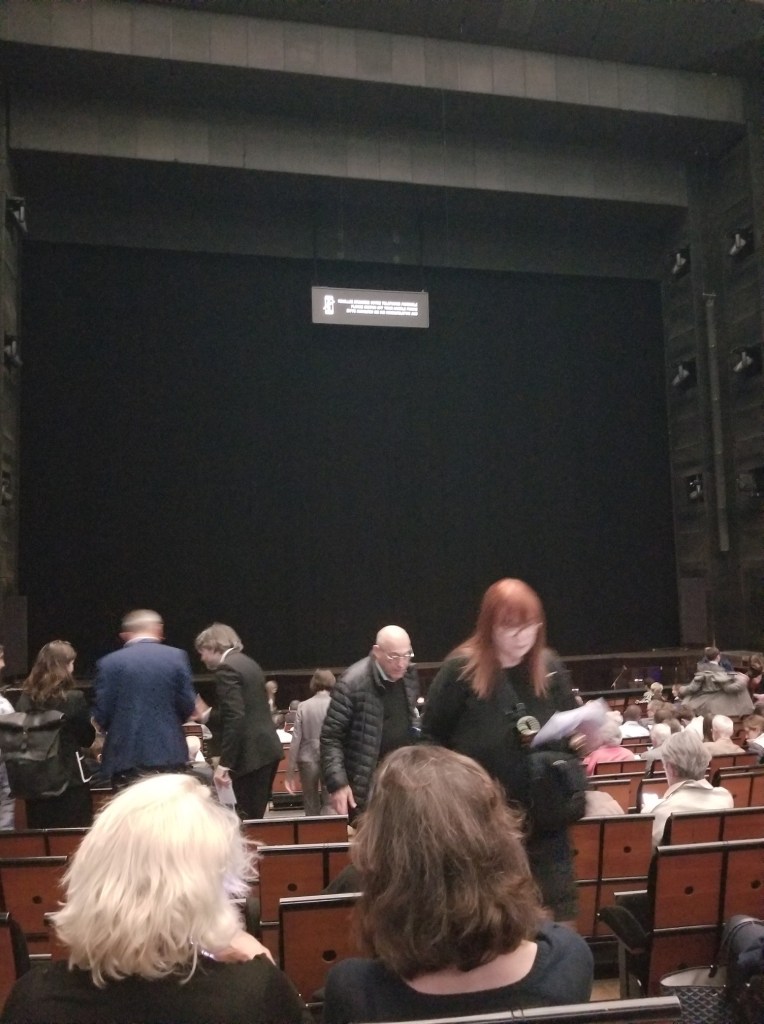
One evening we went to see an Opera at Opera National de Paris located nearby the Bastille. The opera was Rigoletto by Cristiano Grimaldi. It was sung in Italian but above the scene there were subtitles in French and English.
You were not allowed to take pictures, but I snapped this quick photo before of the scene, before the performance started.Hallway outside the theater where you bought snacks and drinks.
This is two minute and 50 second video of La Donna È Mobile sung by Luciano Pavarotti. La Donna È Mobile is a song in Rigoletto. You may recognize it. I should add, it was not Pavarotti who sang it in our performance (he is no longer alive).
Montmartre and Sacré Coeur
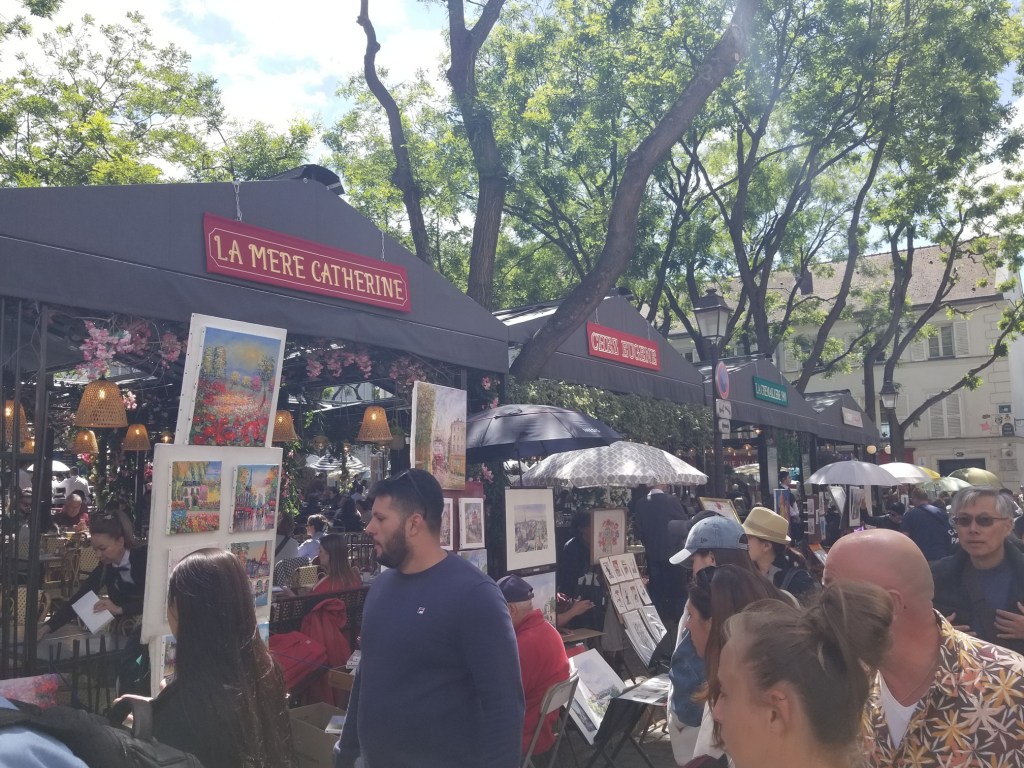
Montmartre is a neighborhood, and a hill located in Paris. It is known for its old picturesque buildings, the plaza, the small stores, cafes and restaurants, and the art. At the top of the hills sits one of Paris most famous cathedrals Basilique du Sacré-Cœur de Montmartre. It is open to visitors, but you may have to stand in line to go inside. The view from the top of the hill is spectacular.
This is the front view of Basilique du Sacré-Cœur de Montmartre. It is one of the most beautiful cathedrals that I have ever seen.This market in Montmartre is located nearby Sacré-Cœur.This market in Montmartre is located nearby Sacré-Cœur.
Sights and Shopping in Paris
Nobody walks in LA but in Paris everyone walks. There is so much to see everywhere, everything is close, and there are several restaurants and shops in every block. So, why not walk a few miles every day. It is healthy too. Below are a lot of photos that I took of things we visited as we walked around Paris.
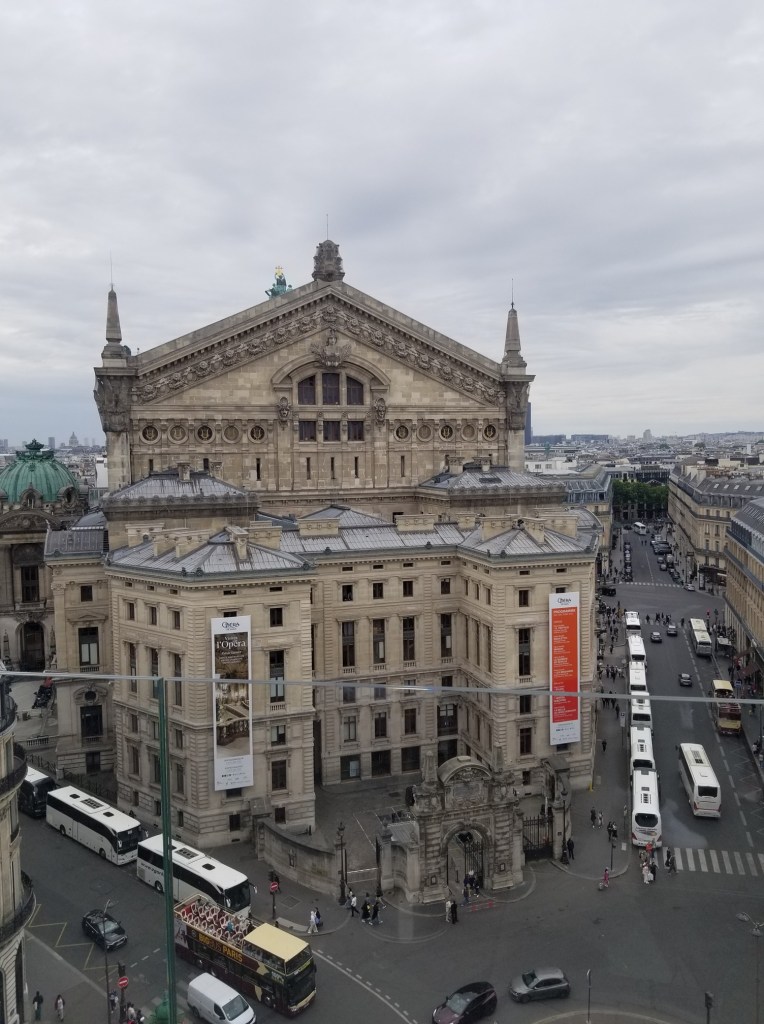
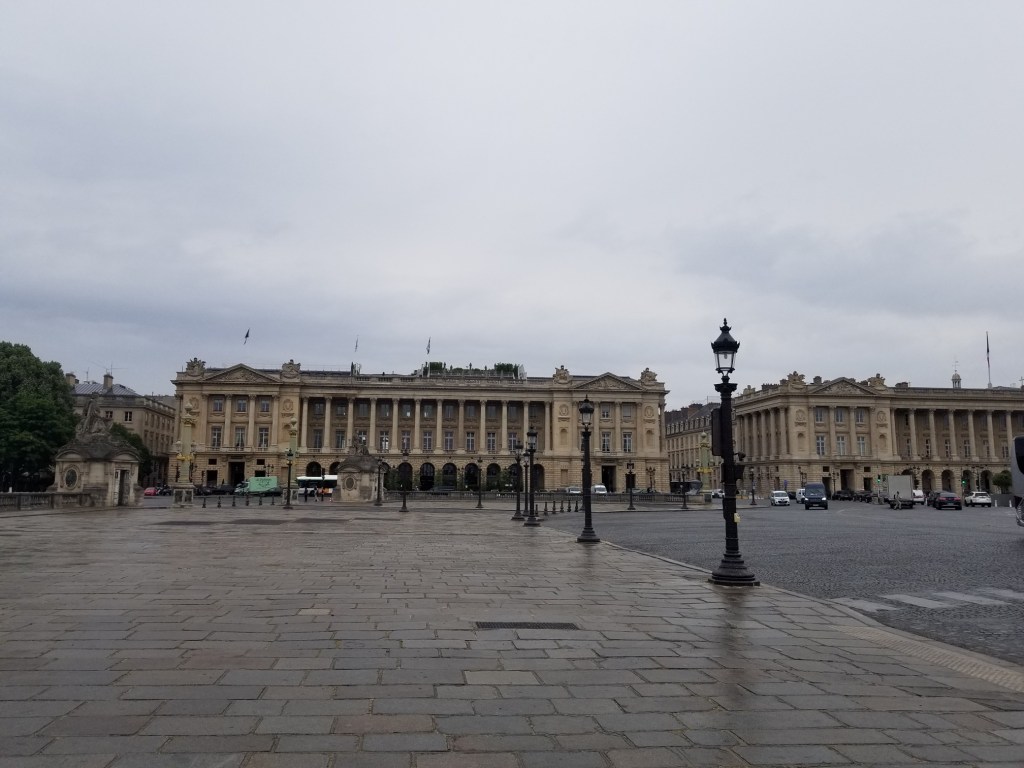
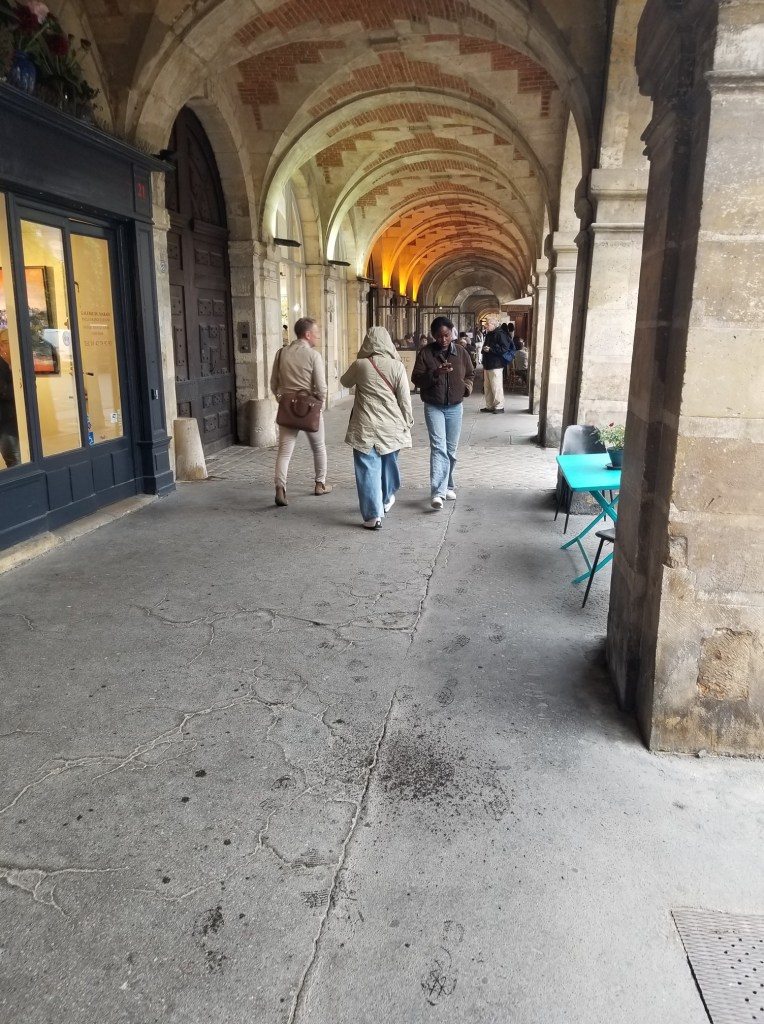
Avenue des Champs Élysées is a long wide street with lots of stores and things to see.My wife found this purse store called Louis Vuitton. I took the photo as I walked into the store. Husbands sat in comfortable sofa chairs and where served coffee, tea and juice while their wives were shopping. When someone made a purchase, they served you champagne and cocktails. My wife did not buy a purse, but my daughter bought one later. The purses were expensive but cheaper than in the states according to my wife.Arc de Triomphe is located on Avenue des Champs Élysées. You can walk up to the top. We did not do that this time.Palais Opéra Garnier was an opera that we toured. However, it was not the opera where we saw Rigoletto, that was Opera National de Paris. However, Palais Opéra Garnier was without doubt a very impressive building.The auditorium of the Palais Opéra Garnier.Another view of the auditorium of Palais Opéra Garnier.One of the large rooms in Palais Opéra Garnier.An artistically decorated hallway in Palais Opéra Garnier.The ceiling of the hallway in Palais Opéra Garnier.I took this photo from the terrace of an eight-story shopping mall called Gallery Lafayette located nearby Palais Opéra Garnier. The photo shows the back of Palais Opéra Garnier. My wife and daughter spend a lot of time shopping here.Photo of Hôtel des Invalides / Les Invalides, where Napoleons tomb is located. Hôtel des Invalides is very large, and this photo only shows a small portion of it.One of the corners of place de la Concorde.The obelix at Place de la Concorde.Inside a church / cathedral called Saint Sulpice.A sidewalk in Paris
Museums and Gardens in Paris
We visited several museums and gardens in Paris. One of the museums we visited was Musée de l’Orangerie which exhibit all kinds of art from ancient times to modern times but especially paintings including several famous painters such as, Pablo Picasso, Claude Monet, Henri Matisse, Henri Rousseau, Walter-Guillaume, Amedeo Modigliano, Marie Laurencine, Maurice Utrillo, Eva Nielsen. Some special exhibits were Monet’s gigantic water lily paintings and “flou” art, intentionally blurry paintings and art because life is blurry. We also visited the Auguste Rodin Museum. The museum had hundreds of Rodin sculptures in the museum building as well as in the surrounding gardens. There were also paintings by Vincent Van Gogh and Claude Monet.
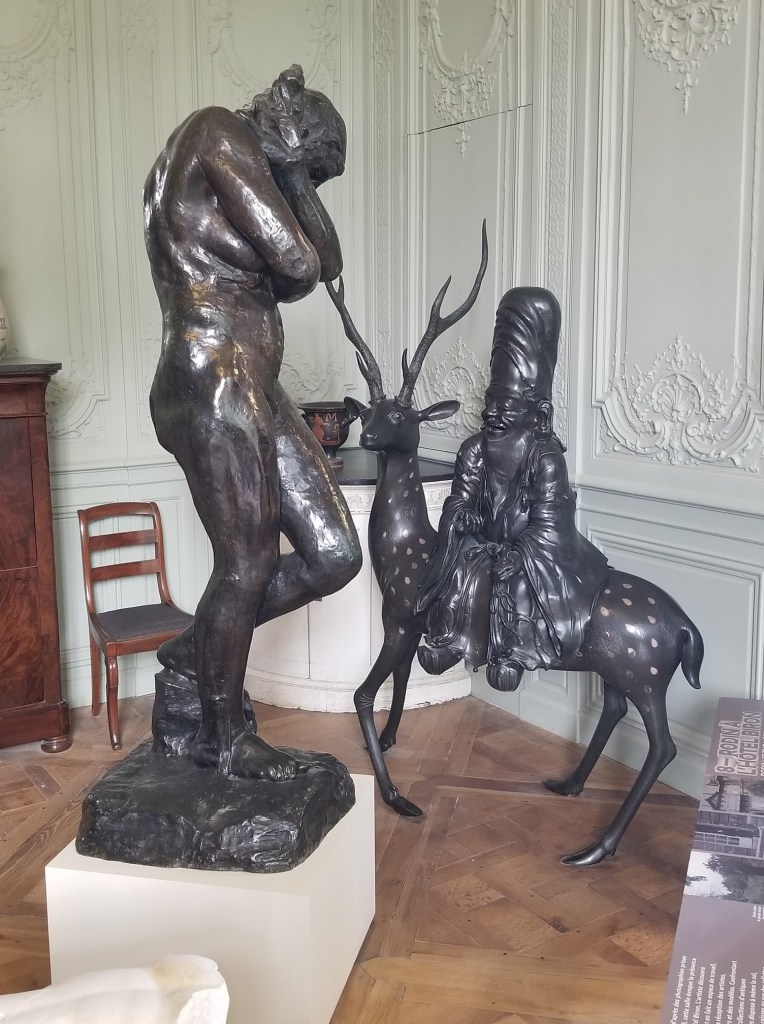
Jardin Du Luxembourg feature several buildings including this one. The garden is huge and difficult to show in a photo, but you can get an idea by looking at the fourth photo (aerial view from the Eiffel Tower) in the Eiffel Tower section above.Musée de l’Orangerie featured many large paintings of water lilies by Claude Monte.Ancient African statues in the Musée de l’Orangerie.An intentionally blurry painting. As mentioned above, this style is referred to as Flou. The paintings are blurry because life is blurry.The Auguste Rodin Museum featured one relatively small museum buildings surrounded by a huge garden. Both the garden and the building contained hundreds of statues, mostly by Auguste Rodin as well as paintings by Vincent Van Gogh and Claude Monet.The famous Rodin bronze statue the thinker, located in the garden.Two of the statues inside the building.
Dessert Places in Paris
There are thousands of Cafes, bakeries and pastry shops in Paris and the cakes, pastries, desserts, tarts and other baked goods are probably the best in the world. We visited a number of these stores and creperies and we had desserts at various restaurants. You can find wonderful baked goods in Italy and in the Scandinavian countries, but I have to say that France, and Paris, takes the cake (pun intended). At Angelina’s I had delicious coffee and I had some of their thick and creamy hot chocolate with whipped cream as well as two incredible cakes. At Berthilon I had amazing rhubarb and wild strawberry ice cream.
Rhubarb and wild strawberry ice cream with a wafer at Berthilon.Small section of the to go counter at Angelina (a sit-down pastry shop).
Violin d’Ingres Michelin Star Restaurant
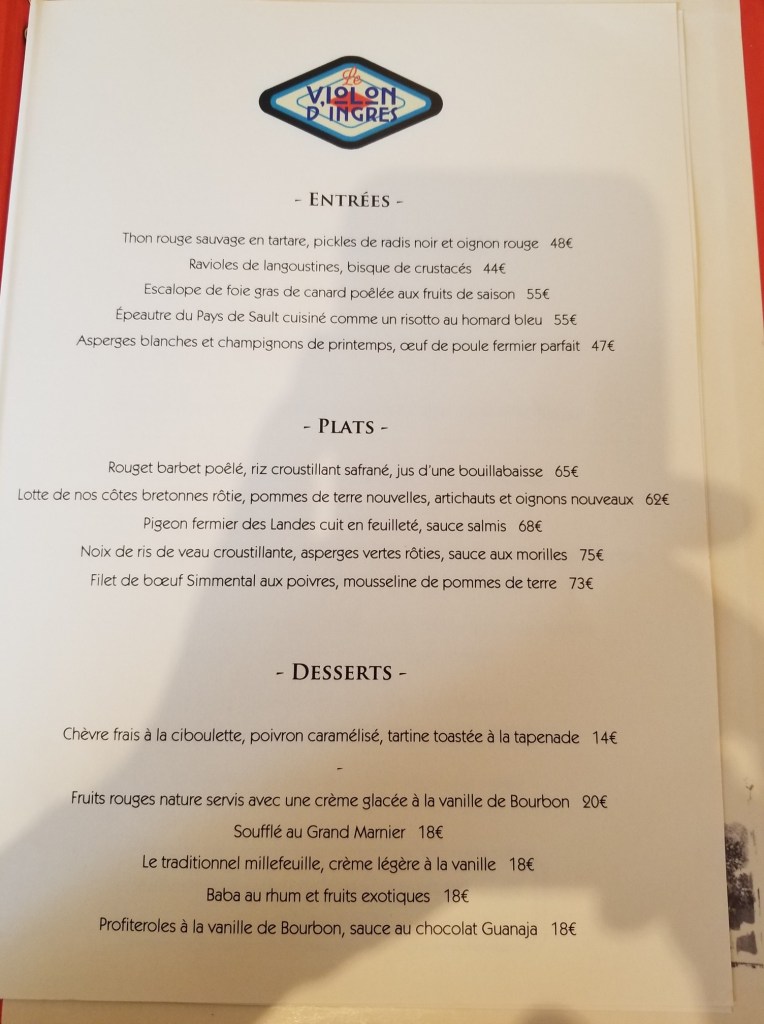
We celebrated a couple of birthdays at a Michelin star restaurant called Violin d’Ingres. In terms of eating that was probably the highlight of the trip. Out of Paris’ 44,000 restaurants only 123 are Michelin star restaurants (10 three-star restaurants, 17 two-star restaurants, and 96 one-star restaurants). I ordered Pigeon, something I’ve never had before. It does not sound appetizing. I joked that you had to go out in the street and kill the Pigeon yourself. However, it was probably the best meal I’ve had so far this year. It was truly delicious.
The menu at Violin d’Ingres. Notice that Entrées means starters or appetizers, just like the word implies. Somehow this got mistranslated into the English language to mean main course.This is my main course, Pigeon in lightly fried bread. It was delicious.
Traffic in Paris
Traffic in Paris is horrendous. Paris has successfully promoted the use of bicycles, mopeds, motorcycles, buses and the metro. As a result, the air is much cleaner than it used to be, but the traffic is still bad. One of the reasons is that it has become quite popular to disturb the traffic in various sorts of protests. When we were there the taxi drivers were on strike. You may think that you could just take an Uber instead, but the taxi drivers were blocking other traffic as well, including blocking the entrance to train stations. We were afraid they might block the entrance to the airport on our return day. I have a hard time understanding this since this kind of behavior is obstruction and is illegal in the United States as well as in Sweden.
However, the striking tax drivers were not the only problem. One day when I was accompanying my wife and daughter shopping, I got bored and decided to walk back to the hotel. It was two miles, and it took me one hour. Since the sidewalks are of such high quality and there is so much to see along the way and so many opportunities to stop if you need, this is easy to do.
Along the way I saw two large demonstrations. One was “dépénaliser cannabis” and there were hundreds of people, many with green hair and weird clothes, carrying flags with green leaves on them, marching down the street and playing music. There were also hundreds of police and the entire street, Rue Voltaire, which is a major street, was blocked. Then came the bicycle demonstration. Hundreds of bicycles blocking traffic and lots of police. Well at least it was not a boring walk. Oh, what I saw on Rue Voltaire!
This is another post with the “25 Leonberger photos” theme. This time the theme is “25 silly Leonbergers”. The post feature Leonbergers looking silly or being in funny situations. A lot of the photos are of our late Leonberger Bronco but there are also Leonberger photos provided by friends as well as a couple of Leonberger stock photos. Below is a list of the previous posts using the theme 25 Leonberger photos.
Also if you have not checked out my new superfactful blog feel free to do so.
25 Silly Leonbergers
The first photos are not really silly, but they are photos of Leonberger puppies and they are cute and act silly. The first photo is of our Leonberger puppy at three months old. It was a chore to get him to sit still.
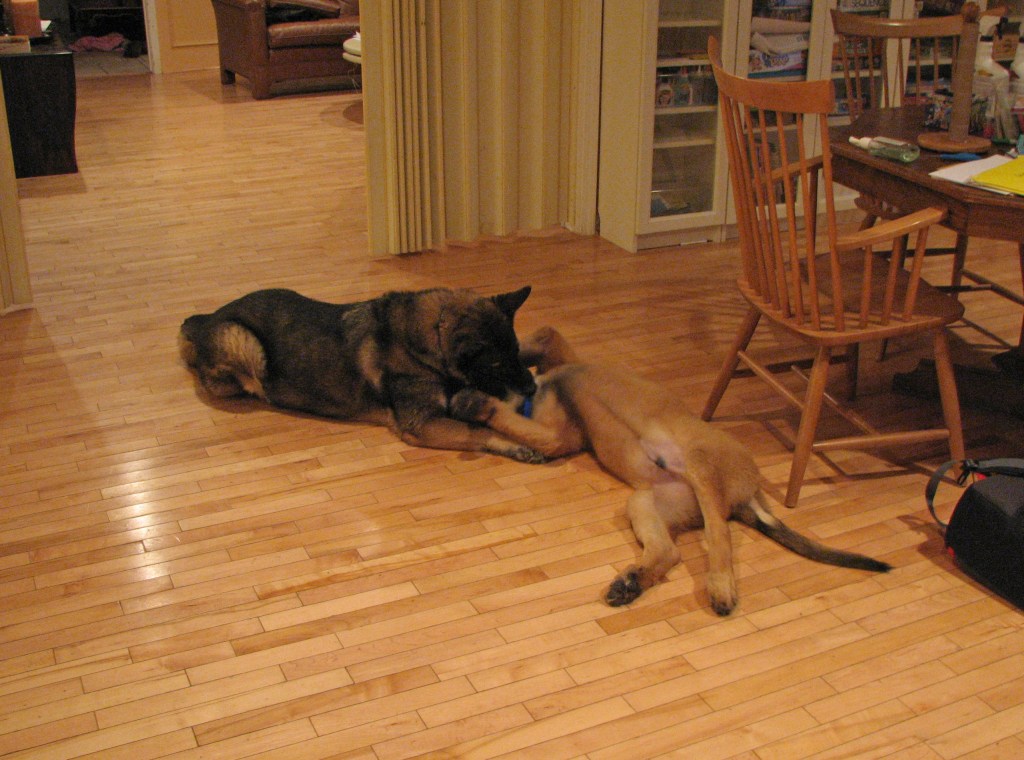
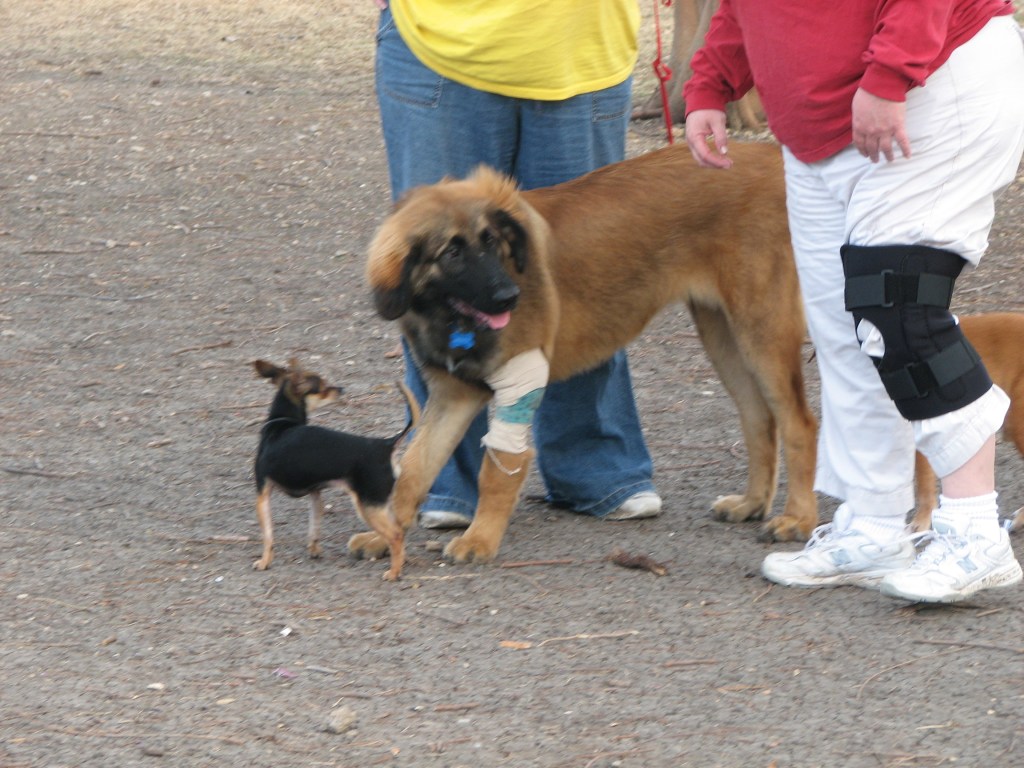
This is a photo of our Leonberger Bronco when he was three months old.Two light colored Leonberger puppies playing. My guess is that they are three months old. Shutterstock-ID: 2141564415 by AnetaZabranska.The silly Leonberger puppy is kissing a chihuahua who is getting annoyed. Stock Photo ID: 2166660069 by cynoclub.Baby our German Shepherd is playing with our four months old Leonberger Bronco. Baby loved Bronco as if it was her own puppy. They were playing all day long. Silly dogs.Our Leonberger Bronco at the White Rock Lake dog park at about five/six months old. He is wearing a bandage on his knee because at the time he had a condition from growing too fast. He had fun playing with the little dog. The two ladies are the owners of the little dog. As you can see one of them has an issue with her knee, just like Bronco.Our one-year-old Leonberger Bronco wants to give me a hug. He wanted to give hugs all the time. We also danced a lot. He was a good dancer and a silly Leonberger.Our Leonberger Bronco is sitting in my wife’s lap. He was 167 pounds at the time. Silly Bronco thought he was a lap dog.
A Leonberger in Action Illustrated
For a couple of weeks there was a peeping Tom who trespassed on our property and sat outside our bedroom window shouting obscenities and threats primarily at my wife. As it turned out the peeping Tom was doing the same thing to a lot of other women in the neighborhood. He had been quite busy looking through bedroom windows at night.
The police were not able to do anything about it, so I hired private detectives. The plan was that they were going to catch him in the act and turn him into the police. They sat in our backyard behind the bushes with a whole bunch of instruments, cameras, recording devices, and metal detectors. They also hid in a dark car parked nearby our house. My father-in-law was surprised that I was able to find the detectives. He did not think people like them existed and he asked me “how did you find them?”. I found them in the phone book (phone books still existed back then). They reminded us of the Ghost Busters with their enthusiasm, dress, and all their instruments.
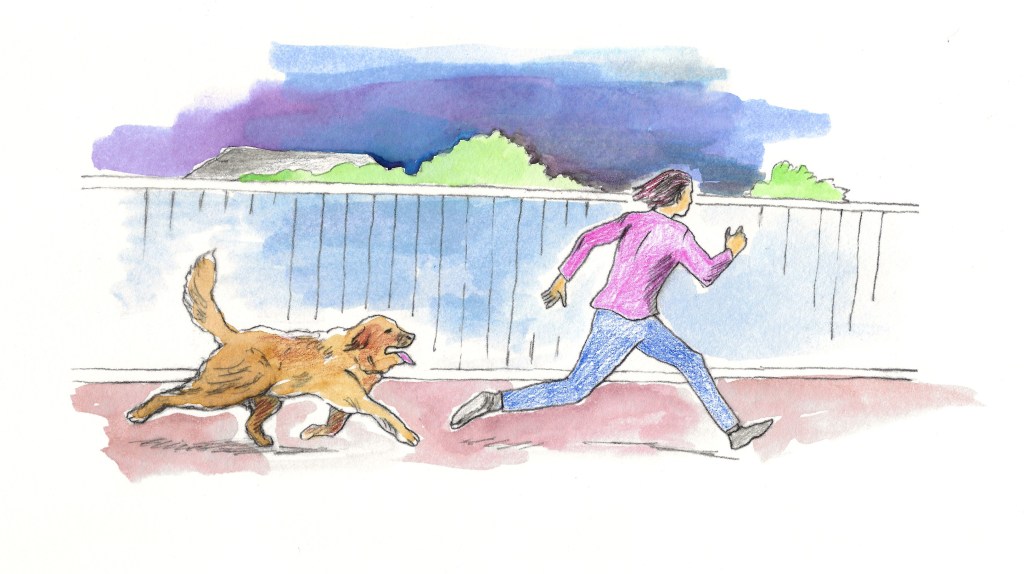
Unfortunately, Ghost Busters, I mean the detectives did not catch the peeping Tom, so I had to let them go. However, that’s when Bronco stepped in. One night we heard a shuffling outside the house, and I sent Bronco out to chase him. It worked. The peeping Tom was really frightened, and he never came back. Bronco probably just wanted to say hello and lick him, but the peeping Tom did not know that. Bronco saved the entire neighborhood. Well Bronco was not the one who was silly this time, but everyone else was including the detectives.
Bronco is chasing off a peeping Tom who was terrorizing the women in the neighborhood including my wife. Illustration by Naomi Rosenblatt.
Back when Bronco our Leonberger was young, the kids had pet hamsters—Moldova and Montenegro. The hamsters escaped from their cages sometimes, but Bronco usually helped us find them whenever they did. Claudia would tell him, “Bronco, find the hamsters,” and he would go around the house sniffing until he found them. One time he found them in the linen closet; another time he found them on a shelf in the living room.
On one occasion, a friend of David trusted us with his two hamsters while he and his family went on vacation. A couple of days later, Claudia noticed that the two hamsters were missing from their cage. The next thing she noticed was that Bronco’s cheeks looked puffy, so she said, “Bronco, drop it!” Out came the two hamsters, both unconscious.
In a panic, Claudia started performing CPR on the unconscious hamsters. She put one hamster at a time in her hand and gently compressed each tiny chest using the finger of the other hand. Fortunately, one hamster revived right away. The CPR didn’t seem to be working on the other hamster, but Claudia put both of them back in their cage, and soon the second hamster also woke up. We decided to keep the incident to ourselves. Hamsters don’t squeal. In this case I think Bronco was silly, even though he might have been a hero.
Bronco’s puffy cheeks hold two hamsters he probably was trying to save. Illustration by Naomi Rosenblatt.
On yet another occasion Bronco was really silly. He had a toe amputation, and we were instructed to keep him inside for ten days and keep him as still as possible. We were to make sure he wouldn’t bump the cast. This was, of course, almost impossible to do, but we were going to try.
However, Bronco really wanted to go out, which he showed us in various ways, such as scratching at the front door. After a week or so, Claudia suggested that we take him outside a little bit, just in our driveway. I agreed. When I handed her the leash, she said, “He can barely walk; do you think he’s going to run off without it?” We laughed, and I agreed that it didn’t seem like we needed it this time. So, Claudia walked out with Bronco slowly limping beside her.
Less than a minute had passed when I heard shouting outside. I opened the door and looked outside to see what was going on. First I saw our neighbor and his two corgis running down the street as fast as they could. Our neighbor was screaming at the top of his lungs, “Get him off me! Get him off me!”
Behind him, Bronco was running with his cast going kabonk-kabonk-kabonk as it hit the sidewalk. Behind Bronco ran Claudia, who was also screaming at the top of her lungs. “Bronco! Sit! Stay! Stop!” Finally, Bronco stopped, and Claudia grabbed him. Holding his collar, she led him back in. This time Bronco was really silly.
This is an illustration showing Bronco running down the street while wearing a cast. He was not supposed to bump the cast. Illustration by Naomi Rosenblatt.
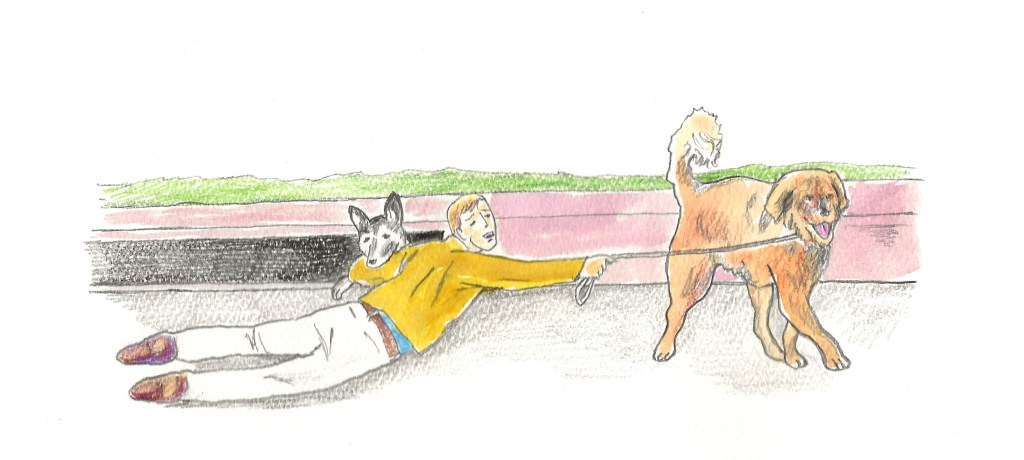
Another time that Bronco was silly was when he started barking and jumping around when he saw a dog across the street. In the process he accidentally pushed our German Shepherd baby into a storm drain. I had to lay down on the ground and lift Baby out of storm drain all while holding onto Bronco. The owner of the other dog lifted up his dog into his arms and ran as fast as he could down the street. That was embarrassing and stressful. Silly Bronco.
Once when Bronco was not so well behaved. He pushed our German Shepherd into a storm drain and I had to get her out while holding onto an agitated Bronco. Illustration by Naomi Rosenblatt.
Additional Silly Leonberger Photos
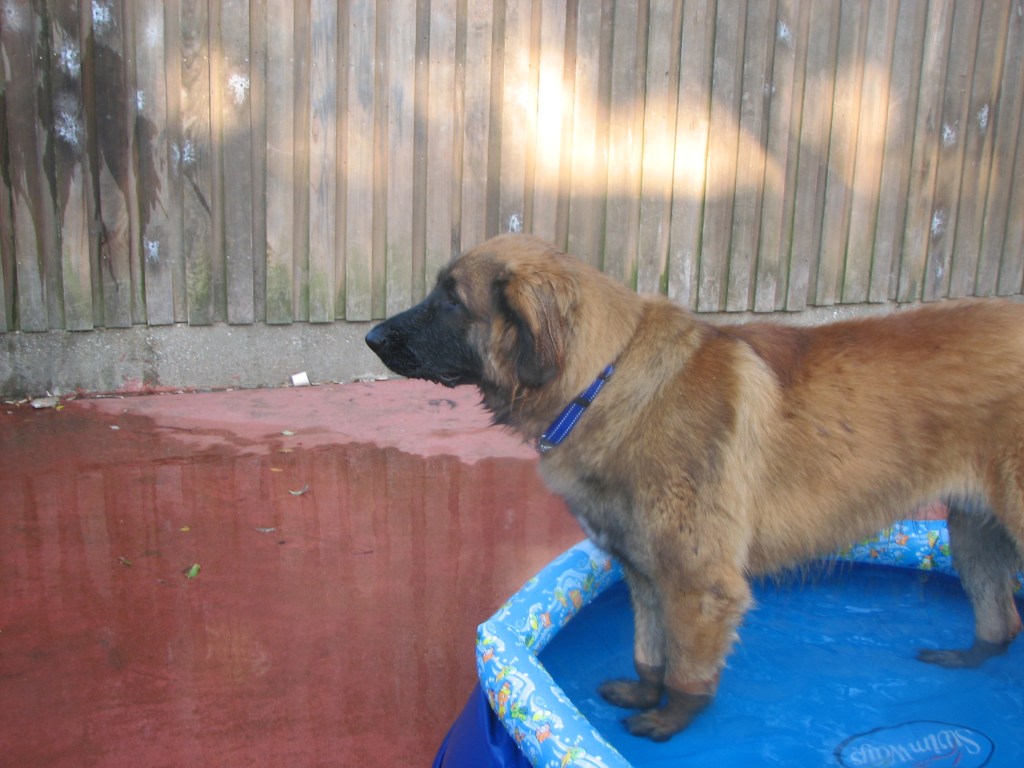
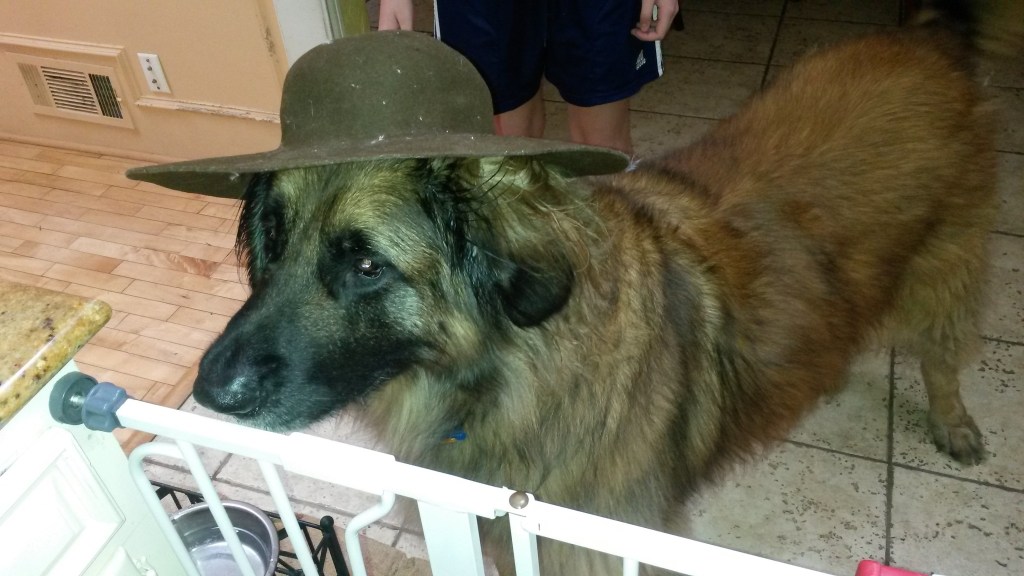
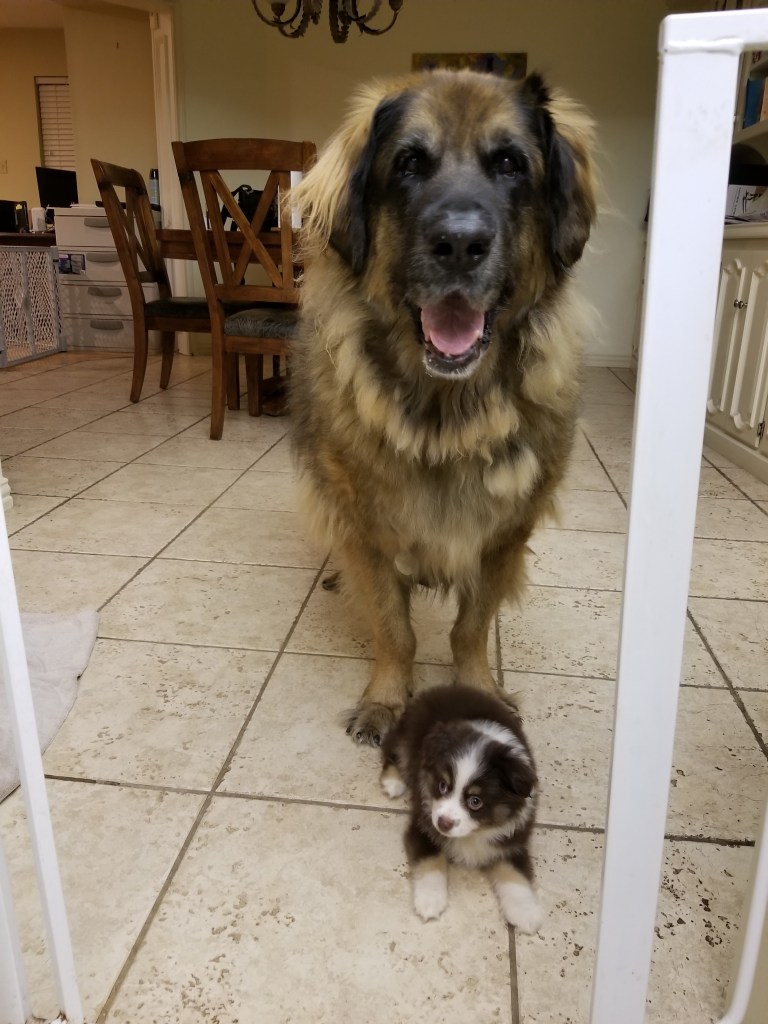
Bronco our Leonberger get washed off at a fairly young age. He liked water.Bronco standing by the kitchen gate. The kitchen gate was there to keep him from going inside the kitchen and do counter surfing.Bronco and our Pug Daisy. Daisy is leaving because she thinks Bronco is hogging the sofa.Our Leonberger Bronco is sleeping on our big leather sofa.Our Leonberger Bronco in the bushes.Our Leonberger Bronco in the backyard. He was a saint. This time it is me, the photographer, who is silly.It is Bronco’s 11th birthday.After a toe amputation due to toe cancer, Bronco needed to wear a cone, a big soft cone. Unfortunately, he frequently cleared tables as he swung the cone back and forth. Here he has just pushed a pile of books and papers off a table.Bronco and our mini-Australian Shepherd puppy Rollo. Bronco is nicely welcoming our new puppy, but the size difference is silly.
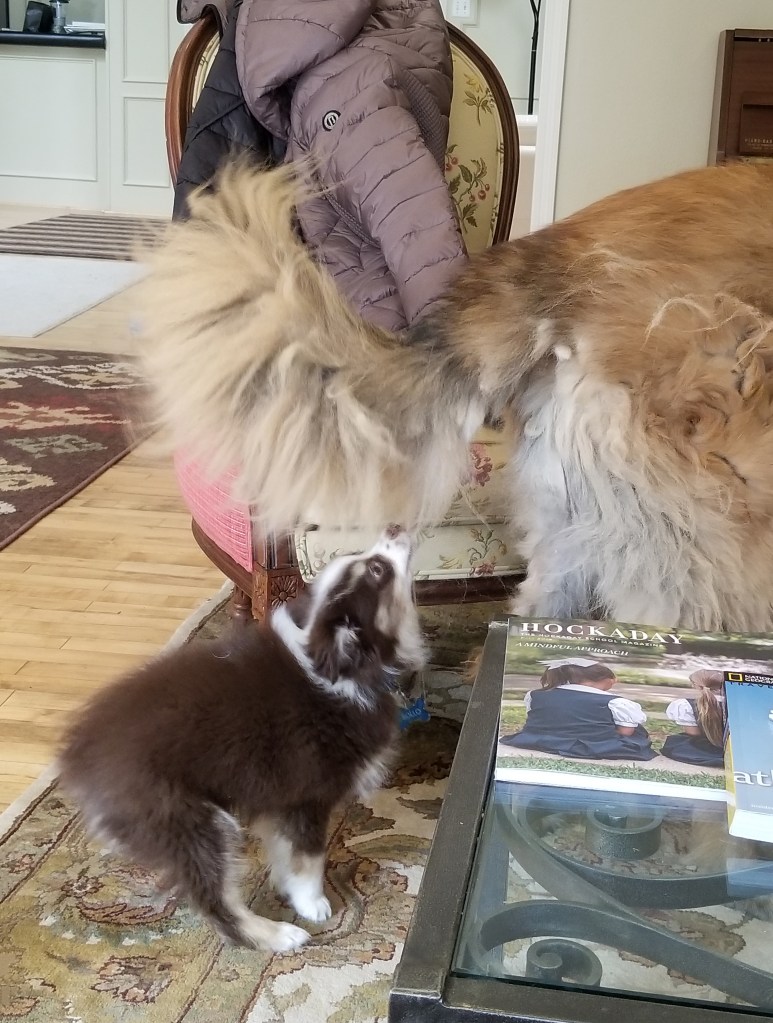
In the photo below it is really our mini-Australian Shepherd Rollo who is being silly. But he is very silly pulling Bronco’s tail. He even swung in it like a swing.
A rambunctious Rollo is biting Bronco’s tail. Bronco was very patient. One time Rollo swung in his tail as if it was a swing.
Below is a photo of silly gingerbread stealing dogs.
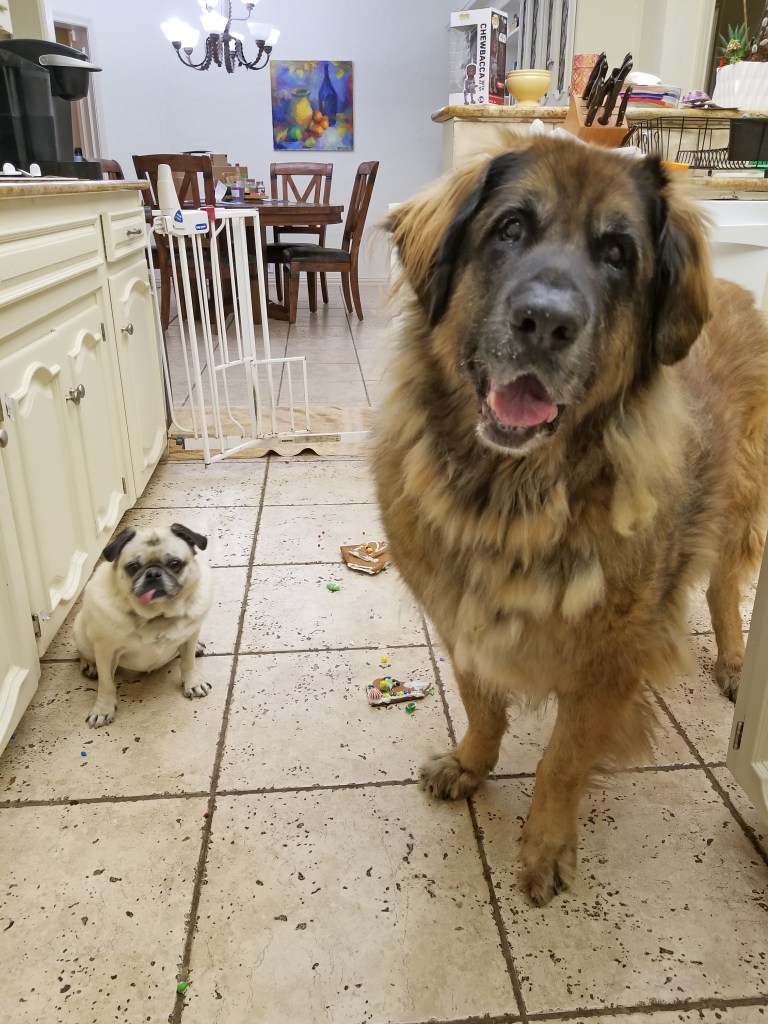
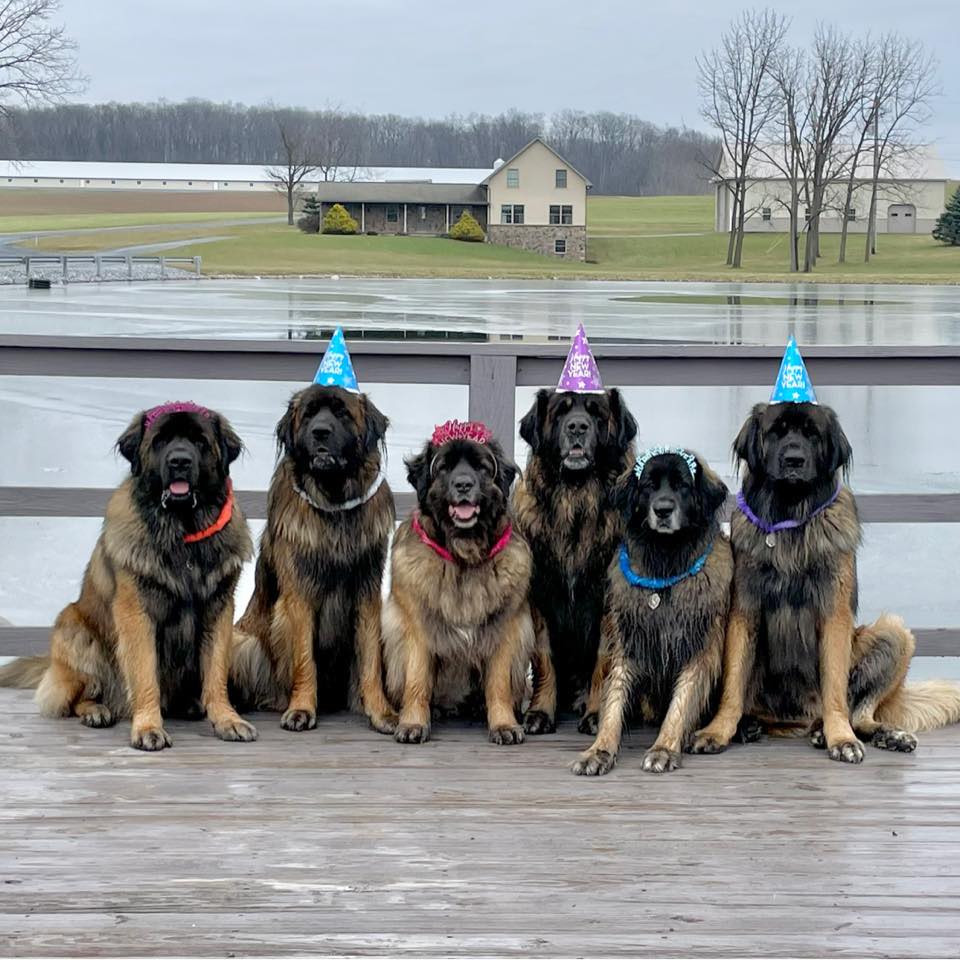
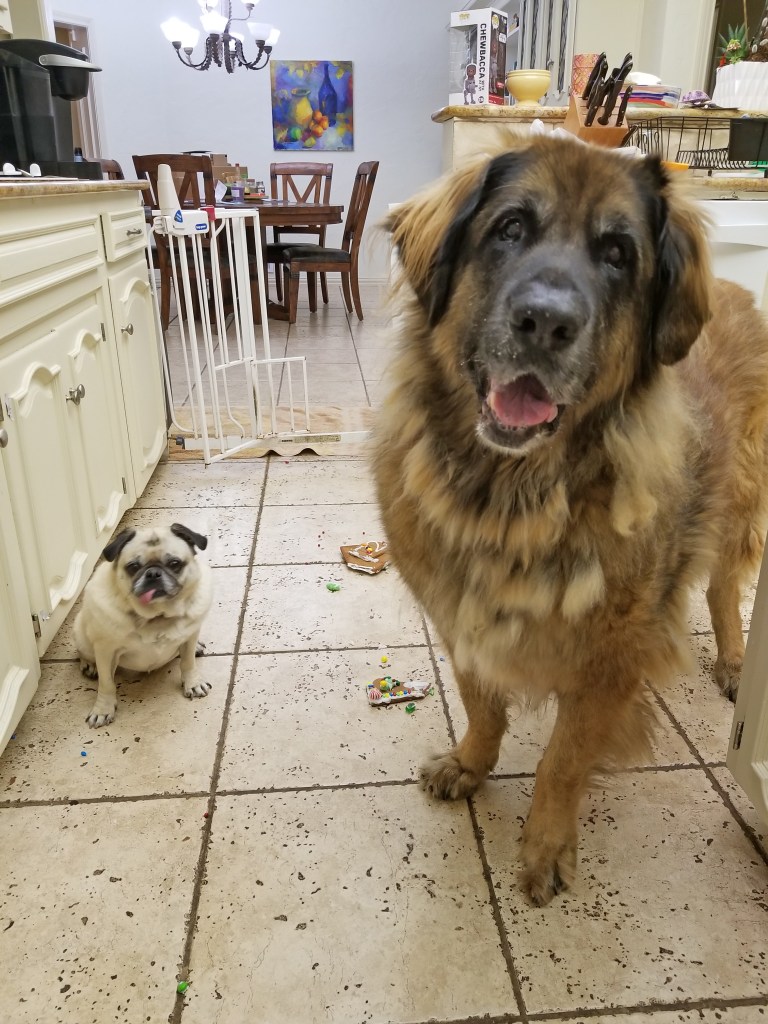
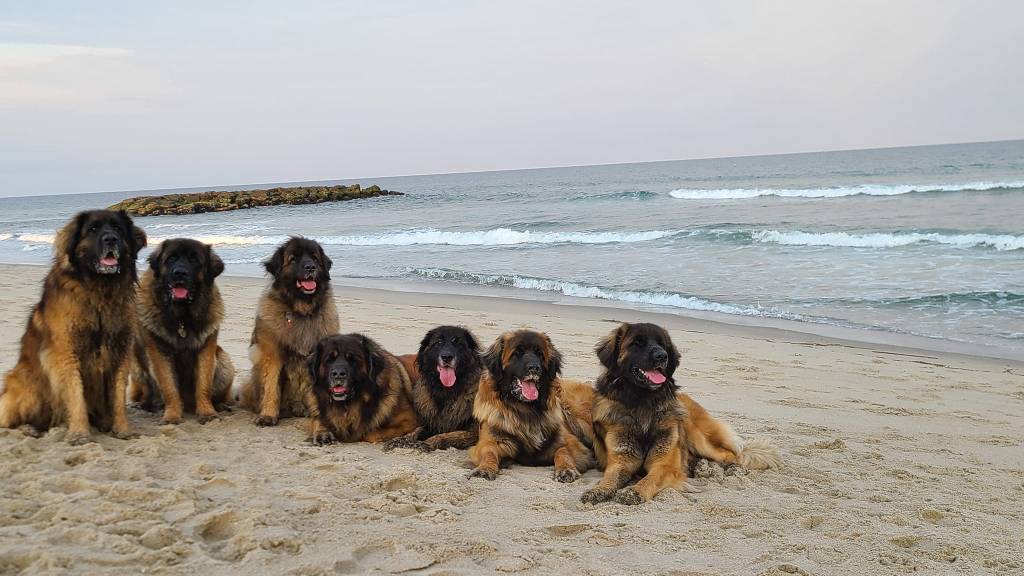
Bronco our Leonberger with Daisy our Pug in the Kitchen. Bronco says, “look what Daisy did to the gingerbread house that stood on the counter”. Actually, what really happened was that Bronco grabbed the gingerbread house and shared it with Daisy.Digory and Obi are two Leonbergers. Digory was a very brave Leonberger who fought cancer. He was featured in the Leo-Letter a Leonberger Magazine Photo by Jen O’Keefe. Jen is a friend in the Leonberger community.Five Leonbergers including Digory on 4th of July 2023. Photo by Jen O’Keefe.Six Leonbergers celebrating a birthday. Photo by Jen O’Keefe.
Today’s post is a highlight of Good News from my super fact blog, which I call Superfactful. I am listing eight posts, seven of which are what I call super facts. A super fact is a fact that is important, not trivia, and that is known to be true and yet are either disputed by large segments of the public or highly surprising or misunderstood by many. The super facts included with this post are what you can call Good News. Surprising news, perhaps shocking news, but still good news.
Peace Is Boring News
The first and my most recent post is not a super fact but my musings on the fact that good news tends to be boring news and therefore forgotten.
West Belfast, Northern Ireland,UK; February, 1994; Girl running with plate of chips past wall where two IRA Volunteers were killed by British soldiers Shutterstock Asset id: 1951602385, Editorial credit: RORY NUGENT.com
Emissions of ozone-depleting gases have fallen by 99 Percent
Super fact 41 : Largely thanks to the Montreal Protocol in 1987 the emissions of ozone-depleting gases have fallen by more than 99%, 99.7% to be exact, according to Our World in Data. This has resulted in halting the expansion of the ozone holes and the reduction in emissions of ozone-depleting gases is saving millions of lives every year.
To visit the page for Emissions of ozone-depleting gases have fallen by 99 Percent click here.
The phase out of six ozone depleting gases. Data source UN Environment Program (2023).
Natural Disasters Kill Less People Now Than 100 Years Ago
Super fact 35: Natural disasters kill a lot less people now compared to 100 years ago. That is despite a larger population and despite the fact that climate change has increased the frequency and intensity of many types of natural disasters.
The explanation for this is that we have become much better at warning people, preventing deaths and rescue people.
To visit the page for Natural Disasters, Kill Less People Now Than 100 Years Ago click here
This graph from the Gap Minder article shows the annual deaths from natural disasters in ten-year intervals starting with 1930. The trend is down.
EV Cars Indeed Emit Less Carbon Pollution
Super fact 29: EV Cars emit less pollution than Internal Combustion Engine, even considering manufacturing, disposal and EV Cars being charged by dirty grids.
To visit the page for EV Cars Indeed Emit Less Carbon Pollution click here
Lifecycle greenhouse gas emissions comparison of average gasoline car and 300-mile range EV.
Smallpox Killed 300 million People in the Last Century Before Eradication
Superfact 24: Smallpox killed 300 million people in the 20th century. However, there have been no naturally occurring cases of smallpox since 1977, and the world was declared free of smallpox on May 8, 1980, by the 33rd World Health Assembly.
To visit the page for Smallpox Killed 300 million People in the Last Century Before Eradication click here
This world map shows when smallpox was eradicated from different countries. The source is Our World in Data , originally Fenner et al. at CDC.
We are living in relatively peaceful times
Superfact 9 : Despite all the wars going on, the world was filled with a lot more war and violence in the past. Despite the grim news reports we are living in relatively peaceful times.
To visit the page for We are living in relatively peaceful times click here
Death rate from wars since 1946. The uptick in 2022 is largely due to the Ethiopian Tigray war with 162,000–600,000 killed and the invasion of Ukraine, which US and BBC estimates at more than 200,000 deaths (but estimates from most other sources are less).
US Violent Crime Nearly Cut in Half Since 1990
Superfact 8 : Despite all the news reports about rampant crime, the US violent crime rate has fallen to half of what it was in the early 1990’s.
To visit the page for US Violent Crime Nearly Cut in Half Since 1990 click here
The four graphs show that both violent crime and property crime have declined since 1990. Visit the post to see the Pew Research article it is taken from.
Poverty and child mortality has been sharply reduced worldwide
Superfact 7 : Extreme poverty as well as child mortality has been sharply reduced the world over. The countries that are the worst-off today are still better off than the countries that were doing the best at the beginning of the 19th century. Over the last 50 years extreme poverty and child mortality has continued to decline sharply.
To visit the page for Poverty and child mortality has been sharply reduced worldwide click here
This graph from Our World In Data shows a steep decline in extreme poverty over time. Click on the picture to visit the original article.
If you have not subscribed to my super fact blog you are certainly welcome to.
Today I received interesting mail. In addition to the usual junk mail and a couple of bills I got the LeoLetter, the Leoberger magazine, and I got a box from Amazon containing two brand new books that I am very excited to read.
The LeoLetter
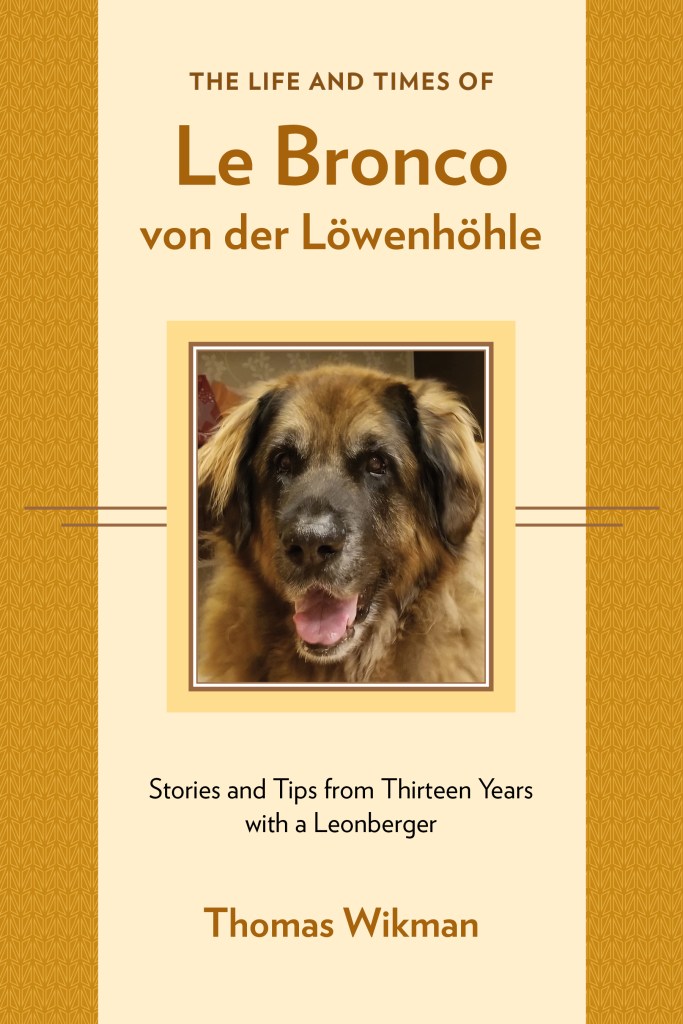
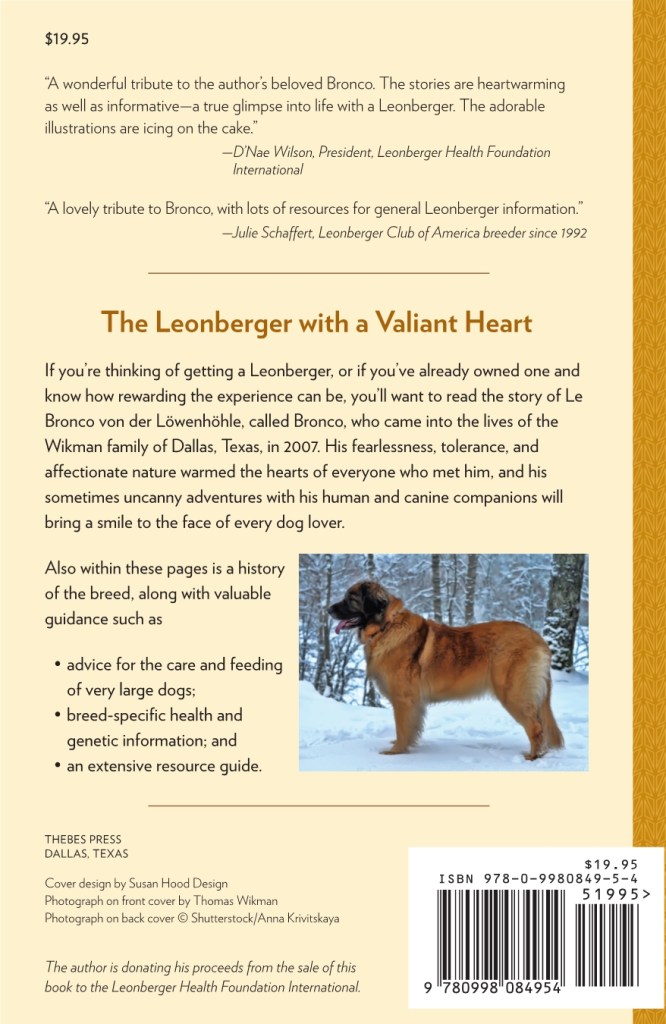
The “LeoLetter : Great Dogs, Great People,” is the official quarterly publication of the Leonberger Club of America. You can read about the history of the Leonberger Club of America here. What makes today’s LeoLetter special to me is because I have an Ad in it for my book “The Life and Times of Le Bronco von der Löwenhöhle: Stories and Tips from Thirteen Years with a Leonberger”. To visit the Amazon location for my book, click here.
The Leo Letter is the official publication of the Leonberger Club of America.This is my ad for my book The Life and Times of Le Bronco von der Löwenhöhle: Stories and Tips from Thirteen Years with a Leonberger. Click on the picture to visit the Amazon location for the book.The front cover of the book The Life and Times of Le Bronco von der Löwenhöhle: Stories and Tips from Thirteen Years with a Leonberger. Click on the picture to visit the Amazon location for the book.The back cover of the book The Life and Times of Le Bronco von der Löwenhöhle: Stories and Tips from Thirteen Years with a Leonberger. Click on the picture to visit the Canadian Amazon location for the book.
Badlands
Next, I opened the box in it was two books. One of them was Badlands (Savage Land) by Jacqui Murray. I bought the paperback version. I have only read the beginning, and it is very exciting. It is book two in a trilogy about prehistoric man. I read the previous book Endangered Species, a book I loved, and you can read my book tour post here and my review here. There is an ongoing book tour for Badlands, and you visit the five first book tour posts here:
Front cover of Badlands by Jacqui Murray. Click here or on the picture to visit the Amazon location for the paperback version.
Below is Amazon’s Overview of the Badlands
Savage Land is the third trilogy about prehistoric man in the series, Man. Vs. Nature.Written in the spirit of Jean Auel, Savage Land explores how two bands of humans survived one of the worst natural disasters in Earth’s history, when volcanic eruptions darkened the sky, massive tsunamis crossed the ocean in crushing waves, and raging fires burned the land. Each of the tribes considered themselves apex predators. Neither was. That crown belonged to Nature and she was intent on washing the blight of man from her face. Join me in this three-book fictional exploration of Neanderthals. Be ready for a world nothing like what you thought it would be, filled with clever minds, brilliant acts, and innovative solutions to life-ending problems, all based on real events. At the end of this trilogy, you’ll be proud to call Neanderthals family.
In Badlands, Book Two, the tribes must split up, each independently crossing what Nature has turned into a wasteland. They struggle against starvation, thirst, and desperate enemies more feral than human. If they quit or worse, lose, they will never reunite with their groups or escape the most deadly natural disaster ever faced by our kind.
This is the back cover of the book Badlands by Jacqui Murray.
Reunion Coda
Another nice surprise in the box was Reunion: Coda: Book 2 of the Reunion Duology by Alex Diaz-Granados. I also read parts of this book so far, and I loved it. It also has a lot of nice pictures to support the story. The end of the book features my interview with the author, which you can read here. You can read my review for the first book in the duology (Reunion) here <<Link-10>>.
Front cover of Reunion: Coda: Book 2 of the Reunion Duology. To visit the Amazon page for the paperback version of the book you can click here or on the picture.
Below is Amazon’s Overview of the Reunion Coda
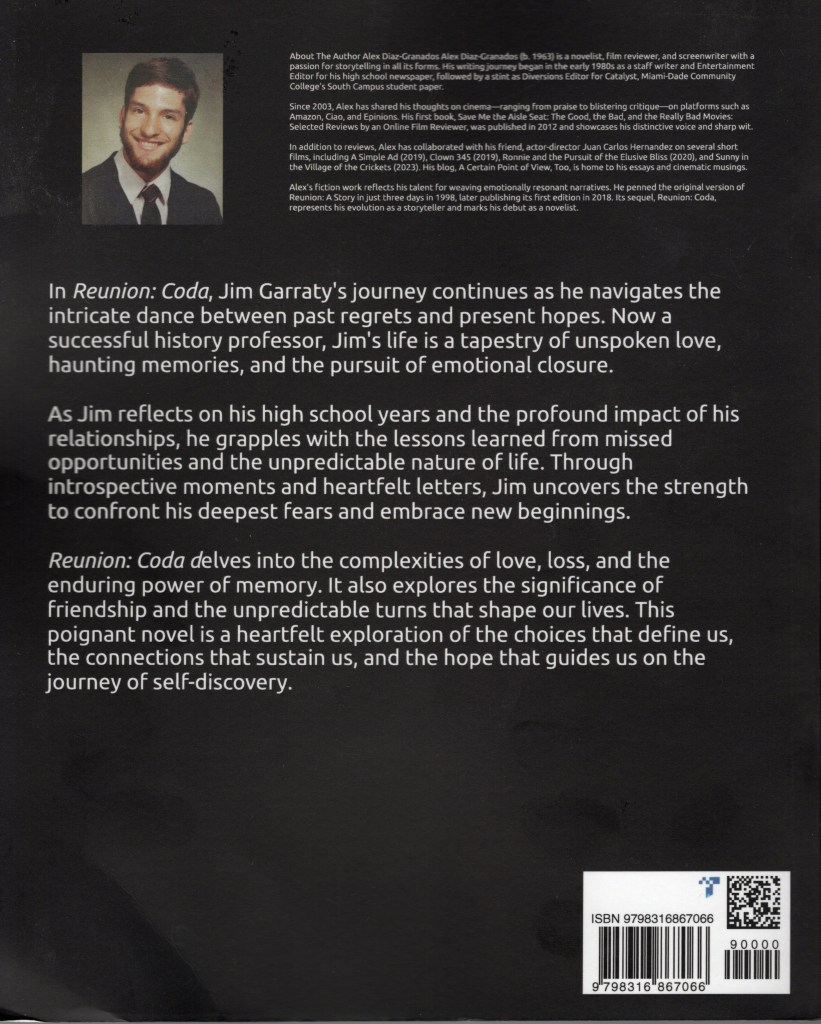
In Reunion: Coda, Jim Garraty’s journey continues as he navigates the intricate dance between past regrets and present hopes. Now a successful history professor, Jim’s life is a tapestry of unspoken love, haunting memories, and the pursuit of emotional closure.
As Jim reflects on his high school years and the profound impact of his relationships, he grapples with the lessons learned from missed opportunities and the unpredictable nature of life. Through introspective moments and heartfelt letters, Jim uncovers the strength to confront his deepest fears and embrace new beginnings.
Reunion: Coda delves into the complexities of love, loss, and the enduring power of memory. It also explores the significance of friendship and the unpredictable turns that shape our lives. This poignant novel is a heartfelt exploration of the choices that define us, the connections that sustain us, and the hope that guides us on the journey of self-discovery.
Back cover of Reunion: Coda: Book 2 of the Reunion Duology.
What if we get it right?
However, before I finish the two books above I will finish another good book that I am reading for my book club called “What If We Get It Right?: Visions of Climate Futures by Ayana Elizabeth Johnson”.
Front cover of What If We Get It Right?: Visions of Climate Futures by Ayana Elizabeth Johnson. You can visit the hardcover version of the book by clicking here or by click on the picture.
Below is Amazon’s Overview of What If We Get It Right?
NEW YORK TIMES BESTSELLER • “With a thoughtfully curated series of essays, poetry, and conversations, the brilliant scientist and climate expert Ayana Elizabeth Johnson has assembled a group of dynamic people who are willing to imagine what seems impossible, and articulate those visions with enthusiastic clarity.”—Roxane Gay
Our climate future is not yet written. What if we act as if we love the future?
A SMITHSONIAN BEST BOOK OF THE YEAR
Sometimes the bravest thing we can do while facing an existential crisis is imagine life on the other side. This provocative and joyous book maps an inspiring landscape of possible climate futures.
Through clear-eyed essays and vibrant conversations, infused with data, poetry, and art, Ayana Elizabeth Johnson guides us through solutions and possibilities at the nexus of science, policy, culture, and justice. Visionary farmers and financiers, architects and advocates, help us conjure a flourishing future, one worth the effort it will take—from every one of us, with whatever we have to offer—to create.
If you haven’t yet been able to picture a transformed and replenished world—or to see yourself, your loved ones, and your community in it—this book is for you. If you haven’t yet found your role in shaping this new world or you’re not sure how we can actually get there, this book is for you.
With grace, humor, and humanity, Johnson invites readers to ask and answer this ultimate question together: What if we get it right?
Back cover of What If We Get It Right?: Visions of Climate Futures by Ayana Elizabeth Johnson.
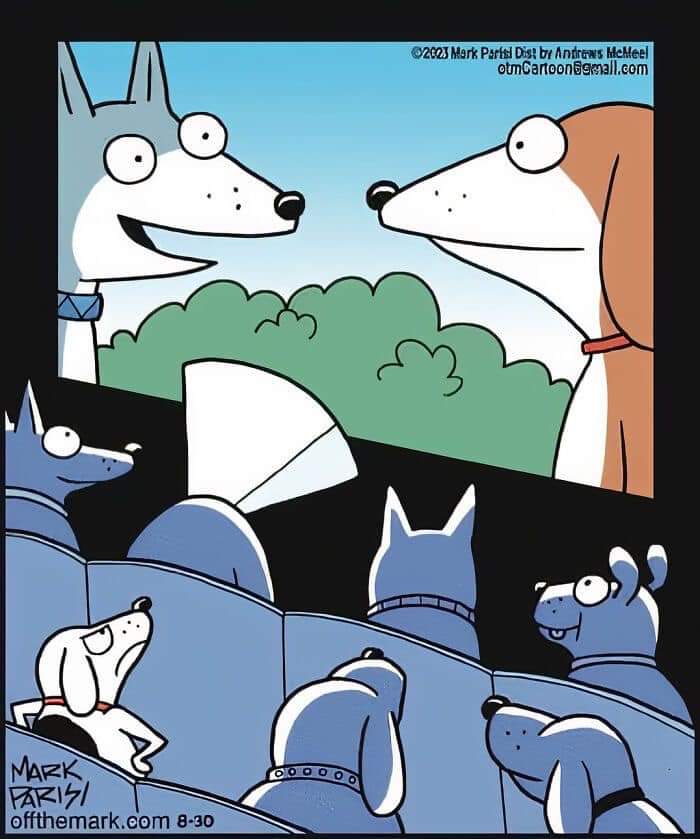
It is time for another Dog Humor post. To see the previous ones see the list below. All the dog comics are Facebook pictures that are being passed around. The original creator is typically noted on the cartoon.
Today’s post has the theme of the physical and mental health of dogs. I chose this theme today because we took our dog Rollo to the veterinary emergency room a couple of days ago because he threw up three times within six hours. He had been chewing on a lot of rawhide which is a bit risky, so we were worried. He got an X-ray and various blood tests. Everything was normal. It was probably just a stomach flu or upset stomach. He received anti-nausea medication, and he is taking anti-diarrhea medication. However, everything is otherwise fine with him. The cartoons below speak for themselves.
Today I was having fun with ChatGPT and Google AI. I asked ChatGPT the following question : Was there a Leonberger called Bronco?
The answer is shown below
I took a screenshot of the answer.
If the text is hard to read in the picture, this is the answer ChatGPT gave.
Yes, there was a Leonberger named Bronco. Bronco, officially named Le Bronco von der Löwenhöhle, lived with the Wikman family in Dallas, Texas, from 2007 until his passing in 2020. Notably, he lived an unusually long life for his breed, reaching almost thirteen years, surpassing the typical life expectancy of Leonbergers, which is around nine years. His story is detailed in the book “The Life and Times of Le Bronco von der Löwenhöhle” by Thomas Wikman, which shares anecdotes of Bronco’s adventures and provides insights into caring for Leonbergers.
I think that sounds right.
Confusing ChatGPT
Next, I asked ChatGPT the following question : Did the Leonberger Le Bronco von der Löwenhöhle rescue Hamsters?
I can add that Le Bronco von der Löwenhöhle is a unique Leonberger name. There is a Leonberger database called the Worldwide Independent Leonberger Database featuring more than 172,000 Leonbergers. It covers most Leonbergers in the world back until the beginning of the 20th century and only three of them were named Bronco including Le Bronco von der Löwenhöhle, which is the only Leonberger named exactly that. As you can see below ChatGPT is confusing our Leonberger Le Bronco von der Löwenhöhle with another dog.
I took a screenshot of the answer.
If the text is hard to read in the picture, this is the answer ChatGPT gave.
Yes, Le Bronco von der Löwenhöhle, a Leonberger, is known for his heroic act of rescuing a group of hamsters! This event gained attention when Le Bronco, who was living in Germany, saved several hamsters from a fire in 2011. The hamsters were trapped in their cages, and thanks to Le Bronco’s quick thinking and bravery, he managed to alert his owners and helped rescue the small animals.
His actions were recognized as a remarkable act of kindness and heroism, showing the intelligence and sensitivity that dogs, particularly the Leonberger breed, can possess.
I’ve noticed that ChatGPT is sometimes wrong. For example, when you ask questions on a topic for which there is sparse information ChatGPT frequently gets the answer wrong. Another way to confuse ChatGPT and get bad answers is to ask vague questions or ask questions that cannot be answered precisely. ChatGPT relies on internet data and may base its answers on people’s biases and cliches rather than accurate information.
Google AI on Bronco
Interestingly enough, Google AI gave more extensive and interesting answers to my questions, and unlike ChatGPT it answered both of them correctly and provided links to the sources.
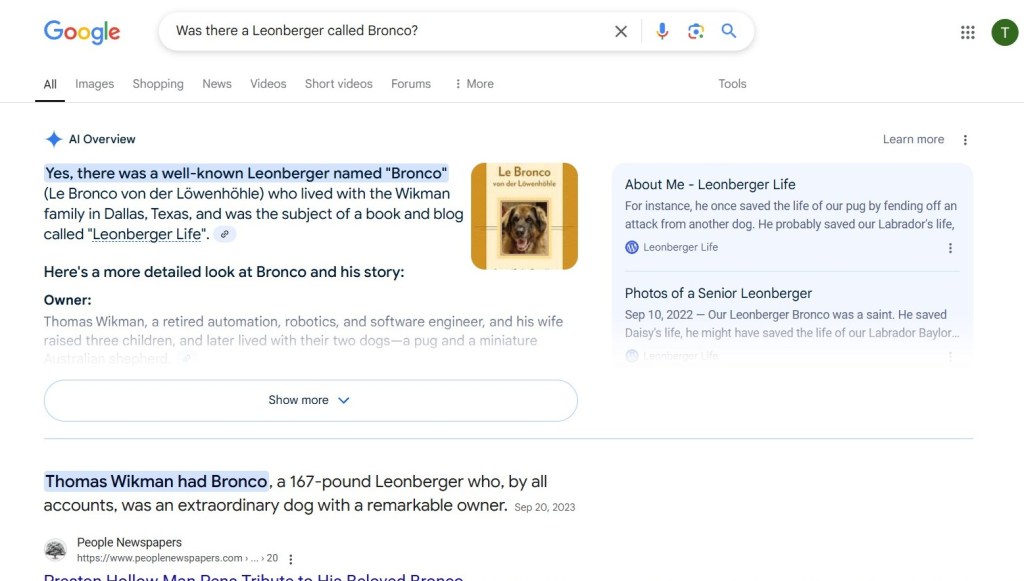
First, I asked : Was there a Leonberger called Bronco?
This is what I got :
Screenshot of answer.
If the text is hard to read in the picture, this is what the screenshot says.
Yes, there was a Leonberger named Bronco. Bronco, officially named Le Bronco von der Löwenhöhle, lived with the Wikman family in Dallas, Texas, from 2007 until his passing in 2020. Notably, he lived an unusually long life for his breed, reaching almost thirteen years, surpassing the typical life expectancy of Leonbergers, which is around nine years. His story is detailed in the book “The Life and Times of Le Bronco von der Löwenhöhle” by Thomas Wikman, which shares anecdotes of Bronco’s adventures and provides insights into caring for Leonbergers.
Yes, there was a well-known Leonberger named “Bronco” (Le Bronco von der Löwenhöhle) who lived with the Wikman family in Dallas, Texas, and was the subject of a book and blog called “Leonberger Life”.
Here’s a more detailed look at Bronco and his story:
As I scrolled down there was more
Screenshot of answer after a bit of scrolling.
If the text is hard to read in the picture, this is what the screenshot says.
Owner:
Thomas Wikman, a retired automation, robotics, and software engineer, and his wife raised three children, and later lived with their two dogs—a pug and a miniature Australian shepherd.
Book and Blog:
Thomas Wikman wrote a book, “The Life and Times of Le Bronco von der Löwenhöhle” and a blog, “Leonberger Life” about his Leonberger, Bronco.
Longevity:
Bronco lived a relatively long life for a Leonberger, receiving the “Grey Muzzle Award” for living longer than 12 years.
Notable Incidents:
Bronco was known for his bravery and protective nature, saving Daisy’s life and potentially Baylor’s life, as well as scaring off a trespasser.
Death:
Bronco passed away in 2020.
On the right side there are references to two of my blog posts and one post by Annika Perry.
Screenshot of answer after a bit more of scrolling.
If the text is hard to read in the picture, this is what the screenshot says.
Thomas Wikman had Bronco, a 167-pound Leonberger who, by all accounts, was an extraordinary dog with a remarkable owner.
This is followed by a link to the People Newspapers a Newspaper that published a review of my book.
How did Google AI do on the second question?
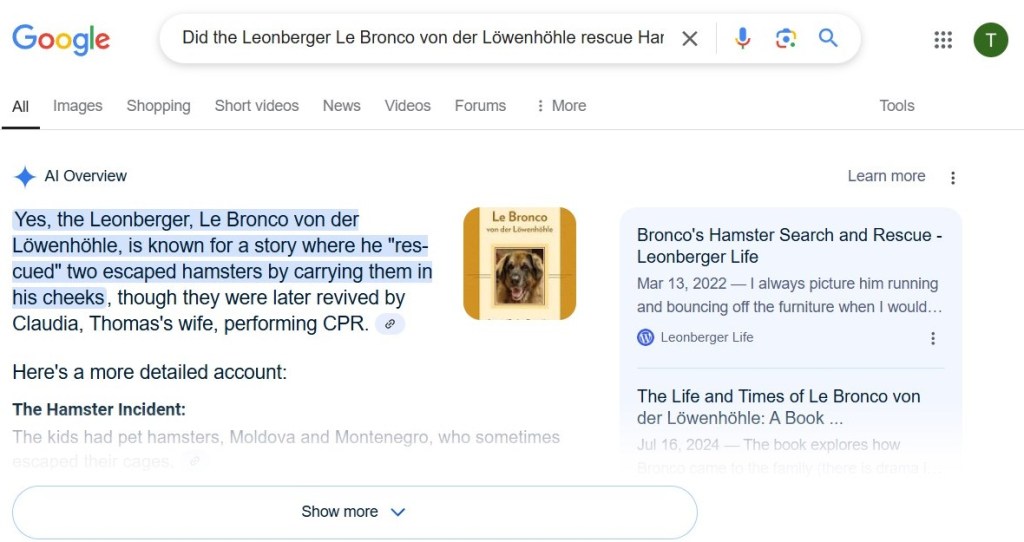
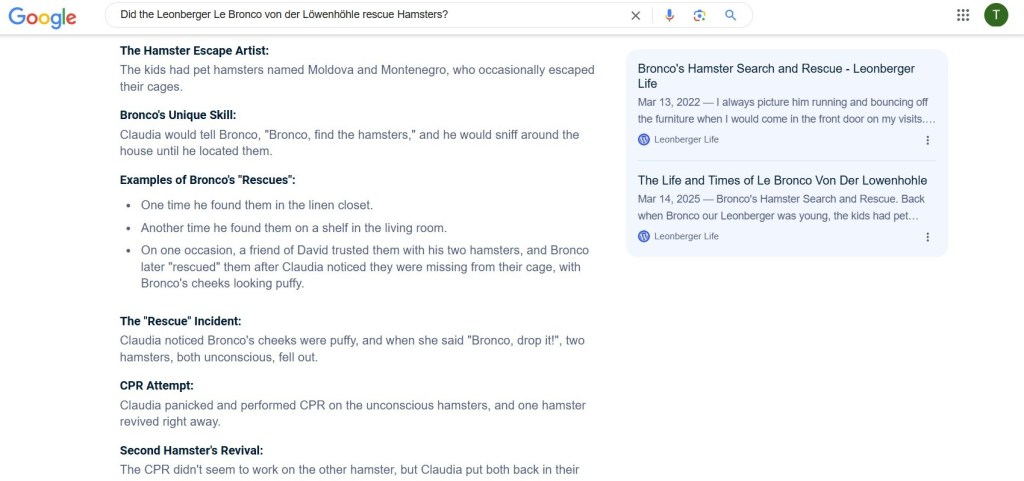
I asked Google AI the same question : Did the Leonberger Le Bronco von der Löwenhöhle rescue Hamsters?
Screenshot of answer.
If the text is hard to read in the picture, this is what the screenshot says.
Yes, the Leonberger, Le Bronco von der Löwenhöhle, is known for a story where he “rescued” two escaped hamsters by carrying them in his cheeks, though they were later revived by Claudia, Thomas’s wife, performing CPR.
Here’s a more detailed account:
Screenshot of answer after additional scrolling.
If the text is hard to read in the picture, this is what the screenshot says.
The Hamster Escape Artist:
The kids had pet hamsters named Moldova and Montenegro, who occasionally escaped their cages.
Bronco’s Unique Skill:
Claudia would tell Bronco, “Bronco, find the hamsters,” and he would sniff around the house until he located them.
Examples of Bronco’s “Rescues”:
One time he found them in the linen closet.
Another time he found them on a shelf in the living room.
On one occasion, a friend of David trusted them with his two hamsters, and Bronco later “rescued” them after Claudia noticed they were missing from their cage, with Bronco’s cheeks looking puffy.
The “Rescue” Incident:
Claudia noticed Bronco’s cheeks were puffy, and when she said “Bronco, drop it!”, two hamsters, both unconscious, fell out.
CPR Attempt:
Claudia panicked and performed CPR on the unconscious hamsters, and one hamster revived right away.
Second Hamster’s Revival:
The CPR didn’t seem to work on the other hamster, but Claudia put both back in their cage, and soon the second hamster also woke up.
Keeping the Secret:
They decided to keep the incident to themselves, as “hamsters don’t squeal”.
Google Search for Leonberger
Finally, I did another experiment. I typed in “Leonberger” in Google Search and my blog came up on the first page following the Wikipedia entry for Leonberger, the “People also ask” section, the American Kennel Club web page on Leonbergers, the Things to Know section and the What people say section and then comes my Leonberger Life blog followed by 7 more sites on the first page. Interestingly my blog is ahead of PetMD, the Leonberger Club of America and the United Kennel Club.
The screenshot shows the Google result for “Leonberger”
In conclusion, I was not that impressed by ChatGPT but I was impressed by Google AI and thought the Google search of Leonberger was fun to see.
Additon : A blogger friend of mine, Miriam Hurdle found the following information, which explains the result. Thank you so much Miriam.
Google AI has a larger database of all the information out there. Probably that’s the reason it has the details of your book and your blog. BBasically Google indicates that ChatGPT is good at idea generation and writing, etc. I think that’s why it doesn’t know the details of your book.
This is another post with the “25 Leonberger photos” theme. This time the theme is Leonberger faces. The post feature close ups of Leonbergers looking into the camera. A lot of the photos are of our late Leonberger Bronco but there are many other Leonberger photos as well. Below is a list of the previous posts using the theme 25 Leonberger photos.
Also don’t forget to check out my new blog if you haven’t done so.
25 Leonberger Faces
About half of the photos of Leonberger faces below are mine, mostly of our Leonberger Bronco. There are also several photos by Jen O’Keefe and Leonberger community friend. There is also a photo by Brenda Seito and one by Debbie Ireland, and the illustration of Bronco’s face was made by Naomi Rosenblatt.
This is a photo of our Leonberger Bronco when he was three months old.This is a black and white photo of our Leonberger Bronco when he was three months old.Bronco our Leonberger dog is taking a rest during a walk. He is twelve and a half years old.Our Leonberger dog Bronco is coming up to me. He wants my attention.Bronco taking a resting in the grass in our backyard. He is pretty old in this picture. For a Leonberger he lived very long.It is Bronco’s 11th birthday.In this photo our Leonberger dog Bronco is eleven and a half years old and we have acquired a new puppy, a mini-Australian Shepherd by the name Rollo.Bronco is taking a break during a walk. He is very old for a Leonberger. Leonbergers typically live 8-10 years. This is a common problem with giant breeds. In this picture he is 12 years old and 10 months.Our Leonberger Bronco was great at finding run away hamsters. This illustration depicts Bronco’s with puffy cheeks in which he is holding two run away hamsters. He saved them! Illustration by Naomi Rosenblatt.Bronco our Leonberger with Daisy our Pug in the Kitchen. Bronco says, “look what Daisy did to the gingerbread house that stood on the counter”. Actually, what really happened was that Bronco grabbed the gingerbread house and shared it with Daisy.A Canadian Leonberger called Mak with my book. Photo by Debbie Ireland.Hachi is a one-year-old Canadian Leonberger here he is featured with my book. The owner and photographer is Brenda Saito and her husband.Digory and Obi are two Leonbergers. Digory was a very brave Leonberger who fought cancer. He was featured in the Leo-Letter a Leonberger Magazine Photo by Jen O’Keefe. Jen is a friend in the Leonberger community.Second photo of Digory and Obi. Photo by Jen O’Keefe.Five Leonbergers including Digory on 4th of July 2023. Photo by Jen O’Keefe.Digory with Leonbergers friends on the beach. Photo by Jen O’Keefe.Six Leonbergers from left to right: Caspian (Obi’s nephew), Austin (Obi’s son), Delfi, Obi, Digory, and Rilian (Obi’s son). Photo by Velvy TheLion.Amie was a Leonberger that we met in northern Sweden. We met her and her owner on a mountain top that we had hiked up to. It was a strenuous hike so the Leonberger and her owner must have been in good shape. The name of the mountain is Skule Berget, or in English, Skull Mountain.Big dog Leonberger portrait in the studio Stock Photo ID: 193024763 by Csanad Kiss.Old Leonberger Stock Photo ID: 2342234815 by theimagebooth.Closeup of old Leonberger Stock Photo ID: 1942925251 by Wirestock Creators.Leonberger in Norway Stock Photo ID: 1779931691 by Britta Paasch.A Leonberger puppy that is probably around two months old. Shutterstock-ID: 629624396 by TOM KAROLA.A Leonberger puppy Asset id: 763087333 by Liliya KulianionakLeonberger puppy in front of white background Asset id: 1910154892 by cynoclub
In this my Leonberger blog I sometimes post about topics other than Leonbergers, including non-Leonberger books that I like and want to promote, and this is one of those. With this post I would like to promote a wonderful fantasy novel, called Tale of the Seasons’ Weaver by D. Wallace Peach. Below I am giving some information about the paperback and Kindle version of the book.
Paperback – Independently published (January 2, 2025), ASIN : B0DNXKS4D4, ISBN-13 : 979-8300966072, 308 pages, Item Weight : 1.17 pounds, dimensions : 6 x 0.7 x 9 inches, it cost $12.00 on US Amazon. Click here to order it from Amazon.com.
Kindle – Independently published (January 2, 2025), ASIN : B0DMKLLW9C, 310 pages. It is currently $3.99 on Amazon.com and free with Kindle unlimited. Click here to order it from Amazon.com.
Front cover of the Tale of the Seasons’ Weaver. Click on the image to go to the Amazon page for the paperback version of the book.
Amazon Description of Tale of the Seasons’ Weaver
“Already the animals starve. Soon the bonemen will follow, the Moss Folk and woodlings, the watermaids and humans. Then the charmed will fade. And all who will roam a dead world are dead things. Until they too vanish for lack of remembering. Still, Weaver, it is not too late.”
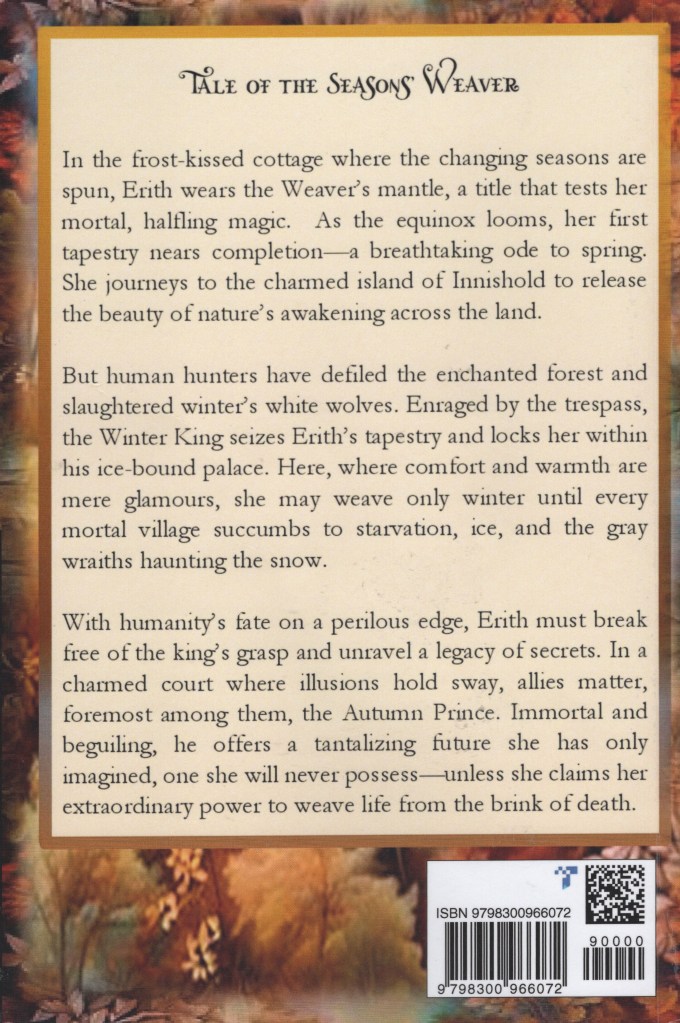
In the frost-kissed cottage where the changing seasons are spun, Erith wears the Weaver’s mantle, a title that tests her mortal, halfling magic. As the equinox looms, her first tapestry nears completion—a breathtaking ode to spring. She journeys to the charmed isle of Innishold to release the beauty of nature’s awakening across the land.
But human hunters have defiled the enchanted forest and slaughtered winter’s white wolves. Enraged by the trespass, the Winter King seizes Erith’s tapestry and locks her within his ice-bound palace. Here, where comfort and warmth are mere glamours, she may weave only winter until every mortal village succumbs to starvation, ice, and the gray wraiths haunting the snow.
With humanity’s fate on a perilous edge, Erith must break free of the king’s grasp and unravel a legacy of secrets. In a charmed court where illusions hold sway, allies matter, foremost among them, the Autumn Prince. Immortal and beguiling, he offers a tantalizing future she has only imagined, one she will never possess—unless she claims her extraordinary power to weave life from the brink of death.
In the lyrical fantasy tradition of Margaret Rogerson and Holly Black, D. Wallace Peach spins a spellbinding tale of magic, resilience, and the transformative potency of tales—a tapestry woven with peril and hope set against the frigid backdrop of an eternal winter.
I don’t read a lot of books in the fantasy genre but when I was a teenager, I read C.S. Lewis Chronicles of Narnia and J.R.R. Tolkien’s fantasy novels (Hobbit, Lord of the Ring, etc.) I’ve never lost my fascination for fantasy, and I still frequently read science fiction novels. I am so happy I came across this delightful read. It is a great novel for older children, young adults and adults alike.
In Erith’s world there are humans and animals as well as magical beings said to be charmed. For the most part they stay on the Isle of Innishold in the lake of Dryftweel. There is an enchanted forest and four kingdoms, winter, spring, summer, and autumn. The charmed often have magical powers, and some of them look scary and some of them are dangerous. Erith, who is part human and part charmed, a halfling, has a unique skill and a unique job, and that is to weave the seasons. She is a Seasons Weaver. The entire world depends on her.
One winter day human hunters defile the land of the charmed and kills the Winter King’s white wolves. The enraged Winter King decides to take revenge on all humans. He sets out to cancel spring by preventing Erith from weaving. His objective is to let winter remain until all humans are dead. This also means the death of nature and all mortal creatures. What the Winter King does not seem to understand is that it could mean the end of the charmed beings as well. Can Erith prevail against the powerful Winter King? Luckily the brave and handsome Autumn King steps up and helps her.
This is an intense and fast paced adventure filled with intrigues, magic, fierce battles, and I think several dozen different kinds of magical beings. There are amusing creatures and funny creatures such as Nobbin, huge and powerful creatures, shape shifting creatures, witches, dangerous and scary creatures, evil frog like evil creatures, and kings, and queens. In addition, there are some obvious themes. Erith must learn to trust her abilities, to be confident and find her strength, and use her wonderful imagination. She is much more powerful than she thinks she is. Her story is an inspiration for all of us.
I loved the author’s imagination and the fantastic world she is skillfully forming in the reader’s mind. I loved the captivating storytelling and the lyrical and magical prose. The author is certainly a weaver herself, a weaver of tales and imagined worlds. In the book the charmed creatures come to realize that they were dependent on human minds and belief for their existence. Is it also the other way around? A manifestation of the mental nature of reality if you will. In any case, I highly recommend this fascinating book.
Back cover of the Seasons’ Weaver. Click on the image to go to the Amazon page for the Kindle version of the book.
About the Author of Tale of the Seasons’ Weaver
A long-time reader, best-selling author D. Wallace Peach started writing later in life when years of working in business surrendered to a full-time indulgence in the imaginative world of books. She was instantly hooked.
In addition to fantasy books, Peach’s publishing career includes participation in various anthologies featuring short stories, flash fiction, and poetry.
She’s an avid supporter of the arts in her local community, organizing and publishing annual anthologies of Oregon prose, poetry, and photography. Peach lives in a log cabin amongst the tall evergreens and emerald moss of Oregon’s rainforest with her husband, two owls, a horde of bats, and the occasional family of coyotes.
For book descriptions, excerpts, maps, and behind the scenes info, please visit D. Wallace Peach Books









































































































 Leonberger Life