Leonberger information and amusing and heartwarming Leonberger stories.
Author: thomasstigwikman
My name is Thomas Wikman. I am a software/robotics engineer with a background in physics. I am currently retired. I took early retirement. I am a dog lover, and especially a Leonberger lover, a home brewer, craft beer enthusiast, I’m learning French, and I am an avid reader. I live in Dallas, Texas, but I am originally from Sweden. I am married to Claudia, and we have three children. I have two blogs. The first feature the crazy adventures of our Leonberger Le Bronco von der Löwenhöhle as well as information on Leonbergers. The second blog, superfactful, feature information and facts I think are very interesting. With this blog I would like to create a list of facts that are accepted as true among the experts of the field and yet disputed amongst the public or highly surprising. These facts are special and in lieu of a better word I call them super-facts.
The focus of this blog is Leonbergers but sometimes I post about books that are not about Leonbergers but are books that I love, and I therefore want to promote. This time I would like to promote All the Words I Kept Inside by P.J. Gudka – July 9, 2024. In this book P.J. Gudka, or Pooja, lets out her innermost feelings utilizing enchanting and beautiful poetry and it ends up being quite powerful. I bought the Kindle edition.
Paperback – Publisher : Wild Ink Publishing (June 29, 2024), ISBN-10 : 1958531650, ISBN-13 : 978-1958531655, 112 pages, Item Weight : 4.7 ounces, dimensions : 5 x 0.26 x 8 inches, it currently cost $ $19.99 on US Amazon. Click here to order it from Amazon.com.
Kindle – Publisher : Wild Ink Publishing (July 9, 2024), ASIN : B0D42BHQQ8, 113 pages. It is currently $6.99 on Amazon.com. Click here to order it from Amazon.com.
Front cover of All the Words I Kept Inside Kindle Edition by P.J. Gudka. Click on the image to go to the Amazon page for the book.
Amazon’s description of the book
What is your truth? What is your secret? What secrets are you keeping from the world that you hope one day you will be brave enough to tell? When will you tell your heart? All The Words I Kept Inside allows you this moment.
This collection of poetry urges you to look deeply inside and confront your darkest thoughts. It takes that inner dread, disappointment, and heartache to reveal the words of the heart. This book will show you that you are not alone. That you are understood. That you don’t have to go through these dark moments on your own because so many of us experience them too. The words found inside will reach out a hand and guide you.
This is your moment.
This is your truth that you’ve never told anyone.
The words see you.
From the very earliest moments, the words know…
“All the words I kept inside. In you, I now confide…”
The Girl Who Fell in Love with the Monster Under Her Bed
It’s OK to mourn the person you were. Even if you love the person you are now. That was one of the phrases in this book. This book features beautiful and deeply moving poems. They are often dark and sad, and while reading it I couldn’t help but recalling the phrase from the song “the sound of silence”, “Hello darkness my old friend I’ve come to talk with you again”. The author put her innermost feelings and angst into poems using enchanting word formations and rhymes. The poems were dark but also full of wisdom, truth and beauty. As soon as my kindle book was made available to me, I started reading it and I could not stop. The poems were so intriguing and powerful. Reading this book was a very special experience. I highly recommend this beautiful book of poetry.
About the Author
P. J. Gudka is a writer, blogger and freelancer currently working from Kenya. Her journey as a blogger began when she created her multi-niche blog, Lifesfinewhine, as a teenager, to share her experiences with life, mental health, travel and more. Since then, her blog has captured the interest of thousands of people around the world and is now her full-time passion.
Her writing has been published in books like Hidden In Childhood: A Poetry Anthology and Glow: Self-Care Poetry For The Soul as well as multiple magazines.
Our late Leonberger Bronco’s birthday was a few days ago, and so was the two years anniversary of the release of my book about him. It is a special occasion and therefore I’ve decided to have a promotion for the month of July. I lowered the price of both the paperback and the kindle version on Amazon by two dollars in all countries (or close to two dollars). For the United States I lowered the price of the Kindle version from $4.99 to $2.99 and for the paperback from $19.95 to $17.95. In Sweden I lowered the price from 180 Swedish Crowns to 150 Crowns or 159 Crowns with VAT.
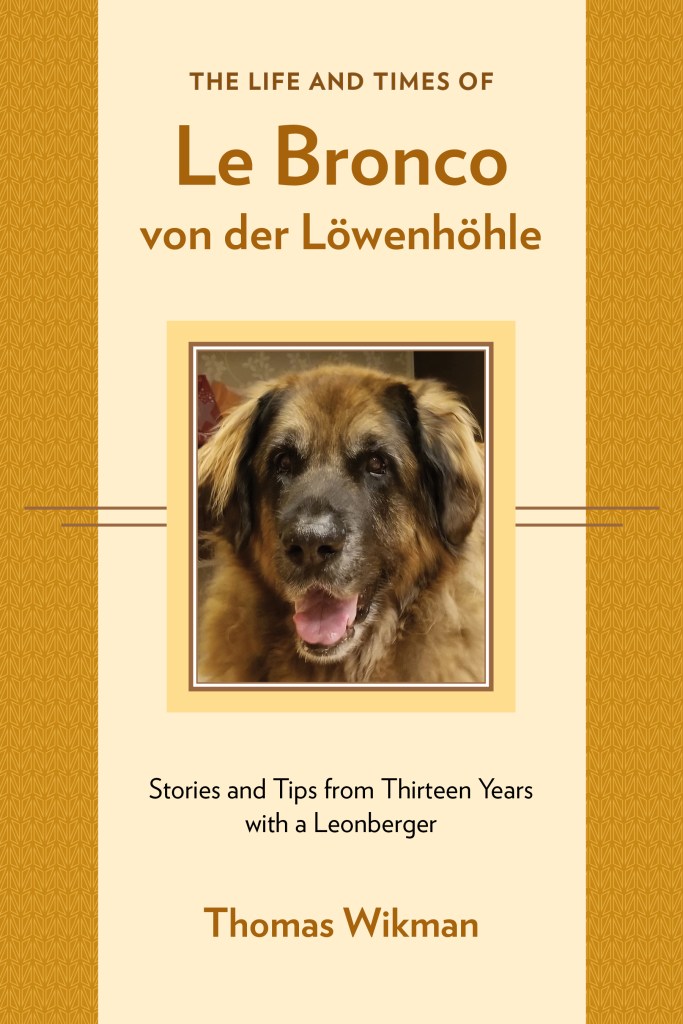
This is the front cover of the book “The Life and Times of Le Bronco von der Löwenhöhle”. Click on the image to go to the Amazon.com location for the paperback version of the book.
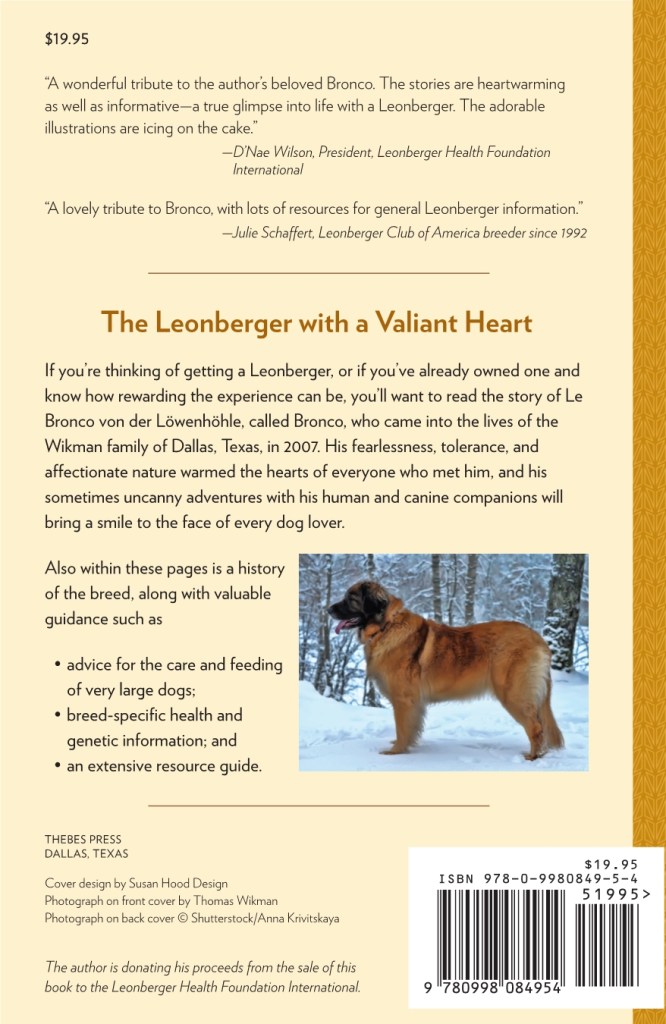
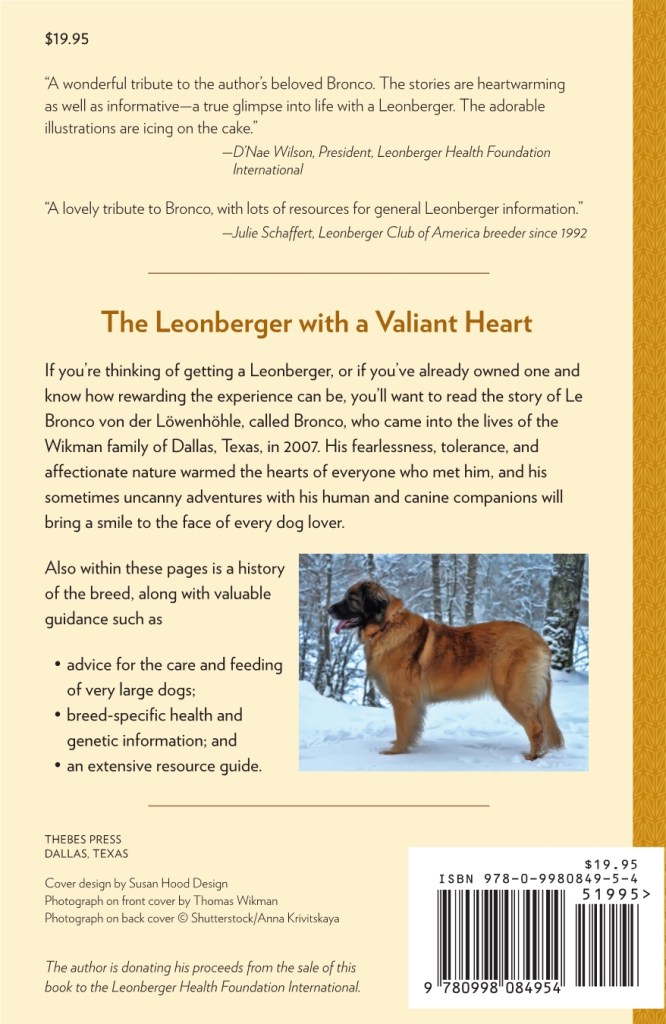
This is the back cover of the book “The Life and Times of Le Bronco von der Löwenhöhle”. Click on the image to go to the Amazon.com location for the kindle version of the book.
If you’re thinking of getting a Leonberger, or if you’ve already owned one and know how rewarding the experience can be, or if you are just a dog lover, then you’ll want to read the story of Le Bronco von der Löwenhöhle, called Bronco, who came to live with us in Dallas, Texas, in 2007. Bronco, a recipient of the Leonberger Health Foundation International’s Grey Muzzle Award, lived an unusually long life for a Leonberger—almost thirteen years. We believe that what helped him exceed his breed’s normal life expectancy was his brave and loving heart.
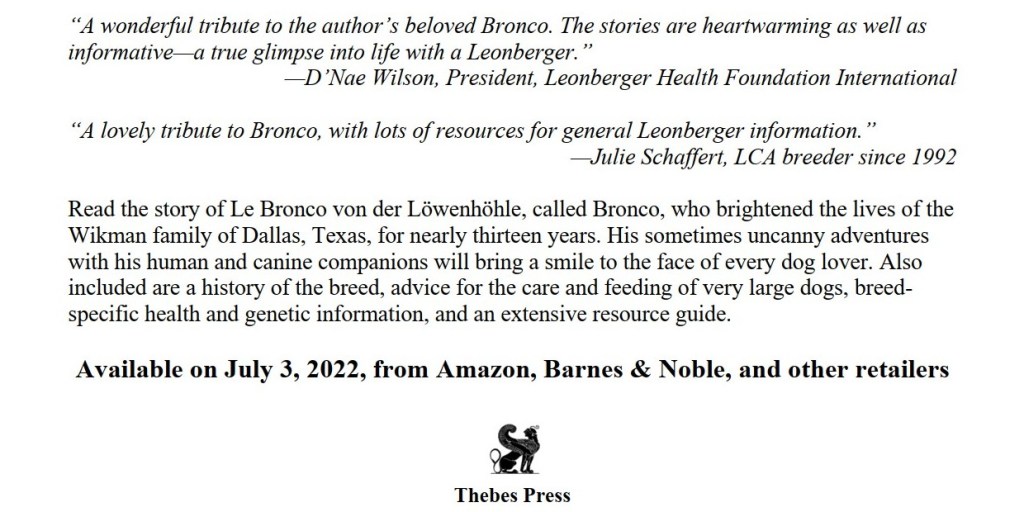
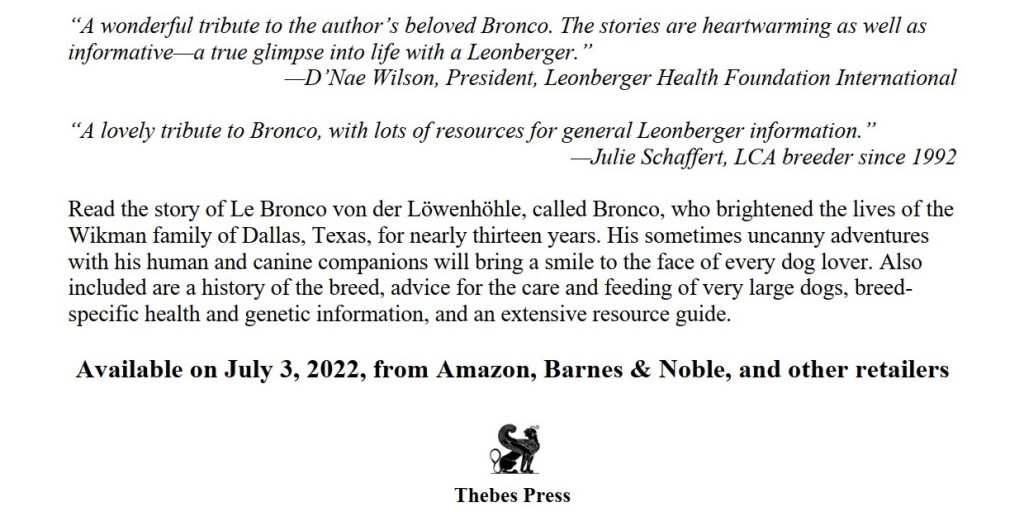
These are the endorsements for the book. Click on the image to got to the Barnes and Noble location for the book.
In this book you’ll read about some of Bronco’s amazing feats: the night he scared away a prowler; the day he performed a hamster search and rescue; the time he stumped the Geek Squad; and the late night he snuck into the kitchen and ate a two-pound bag of dog treats, a box of pastries, a loaf of bread, a grilled chicken, and a Key lime pie, all in one sitting. You’ll also read about his unflappable calm during a north Texas tornado and his stoicism as he endured health challenges in his later years.
In addition to entertaining stories, these pages contain a wealth of practical guidance, including:
a history of the Leonberger breed;
advice for the care of very large dogs;
breed-specific health and genetic information;
training and feeding tips;
suggestions for finding a breeder;
the official breed standard; and
an extensive resource guide.
Bronco’s fearlessness, tolerance, and affectionate nature warmed the hearts of everyone who met him, and his sometimes uncanny adventures with his human and canine companions will bring a smile to the face of every dog lover.
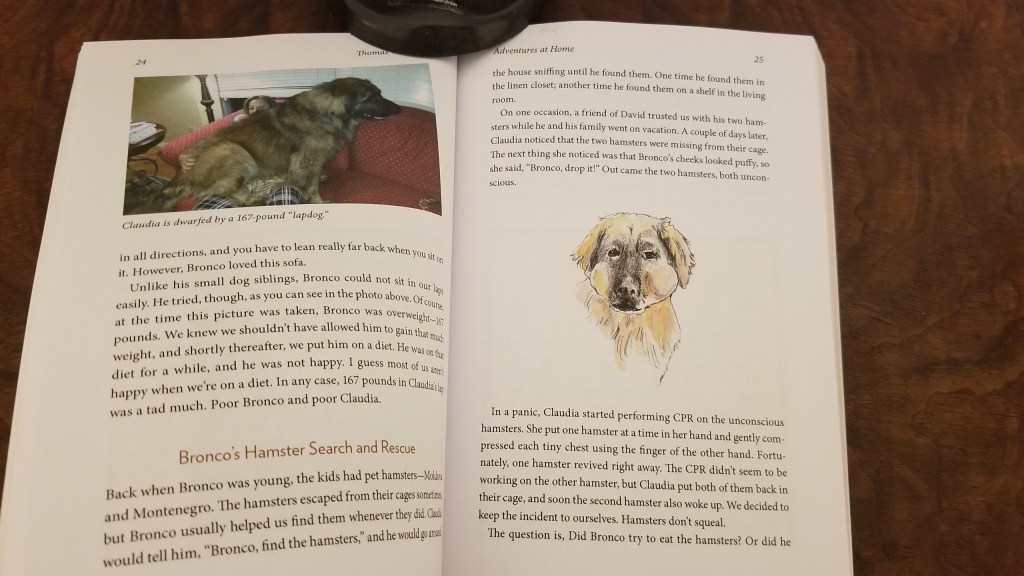
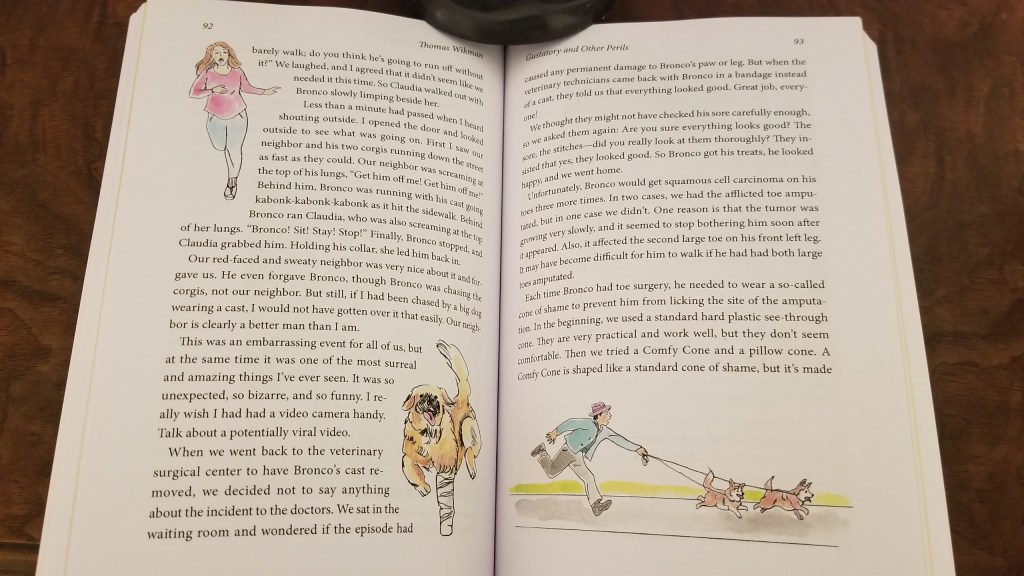
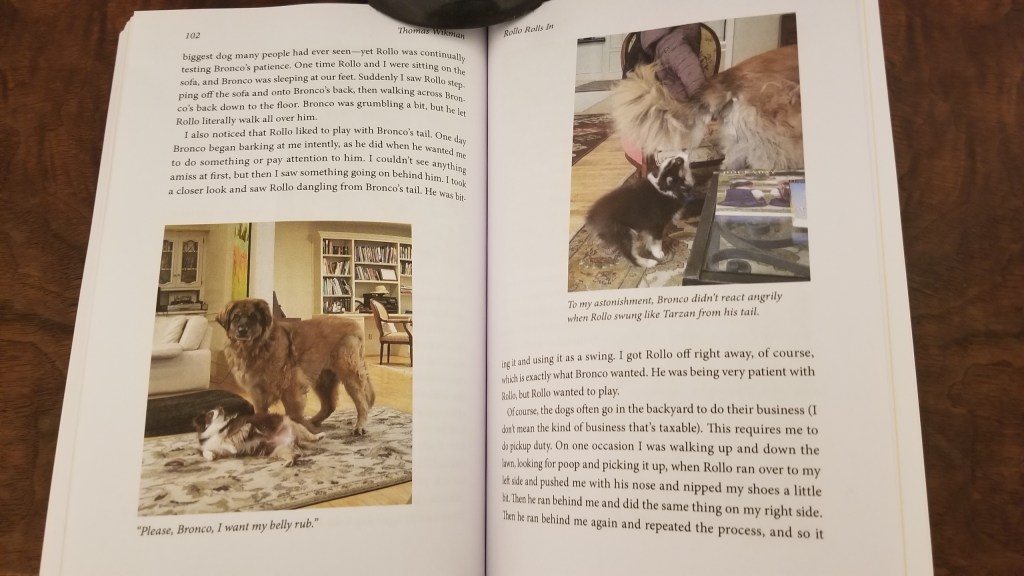
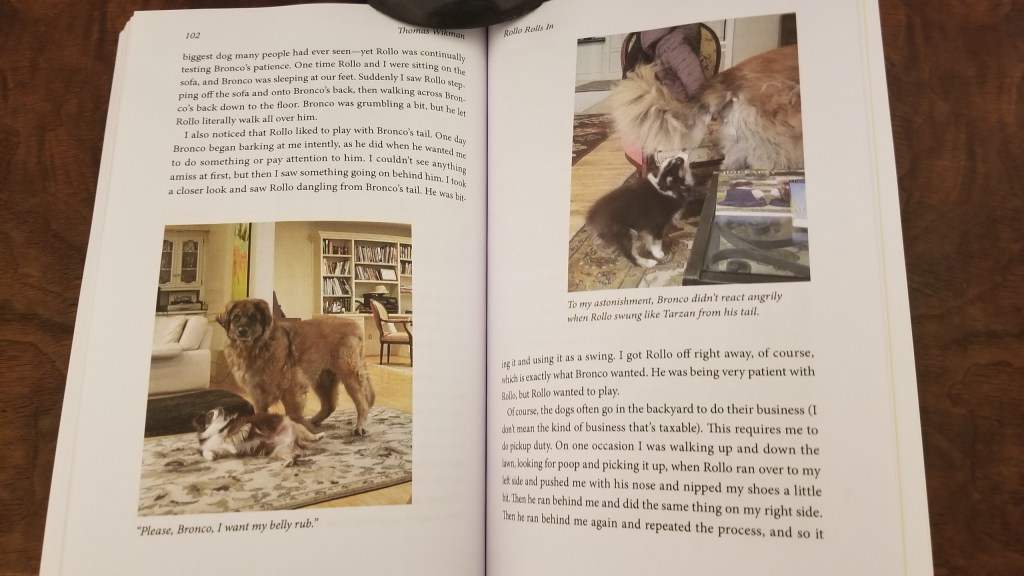
This is a sample spread from my book (The Life and Times of Le Bronco von der Löwenhöhle). It is page 24 and 25. The illustration (by Naomi Rosenblatt) showing Bronco with puffy cheaks depicts him holding two rescued hamsters in his mouth.This is another sample spread from my book. It is page 92 and 93. The spread contains the story about when Bronco was chasing our nice neighbor while wearing full leg cast, despite the fact he was not supposed to bump it. The illustrations were made by Naomi Rosenblatt.This is another sample spread from my book. It is page 102 and 103. The other dog is our mini-Australian Shepherd Rollo.
Below is a list of places where you can get my book.
An economic externality or external cost is an indirect cost or benefit to an uninvolved third party that arises as an effect of economic activities. They are unpriced components of market transactions. An example is the gasoline you buy. Burning the gasoline causes pollution that harms other people including those who do not own cars, future generations, and it harms the environment including animals. Society incurs a cost from that pollution that you don’t pay for at the pump. The gasoline producers and vendors do not pay for it either. Unless you add a tax or make other adjustments the act of polluting is free of charge, even though there is a real cost associated with it. It is a cost that is invisible to unfettered “free markets”. It is a market failure. Note I am putting “free markets” in quotes because the free market does not exist all by itself. It exists within a framework of societal norms, culture, laws, a banking system, and entities such as limited liability corporations, etc.
Pollution is an example of a negative externality. Photo by Chris LeBoutillier on Pexels.com
The existence of economic externalities is entirely uncontroversial among economists, including laissez-faire (libertarian) economists such as Milton Friedman, Friedrich Hayek, and Ludwig von Mises, even though Ludwig von Mises said that they arise from lack of “clear personal property definition.” In fact, Milton Friedman, Nobel prize winner in economics, and leading anti-tax champion, stated that pollution met the test for when government should act, but that when it did so, it should use market principles to the greatest extent possible — as with a pollution tax. However, in my experience the existence of economic externalities is unwelcome news to market fundamentalists who lack education in economic science, including many libertarian leaning politicians. If you bring up the subject you might be dismissed, scoffed at, or labeled as a leftist. I don’t have a Gallup poll to back this up, but I believe it is correct to say that economic externalities are controversial among significant portions of the public despite being a universally accepted and fundamental concept of economic science.
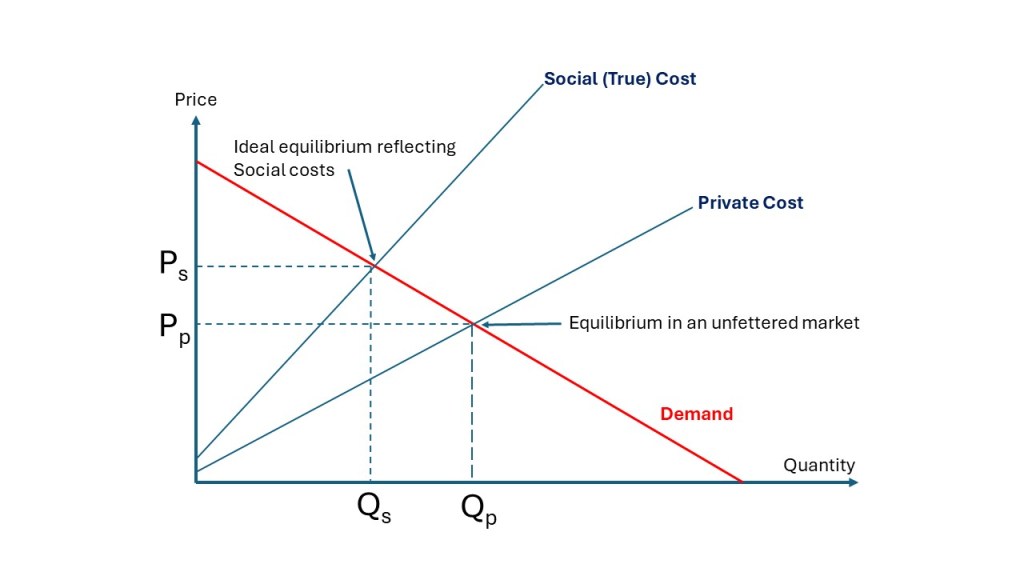
This simplified supply and demand graph shows two different graphs in blue. One for the private/production cost per unit of a goods and a second that also includes the cost of the externality.
In the simple supply-demand graph above we see how the price of a product per unit (private cost / or production cost) increases with the increased quantities produced. The increase in price could be because resources become increasingly scarce as more must be produced. The curves are typically not simple straight lines like this. It is just an illustration. As the price goes up demand goes down (the red demand curve/line) because fewer people want to buy the product or can afford the product. An equilibrium is reached where the curves meet. According to classical economics (micro-economics classes, or macro-economics classes) this equilibrium represents the optimum benefit for society assuming consumers and producers are perfectly rational (with respect to their self-interest) and there are no externalities.
Unfortunately, in this example, there is an externality and as we know the unfettered free market does not account for it. Let’s say that we know the cost of the externality and we find a way of adding that cost to the price, perhaps via a tax. The price is higher and fewer units will be sold and we have a new equilibrium. Now the economically optimal point is the ideal equilibrium that reflects social cost. In the 1920’s an economist Arthur Pigou argued that a tax, equal to the marginal damage or marginal external cost on negative externalities could be used to reduce their incidence to an efficient level. Notice this tax is not for redistributing wealth or bringing revenue for the government but to reduce economic harm to society. There are other ways to address the problem, but this type of tax is called a Pigouvian tax.
How a Pigouvian tax can reduce economic harm to society. Photo by Pixabay on Pexels.com
Finally, I would like to give a few examples of negative and positive externalities. Negative externalities could be :
Pollution
Climate Change
Depletion of fish due to overfishing
Depletion of other resources
Overuse of antibiotics
Spam email
Some positive externalities are :
A beekeeper keeps the bees for their honey, but a side effect or externality is the pollination of surrounding crops by the bees.
Education (societal benefits beyond the individual).
Research and development
Innovations
Scientific discoveries
Vaccination
When a beekeeper keeps bees for their honey, a side effect is the pollination of surrounding crops by the bees. This is an example of a positive externality.. Photo by Pixabay on Pexels.com
As I previously mentioned I would like to launch a second blog featuring small facts or insights that are widely disbelieved despite being known to be true by the experts in the relevant field or facts that are very surprising or misunderstood by a lot of people. These facts shouldn’t be trivia but important facts that are somewhat easy to understand despite their status as being unthinkable to many. They are not scientific theories or complex sets of facts or information, but facts that you can easily state. I’ve decided to call these facts super facts (is that a stupid name?). This is the last super fact I am posting on my Leonberger blog. I will create a list of hundreds of super facts but that is for my upcoming blog. To see the other four super fact posts so far check the list below:
As I previously mentioned I would like to launch a second blog featuring small facts or insights that are widely disbelieved despite being known to be true by the experts in the relevant field or facts that are very surprising or misunderstood by a lot of people. These facts shouldn’t be trivia but important facts that are somewhat easy to understand despite their status as being unthinkable to many. They are not scientific theories or complex sets of facts or information, but facts that you can easily state. They may be part of a scientific theory, or a result of an established scientific theory but not an entire scientific theory. I’ve collected hundreds of these facts because to me they seem to be extraordinarily important. They are worldview altering facts, big shocking facts to some, facts that many people deny regardless of the evidence, super-facts if you will.
In a previous post I discussed that despite the fact that the scientific community states that Earth is 4.5 billion years old and that humans evolved over millions of years a 2019 Gallup poll, showed that 40% of US adults believe that God created humans in their current form within the last 10,000 years. The evidence proves that this 40% of the population is wrong. The scientists aren’t guessing. They make their claim that earth is 4.5 billion years old based on a lot of strong evidence. Evidence which is unknown to a lot of people. In this post I am discussing a fact that once was widely disputed but today is more just surprising or not understood by many and that is that the speed of light in vacuum is a universal constant.
No matter how fast you travel, what direction, or where you are you will measure the speed of light compared to yourself to be c = 299,792,458 meters per second or approximately 186,000 miles per second or 671 million miles per hour.
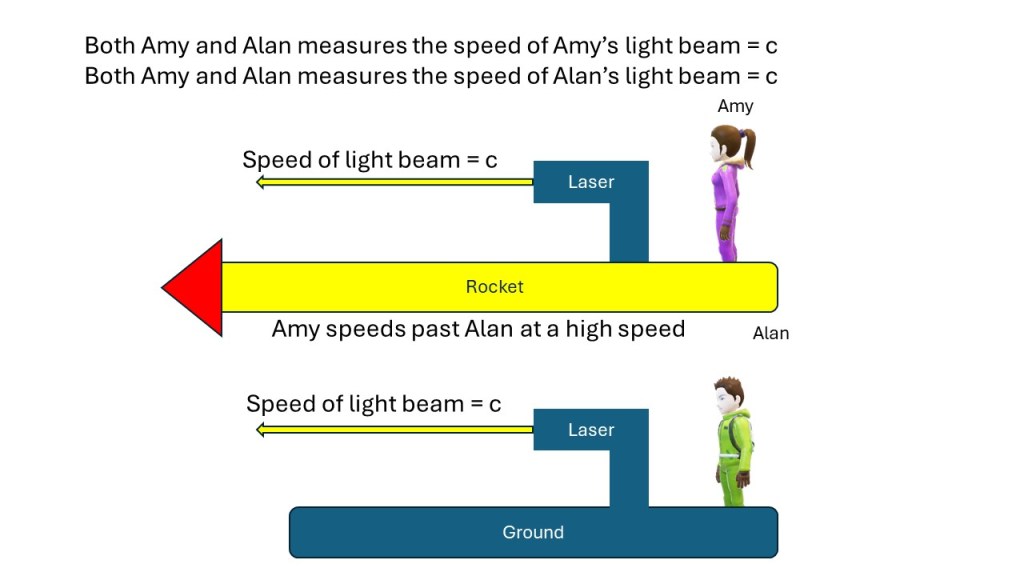
In this picture Amy is traveling past Alan in a rocket. Both have a laser. Both measure the speed of both laser beams to be c = 299,792,458 meters per second.
In the picture above let’s say Amy is flying past Alan at half the speed of light. If you believe Alan when he says that both laser beams are traveling at the speed of c = 186,000 miles per second, then you would expect Amy to measure her laser beam to travel at a speed that is half of that c/2 = 93,000 miles per hour, but she doesn’t. She measures her laser light beam to travel at the speed of c = 186,000 miles per second just like Alan. This seems contradictory. The solution that the special theory of relativity offers for this paradox is that time and space are relative and Amy and Alan measure time and space differently (more on that in another post).
Time is going to be different for me. From shutterstock Illustration ID: 1055076638 by andrey_l
I should add that the realization that the speed of light in vacuum is a constant regardless of the speed or direction of the observer or the light source was a result of many experiments, which began with the Michelson-Morley experiments at Case Western Reserve University, Cleveland, Ohio in the years 1881-1887. At first scientists thought that there was an ether that compressed the experimental equipment and distorted clocks so that it seemed like the light vacuum always came out the same. With the special theory of relativity in 1905 those speculations were laid to rest.
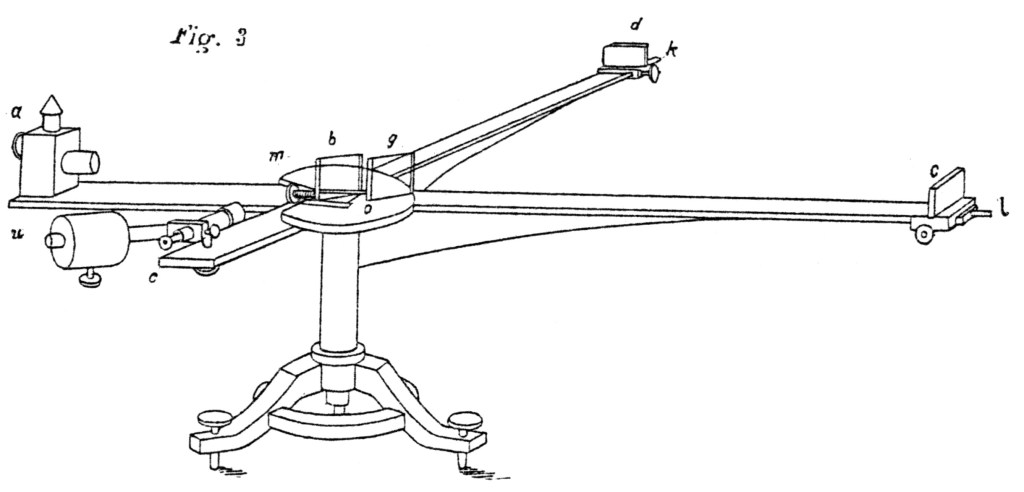
The first Michelson-Interferometer from 1881. It was used to measure the speed difference of two light beams (well a split light beam) with a very high accuracy (for the time). The light traveled with the same speed in all directions and no matter what earth’s position and speed was in its orbit around the sun. This picture is taken from Wikipedia and is in the public domain of the United States.
The speed c = 299,792,458 meters per second is a universal speed limit created by time and space
I should point out that there is nothing magical about the speed of light in a vacuum. Light traveling through matter, like glass or water, does not travel at this speed c, but slower. It also isn’t entirely correct to say that the speed of light in vacuum is a universal constant, because it isn’t about light per se. What is happening is that light traveling completely unimpeded through vacuum is prevented from traveling infinitely fast by the way time and space is set up. All massless particles / radiation, or anything that hypothetically could be traveling at an infinite speed is prevented from doing that because of the way time and space are related. Light in vacuum just happened to be what we first discovered to be restricted by this universal speed limit. Yes, time and space are annoying that way, putting a limit on the speed of light and on massless particles.
So how is time and space arranged to cause this universal speed limit? Well, that is an even more surprising blog post for another day (I will link to it once I have made the post). From this discovery about time and space came a lot of other interesting realizations but that is also for another post, but let’s just give a brief summary:
Time for travelers moving fast compared to you is running slower.
Length intervals for travelers moving fast compared to you are contracted.
Simultaneous events may not be simultaneous for another observer.
The order of events may be reversed for different observers.
If you accelerate to a speed that is 99.999% of the speed of light you still haven’t gotten any closer to the speed of light from your perspective. Light in vacuum will still speed off from you at c = 186,000 miles per second.
Acceleration will get harder the closer you get to the speed of light in vacuum. The force required will reach infinity as you approach the speed of light in vacuum.
Forces, the mass of objects, momentum, energy and many other physical quantities will reach infinity as you approach the speed of light in vacuum assuming you are not a massless particle.
Mass is energy and vice versa E = mc2
Magnetic fields pop out as a relativistic side-effect of moving charges.
Mass is energy and vice versa, a direct result of the way time and space are related. Stock Photo ID: 2163111377 by Aree_S
How do you feel about time and space creating this universal speed limit in which light in vacuum travel?
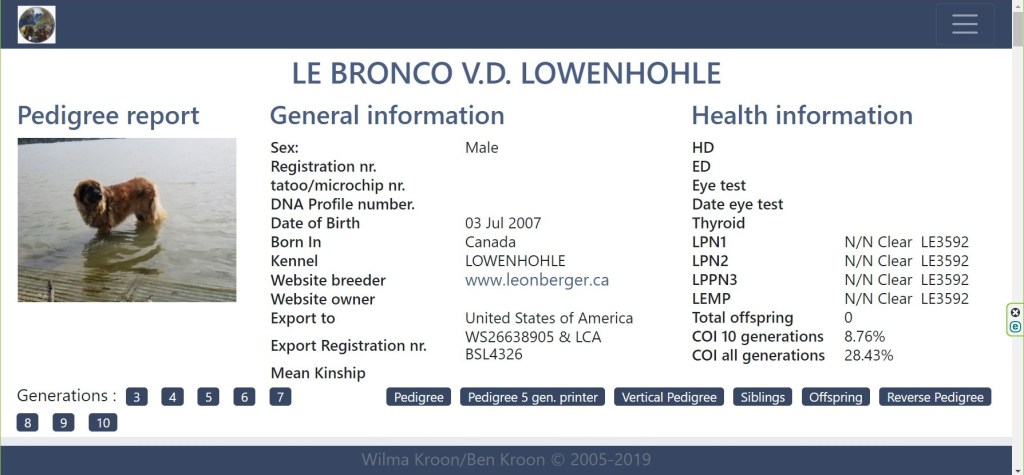
Our Leonberger Bronco was born in British Columbia, Canada (nearby Vancouver), on July 3rd, 2007. That was 17 years ago today. His full name was Le Bronco von der Löwenhöhle. His father’s name was Priamos Vom Dreiburgenland and his mother’s name was Justus Aria Von Drevas. He had four full siblings, or twins, Little Jonah, Love Ryan, LRV’s Moose, and Lakeisha Makita. That was his litter. Notice that all names begin with an ‘L’. He had 83 siblings in total. The breeder’s name was Julie Schaffert, who is a Leonberger Club of America certified breeder (since 1992), and arguably North America’s most prominent breeder.
Bronco’s entry in the Leonberger Data Base. Click on the picture to visit the Leonberger Data Base.
About 8-9 weeks later he came to Dallas, Texas to be with his new family. That was us. 13 years later he passed away. The name we picked for him was Bronco. However, we were told that his name needed to begin with an ‘L’, so my wife said, “Let’s do Le Bronco”, intending it to be “Le Bronco”. It took us several years to change his name from “Lets Do Le Bronco”, which also begins with an ‘L’, to “Le Bronco”.
Bronco’s original birth certificate from LCA (Leonberger Club of America). His name at this time was “Lets Do Le Bronco von der Löwenhöhle”.Close up of his name, which incorrectly was “Lets Do Le Bronco von der Löwenhöhle”.Bronco at the age of three months and at the age of almost 13.
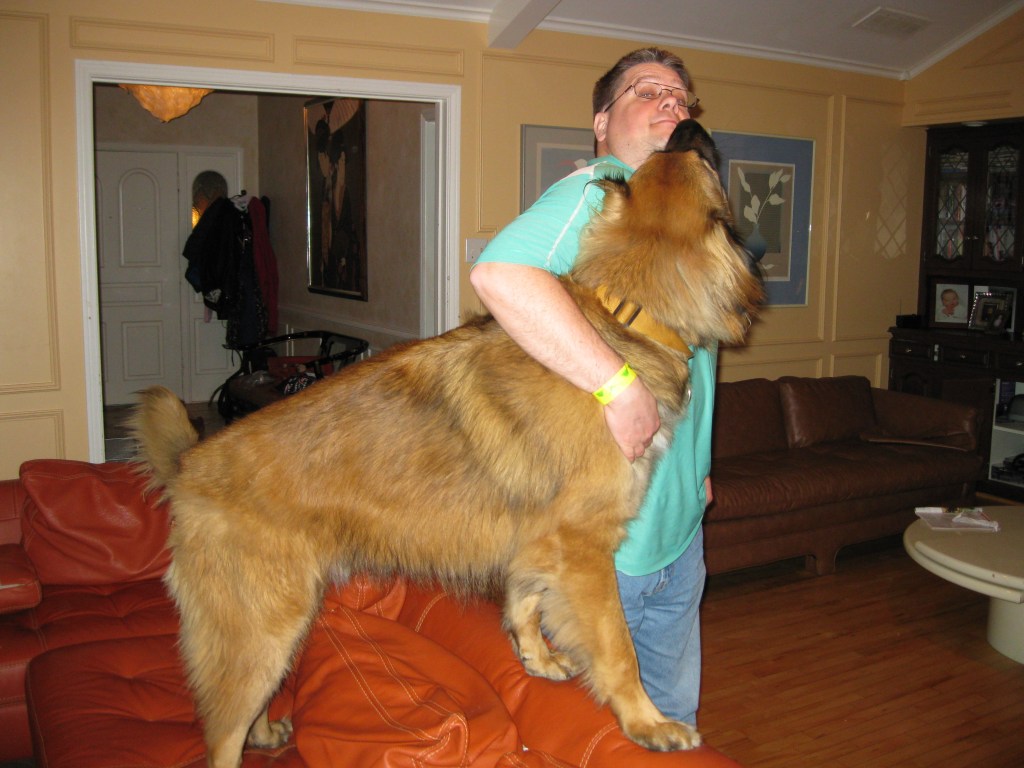
Bronco quickly grew to become a big dog. At one point he was 167lbs but his ideal weight was 135lbs. When he joined our family, we had two other dogs, a Labrador (or Labrador mix) called Baylor and a female German Shepherd called Baby. Baby was like a mother to Bronco, and she was fiercely protective of him. We would soon get two more dogs, a Japanese Chin called Ryu and a pug called Daisy. Once Bronco was older, we would get one more dog, a mini-Australian Shepherd called Rollo. Bronco loved all the other dogs, and he was very protective of them. He saved the life of our Labrador by sniffing out an oncoming insulin shock and he saved our pug Daisy from an attacking German Shepherd.
This is Bronco and me. He is about one year old. Not yet fully grown but still big.Bronco when he was 167lbs sitting in my wife’s lap. He went on a diet after this photo.Bronco with our pug Daisy and Japanese Chin Ryu.Bronco with our pug Daisy and Japanese Chin Ryu again.The portrait was drawn by Veniceme at Etsy (Natasha Dall’Ara) and it is based on one of our photos.
One thing that we are proud of is that Bronco lived very long for a Leonberger. The typical lifespan for a Leonberger is 8-10 years. Giant breeds tend to have a short lifespan. The Leonbergers who live at least 12 years are awarded the so-called Grey-Muzzle Award by the Leonberger Health Foundation International, and Bronco was a recipient. The Leonberger Health Foundation International (LHFI) is supporting research that aims to solve health issues in Leonbergers and other giant breeds. All proceeds from the sale of my book are donated to the Leonberger Health Foundation International. I can add that when Bronco passed away, we sent his DNA to the University of Minnesota to be used in research. This was facilitated by the LHFI.
Bronco was a very special dog, and he also gave us many amusing stories. Some of the stories were great, like when he chased off a trespasser / peeping Tom who had been terrorizing my wife and the other women in the neighborhood, but that the police and the private detectives I hired could not catch. Or when he saved runaway hamsters or saved the lives of other dogs. He also gave us some embarrassing stories, such as when he put our neighbor’s head in his mouth, like the circus lion trick, or pushed our German Shepherd into a storm drain. After Bronco passed, I decided that the world needed to know about Bronco, so I wrote a book about him. It is a tribute to him as well as a collection of funny stories. I also added information about Leonbergers in the book, their origins, care, training, health, etc.
Bronco is chasing off a trespassing peeping Tom who had been terrorizing the women in the neighborhood at night. Illustration by Naomi Rosenblatt.Bronco with hamsters in his mouth. When he dropped them, they were unconscious, so my wife gave the hamsters CPR. They were fine. Illustration by Naomi Rosenblatt.Bronco acting wild pushing our German Shepherd into a storm drain. I am trying to get her up. Illustration by Naomi Rosenblatt.
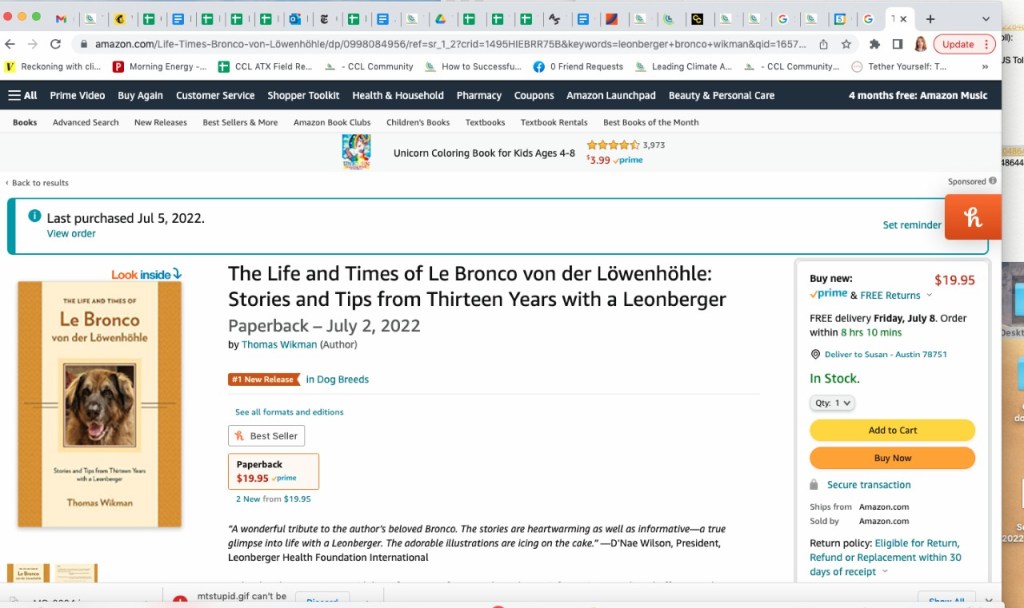
Finally, I would like to give an overview of my book about Bronco and Leonbergers. I intended to release the Book on July 3rd, 2022, on what would have been Bronco’s 15th birthday. However, Amazon was quicker than I expected. The Kindle version became available on the day I uploaded it July 1st, 2022, and the paperback version July 2nd, 2022, but I did not tell people about it until July 3rd. Well today it is July 3rd again. To read more about my book click here.
In July of 2022 my book was the number one new release on American Amazon in the category “dog breeds”This is a sample spread from my book (The Life and Times of Le Bronco von der Löwenhöhle). It is page 102 and 103. The other dog is our mini-Australian Shepherd Rollo.This is the front cover of the book “The Life and Times of Le Bronco von der Löwenhöhle”. Click on the image to go to the Amazon.com location for the paperback version of the book.This is the back cover of the book “The Life and Times of Le Bronco von der Löwenhöhle”. Click on the image to go to the Amazon.com location for the kindle version of the book.These are the endorsements for the book. Click on the image to got to the Barnes and Noble location for the book.
If you haven’t already, please take a look at my book
The focus of this blog is Leonbergers but sometimes I post about books that are not about Leonbergers but that I loved, and I want to promote. This time I would like to promote Sarah (Women in the West Adventure Series) by Kaye Lynne Booth – May 7, 2024. This is a captivating wild west book with a female main character. I did not buy the book. I won the book in a book raffle organized by the author. I was lucky. It is a great book.
Paperback – Publisher : Wordcrafter Press (May 7, 2024), ASIN : B0D32GQD8M, ISBN-13 : 979-8223446460, 314 pages, Item Weight : 14.1 ounces, dimensions : 5.5 x 0.7 x 8.5 inches, it currently cost $20.99 on US Amazon. Click here to order it from Amazon.com.
Kindle – Publisher : Wordcrafter Press (May 7, 2024), ASIN : B0CWZHG1W8, 318 pages. It is currently $6.99 on Amazon.com. Click here to order it from Amazon.com.
Front cover of Sarah by Kaye Lynne Booth. Click on the image to go to the Amazon page for the book.
Amazon’s description of the book
Sarah survived being abducted at fourteen and sold to the Utes.
She works hard to learn and be accepted as the squaw of the chief’s brother, Three Hawks, and she now looks forward to raising a family among the Ute tribe. But when a mysterious stranger, a lone Sioux warrior, she is thrown into a game of survival in the mountains of Colorado.
Hope and a streak of stubbornness take this optimistic heroine up against the adversities of the western frontier as she blossoms into a young woman and tries to make a place for herself in the world.
If you like strong female protagonists, you’ll love Sarah.
This is my five-star review of the book Sarah. Click here to see my review on Amazon.
A Young Woman’s Dangerous Adventures in the Wild West
I won this book in a raffle, so I did not buy the book from Amazon. Recently I’ve been reading a few Westerns featuring female main characters that was written by female authors. I’ve been awestruck by their intensity and compelling story telling, including this one. I think this might be a genre with a lot of hidden gems. Both women and men can certainly enjoy the captivating and fast-paced story about Sarah, or Hair-of-Fire, which was her Shoshone name.
Sarah was kidnapped by two men and sold to the Shoshone / Ute tribe. She became part of the Ute tribe and integrated into the Shoshone culture. She learned to speak Shoshone, but she retained her ability to speak English. Then one day she was abducted by a Sioux warrior that had been exiled from his tribe, and so began her complicated and tumultuous journey back to “white civilization”. She encountered a lot of life-threatening situations, dangerous animals, evil men, accidents and treacherous acquaintances as well as kindhearted men and women. Sarah is brave, cunning, and strong. She is a survivor with a good heart. That this book is fast-paced and intense is an understatement.
I also really enjoyed the depiction of animals in the book, including her loyal and brave dog Blue and her smart and strong horse Natsam-mayaapeh Beepi or “Beepi” for short. Blue really stole my heart. It seemed to me that the author had done her research well. It appeared that she was well informed about the frontier societies in the old West, she understood native American cultures, is familiar with the landscape in the area and she is a dog lover and horse lover. I highly recommend this book.
About the Author
For Kaye Lynne Booth, writing is her passion. It is a very strange time indeed when Kaye Lynne does not have at least three WIPs, in addition to her other writings, teaching and other life activities. Kaye Lynne lives, works and plays in the beautiful mountains of Colorado.
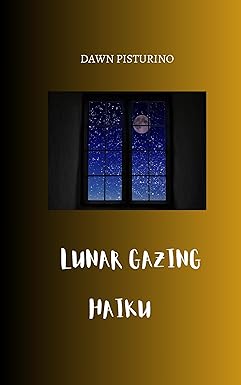
The focus of this blog is Leonbergers but sometimes I post about books that are not about Leonbergers but that I want to promote. This time I would like to promote Lunar Gazing Haiku by Dawn Pisturino. This is a wonderful short book featuring beautiful poetry. I bought it from Amazon for 99 cents. The publisher is Horse Mesa Press (June 8, 2024), print length is 32 pages, ASIN : B0D6LWR5GL.
Front cover of Lunar Gazing Haiku by Dawn Pisturino. Click on the image to go to the Amazon page for the book.
Amazon’s description of the book
In Japan, tsukimi (moon gazing) is an annual Harvest Moon Festival celebrated in September. Dating back centuries, when the noble classes composed music and poetry while viewing the full moon, the festival now includes everybody and marks the celebration of the autumn season. Looking for the “rabbit in the moon” while picnicking under the stars, appreciating the moon’s sacred splendor, giving thanks for bounties received, and looking forward to a prosperous future make this a special event. The 62 haiku in this digital chapbook celebrate all seasons and all aspects of life, with the last chapter dedicated to moon gazing. Enjoy the fun.
Lunar Gazing Haiku is a delightful short book featuring 62 Haikus about the seasons, holidays, nature, love, spirituality, animals and the moon. The book also has an interesting introduction explaining what a Haiku is and the history of Haiku. The Haikus in the book are fun, ponderous, beautiful, often soothing and sometimes they evoked beautiful imagery and memories. Snow Moon brought me back to my childhood and the dark winters in northern Sweden. My favorites were Your Name, Old Age, Dogs, The Beach, Mercury, Words, and Snow Moon. I highly recommend this beautiful little book of poetry.
About the Author
Dawn Pisturino is a retired nurse in Arizona whose international publishing credits include poems, short stories, and articles. Her poetry has appeared in several anthologies, most recently in Hidden in Childhood: A Poetry Anthology, Wounds I Healed: The Poetry of Strong Women, and the 2023 Arizona Literary Magazine. She is a Mystery Writers of America, Arizona Authors Association, and PEN America member.
As I mentioned in a previous post I would like to launch a second a blog. The topic would be facts and insights that are either widely disputed or often misunderstood amongst the public, yet important and known to be true to the experts and scientists in the relevant field. I’ve identified hundreds of such cases.
In my previous post I discussed the fact that despite the fact that the scientific community states that Earth is 4.5 billion years old and that humans evolved over millions of years a 2019 Gallup poll, showed that 40% of US adults believe that God created humans in their current form within the last 10,000 years. As a teenager I believed that myself. That was before I knew much about science. I had read agenda driven books that left out, or wrongfully dismissed the evidence for an old earth while presenting faulty arguments for a young earth. Just learning about the relevant science was enough for me to realize that I had been bamboozled. At first, I dug my heels in, but I eventually realized that the belief that earth was 6,000 years old was not tenable and unsupportable by science.
Is Earth 4.5 billion years old or 6,000 years old? Photo by Pixabay on Pexels.com
My goal for the blog is not to be an exhaustive source for these kinds of topics, or a deep dive into these topics, but just to collect a large set of these unnecessarily controversial topics and provide some insight into the surrounding misunderstandings. Not a complete insight into the topics, but some. Perhaps my blog will lead to some new insights for some, or intellectually honest reflection as well as interesting and friendly discussions.
Perhaps some new insight. Perhaps some intellectually honest reflection. Photo by Keegan Houser on Pexels.com
The format I decided on is to present the evidence for the fact or insight in question as a headline in bold followed by a list of failed objections to that evidence. Then, if applicable, failed arguments for the opposing point in bold as well, followed by an explanation as to why the argument does not work. It may seem like this setup is biased. However, the point is that the fact or insight in question is not commonly contested among the experts for good reasons, and therefore this setup is natural. Naturally, I would be open to counter arguments. I could, of course, be wrong and then I have to remove the fact/insight from my list.
I will certainly be open to counter arguments but let’s keep it friendly. Photo by Mikhail Nilov on Pexels.com
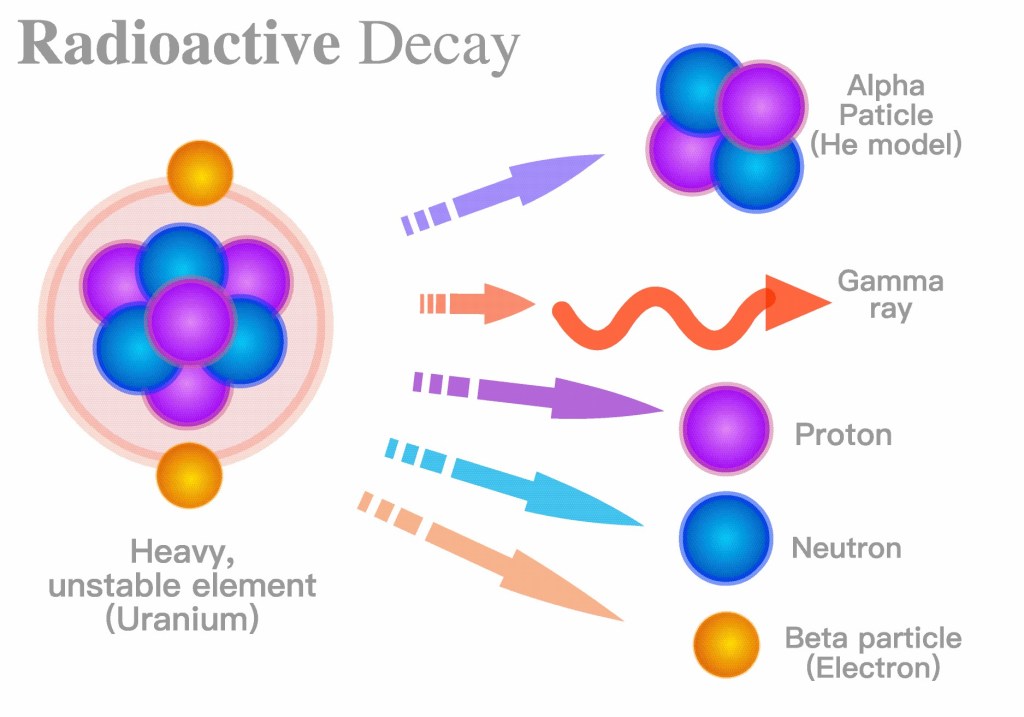
Radiometric dating of meteorite material, terrestrial material and lunar samples demonstrate that earth is 4.5 billion years, or more precisely 4.54 billion years old.
Radioactive decay rates have changed: This objection does not work because rates of radiometric decay (the ones relevant to radiometric dating) are thought to be based on rather fundamental properties of matter, such as the probability per unit time that a certain particle can “tunnel” out of the nucleus of the atom. Analysis of spectra from quasars show that the fine structure constant has not changed over the last ten billion years. There are dozens of radiometric dating methods that are consistent with each other throughout time. Also, for a young earth you would need the decay rates to have been millions of times faster in the past, which would require changes in fundamental properties that would have plenty of noticeable effects on processes other than radioactive decay, not to mention the radiation being millions of times stronger than today. It would have fried everything.
Young earth creationists sometimes make the claim that the initial ratios between isotopes may have been different: That the initial ratios/condition were different in the past and therefore radiometric dating is unreliable. This is a better objection, but it also fails. In this case you must take it case by case for each radiometric dating method and situation. But in many cases the amount of the daughter isotope is known to have been zero, which makes it easy and reliable.
Radioactive decay wasn’t a million times faster 6,000 years ago. Stock Vector ID: 2417370135 by grayjay
We can see galaxies that are billions of lightyears away. This does not establish the age of the earth, but it makes a young earth and a young universe implausible.
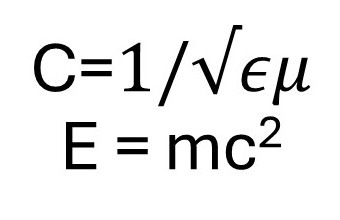
A common objection to this observation is that lightspeed in vacuum has changed: Similar to above this objection does not work because the light speed in vacuum is a fundamental constant that is not believed to change. It has been measured and no change has been seen. An example is the Einstein’s equivalence of energy and mass E = mc2. If the speed of light once was millions of times faster than now, the energy contained in a kilogram would be a trillion times larger than now. Where did all that energy go? The speed of light is determined by the inverse of the square root of the electric constant multiplied by the magnetic constant. You would have to drastically change the strength of the electric and magnetic fields (by the trillions) to get the speed of light to be millions of times faster. Wouldn’t that be noticeable? The light speed in vacuum shows up in many other physical relations as well. It is not a tenable objection.
A couple of equations in which the speed of light in vacuum is a fundamental constant.
We know stars are old because they develop according to certain physical processes that for some stars take billions of years. An example is our sun. It has fused (burned up) up five billion years’ worth of hydrogen.
The heavier elements in our solar system originate with older stars that burned out and exploded.
Electromagnetic radiation, including light, heat transfer if you will, travels from the inside of the sun to the surface and this takes 100,000 years. The photons are emitted and reabsorbed over and over, which is why the electromagnetic transfer is lower than in vacuum. If the sun is only 6,000 years old, how can we see it?
Finally, some objections to old earth by young earth creationists.
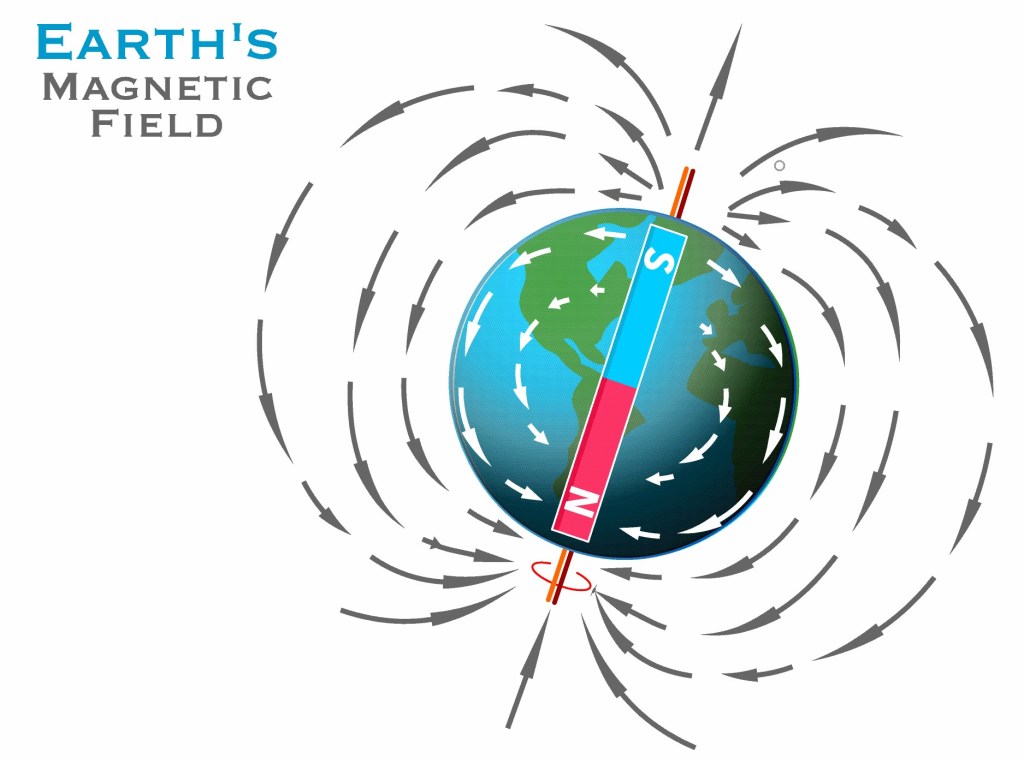
The earth’s magnetic field has been weakening during the last 130 years as if it was formed from currents resulting from earth being a discharging capacitor (claim by Thomas Barnes). This would make an impossibly strong magnetic field already 8,000 years ago. I remember this being the argument in a young earth creationist book I read as a teenager.
The first problem with this argument is that there is no good reason to believe that earth’s magnetic field acts this way.
We know that earth’s magnetic field has reversed itself several times thus disproving the discharging capacitor model.
Thomas Barnes’ extrapolation completely ignores the nondipole component of the field.
Conclusion, this objection is not reasonable.
Earth’s magnetic field. Stock Vector ID: 1851166585 by grayjay.
If the earth and the moon were billions of years old there would be a hundred feet thick dust layer from meteorites on the moon. The moon landing proved otherwise. This is another argument I remember reading in a young earth creationist book (Scientific Creationism by Henry Morris) as a teenager.
The problem with this argument, as I would later find out, is that Morris’ claims about a hundred feet thick dust layer was based on faulty and obsolete data. The expected depth of meteoritic dust on the Moon is less than one foot (after billions of years).
If I had known and understood any of this when I was 14 years old, I would not have been bamboozled by the young earth creationists, but it was not the only time I was bamboozled.
Anyway, this is how I envision one blog post in my upcoming blog post adventure. It is a brief overview of why experts/scientists can be trusted in regards the topic of the post. I have not yet decided on a name for my new blog.
For American Father’s Day (yesterday) I got a number of presents and cards including a portrait of our late pug Daisy. She passed April 5th. For my birthday in March, I got a portrait of our late Leonberger Bronco. With this post I just wanted to show these portraits. They are made by a company called Etsy and the portraits are based on our photos.
A painting of our late pug Daisy who passed two months ago. It is based on one of our photos and created by Etsy. I believe by the same woman who made Bronco’s portrait (have to verify this).The portrait was drawn by Veniceme at Etsy (Natasha Dall’Ara) and it is based on one of our photos.