This blog feature amusing and heartwarming stories about our late Leonberger dog Bronco, as well as other Leonbergers. It also has a lot of information about the Leonberger breed, the history, care, training, Leonberger organizations, etc. I also wrote a Leonberger book, which I am featuring in the sidebar.
Above this post there are Menus “About Me”, “Home”, “History”, “All Posts”, “The Book”, “Contact”. Today I updated the content of the menu called “All Posts”. This page lists all my blog posts that I’ve ever done. I added headers to the nine categories as well as a banner style image to every category. Below I am illustrating the first category “The Adventures of Bronco and his Dog Friends”. Please check out the new page – click here. What do you think?
I would like to highlight today’s Superfactful post called “Global Warming is Happening and is Caused by us”. I think it is an interesting one that is quite educational. It features 10 conclusive pieces of evidence that it is happening and then 10 pieces of evidence that we (humans) is the cause.
Superfact 25: Global warming or if you call it Climate Change or Climate Disruption is happening, and it is happening very fast, and we also know that it is caused by us primarily as a result of our burning of fossil fuels. There is a long-standing scientific consensus on these two facts because the evidence is conclusive. Check the evidence below.
Click here to visit my superfactful post and if you haven’t subscribed yet feel free to do so.
The so-called hockey stick curve depicting the last 1,000 years. The blue line is the first hockey stick curve ever created (by Michael Mann). He used proxy measurements such as tree rings, green-dots 30-year average, red temperature measurements. Wikimedia commons <https://creativecommons.org/licenses/by-sa/4.0/deed.en>. This graph is taken from this page.
Amazon lowered the price of the paperback version of my book “The Life and Times of Le Bronco von der Löwenhöhle” from $19.95 to $17.95 some time ago and I cannot set it back to $19.95. I am guessing that it is because of Amazon’s lowest price policy and that another bookstore somewhere is selling it for $17.95. So, I am thinking, why not roll with it and have a holiday promotion. I also just lowered the price of the Kindle version from $4.95 to $2.99. The prices in all other countries, Canada, the UK, Germany, France, the Netherlands, Italy, Spain, Australia, etc., are likewise lowered by the same amount.
I would like to add that the reason I tried to set the price back to $19.95 is not because I want more money. I am donating all royalties to the Leonberger Health Foundation International, which is a great organization that supports health related breed-specific research. However, the research frequently improves the health of other dog breeds as well. You can read more about the Leonberger Health Foundation International below.
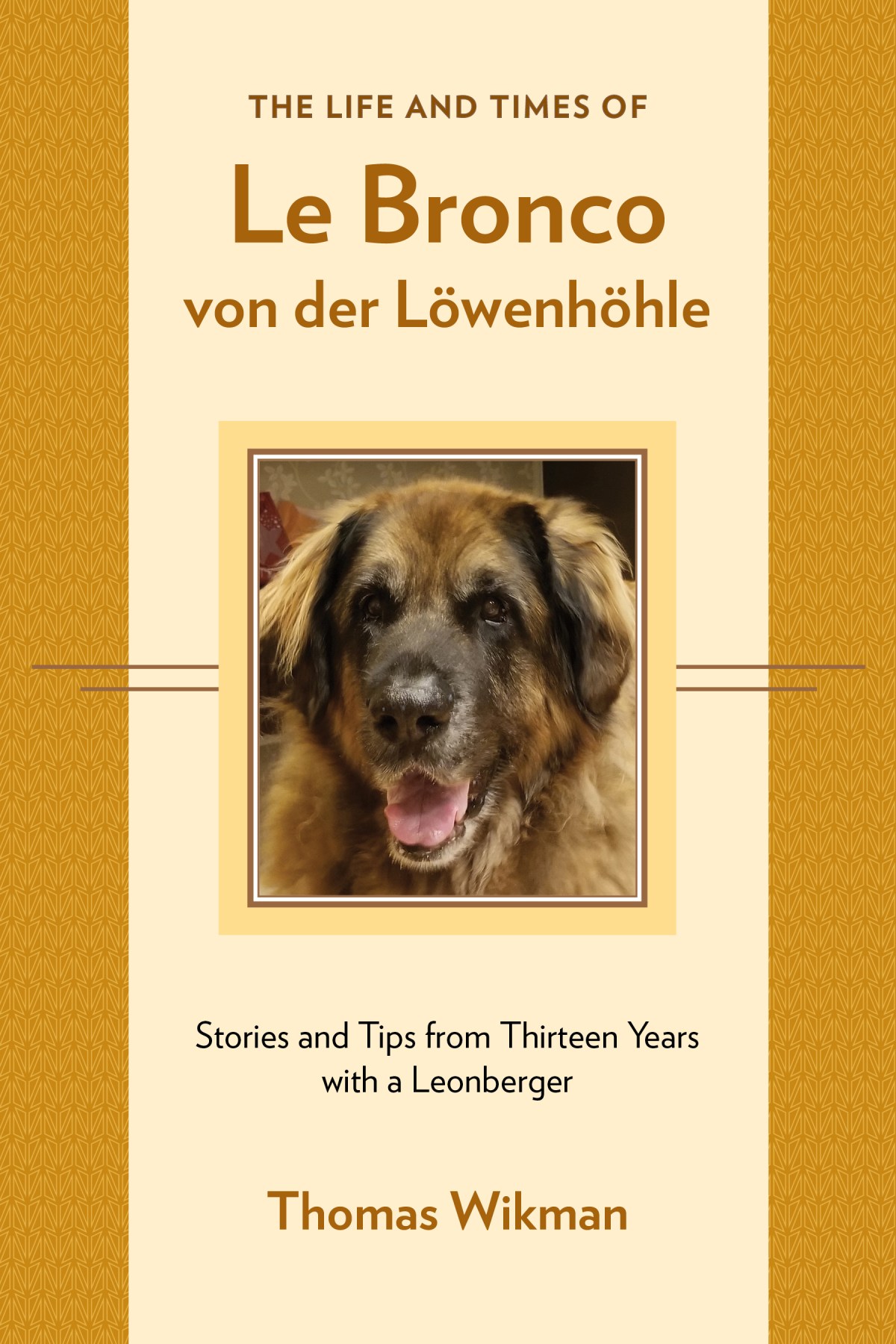
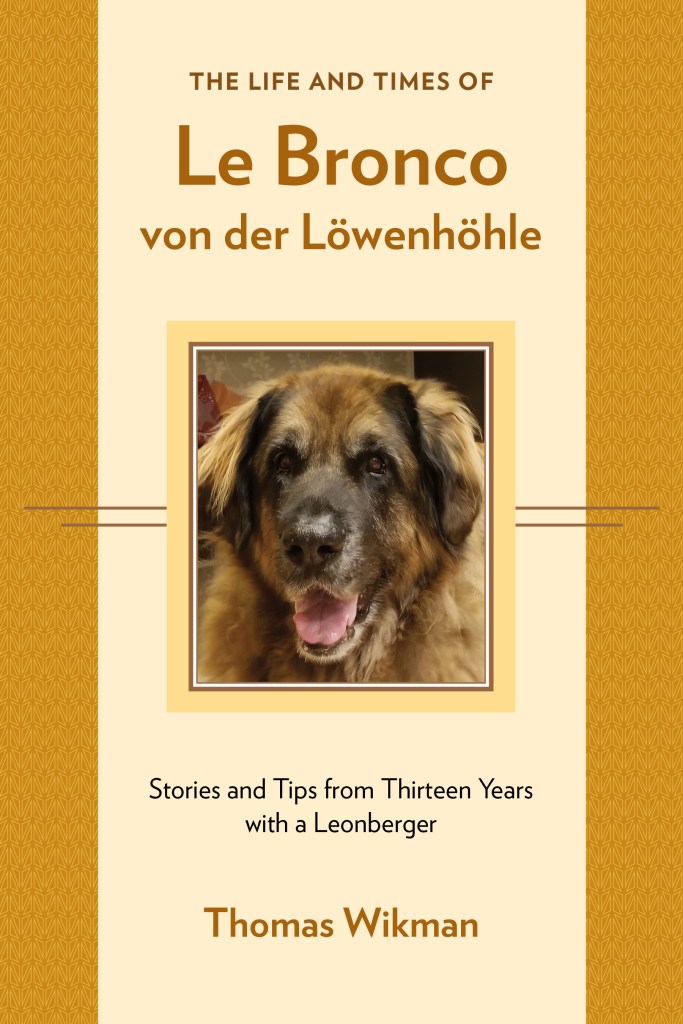
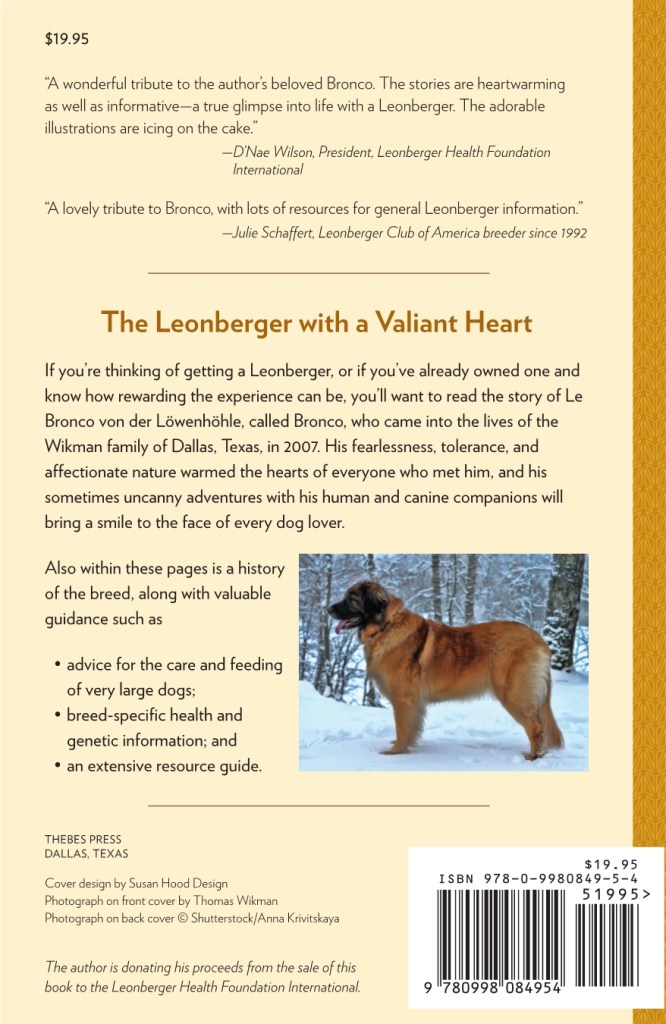
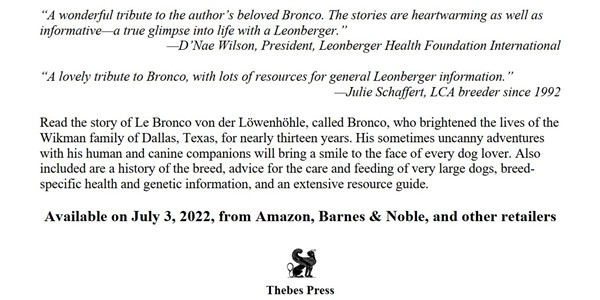
This is the front cover of the book “The Life and Times of Le Bronco von der Löwenhöhle”. Click on the image to go to the Amazon.com location for the paperback version of the book.This is the back cover of the book “The Life and Times of Le Bronco von der Löwenhöhle”. Click on the image to go to the Amazon.com location for the kindle version of the book.These are the endorsements for the book. Click on the image to go to the Barnes and Noble location for the book.
In this book you’ll read about some of Bronco’s amazing feats: the night he scared away a prowler; the day he performed a hamster search and rescue; the time he stumped the Geek Squad; and the late night he snuck into the kitchen and ate a two-pound bag of dog treats, a box of pastries, a loaf of bread, a grilled chicken, and a Key lime pie, all in one sitting. You’ll also read about his unflappable calm during a north Texas tornado and his stoicism as he endured health challenges in his later years.
In addition to entertaining stories, these pages contain a wealth of practical guidance, including:
a history of the Leonberger breed;
advice for the care of very large dogs;
breed-specific health and genetic information;
training and feeding tips;
suggestions for finding a breeder;
the official breed standard; and
an extensive resource guide.
Below is a list of places where you can get my book.
The Leonberger Health Foundation International is an organization that supports science and research impacting Leonberger health, longevity and breed preservation. Examples of research they’ve supported include research on Addison’s Disease, Inherited Leonberger Polyneuropathy (LPN), LEMP research, the Rabies Challenge Fund, Osteosarcoma, Hemangiosarcoma, genetic causes of male (dog) infertility, Cryptorchidism, study of cruciate ligament repair, Glaucoma, cardiac diseases, thyroid disease, neurological disorders, longevity & aging, population diversity, juvenile renal dysplasia, anal furunculosis, the EGFR Immunotherapy Project, and Leonberger inherited Arrythmia. As mentioned above, a lot of the progress applies to other dog breeds as well.
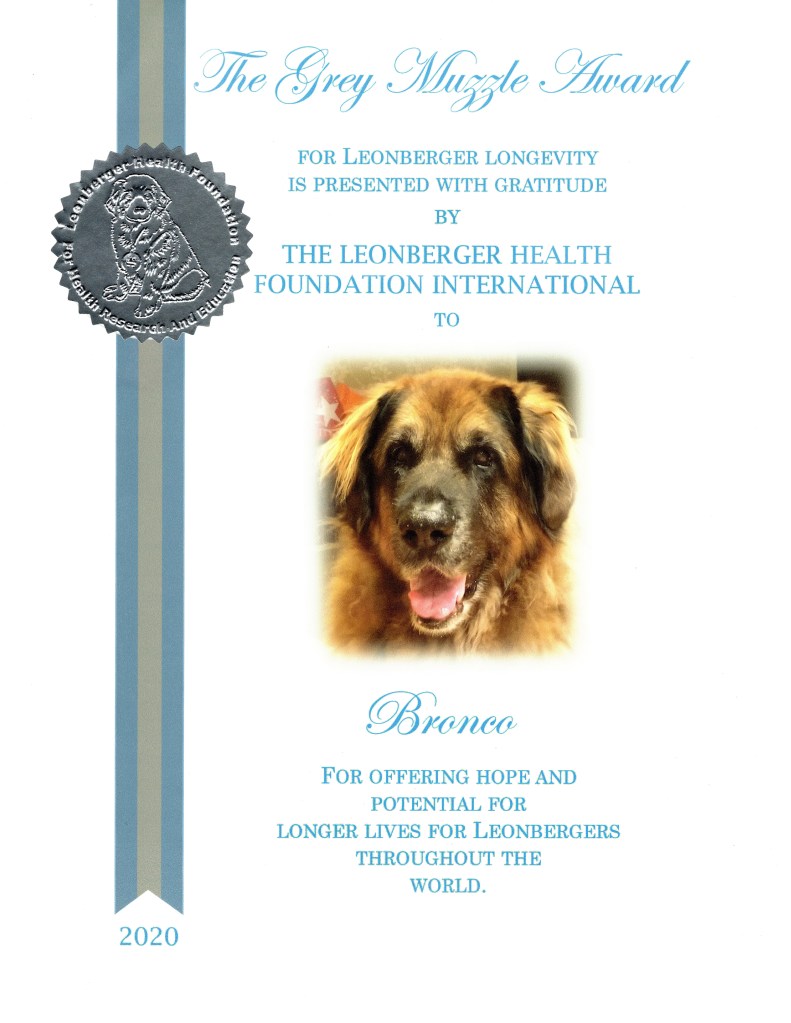
LHFI’s global biobank contains DNA samples from more than nine thousand Leonbergers. Among the organization’s notable achievements are the eradication of Addison’s disease among Leonbergers and the raising of more than $650,000 for research into conditions that affect canine health. Another success is the fact that since 2011, no Leonbergers with two copies of the LPN1 gene mutation (which causes Leonberger polyneuropathy) have been recorded in LHFI’s biobank. LHFI does other things as well. LHFI grants an award called the Grey Muzzle Award to Leonbergers who reach the impressive age of 12 years. Leonbergers and other giant breeds tend to live short lives, something LHFI is trying to solve and they have made progress. One of the recipients of the Grey Muzzle Award was our Leonberger Bronco.
The Grey Muzzle Award from the Leonberger Health Foundation International.
Below is an 8-minute video explaining the ongoing research on sudden cardiac death in young Leonbergers.
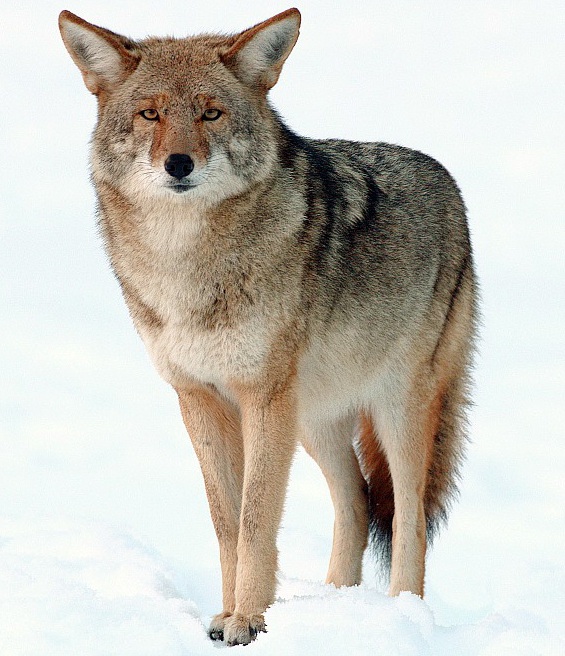
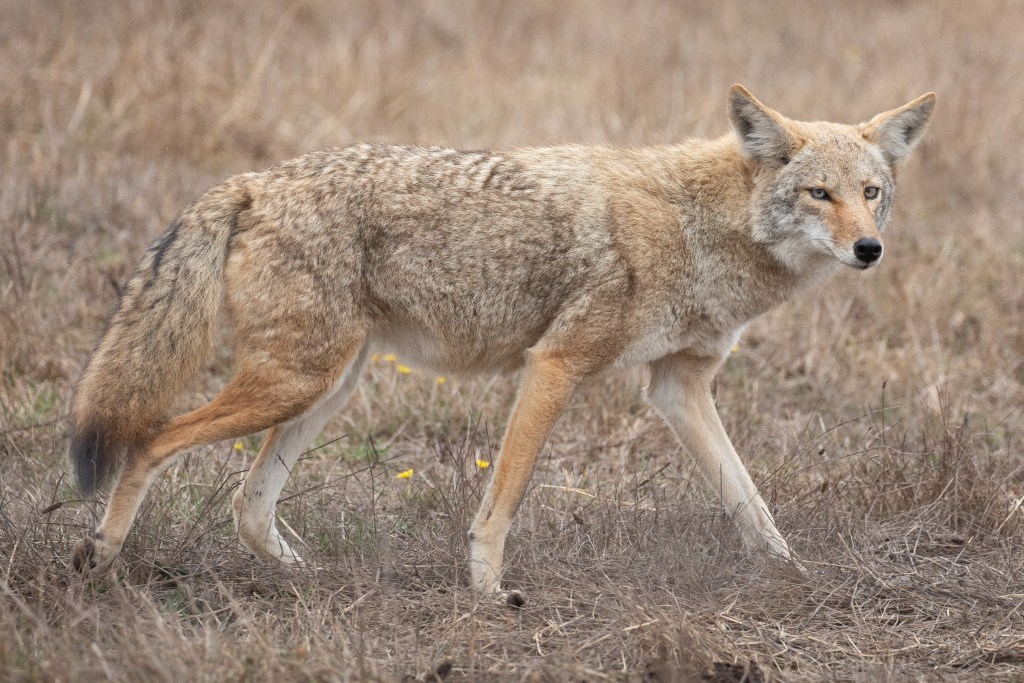
The coyote (Canis latrans) is a close relative of the wolf (Canis lupus) and the dog (Canis lupus familiaris). Coyotes live in every US state except Hawaii. It is estimated that there are between three to five coyotes in the United States. Coyotes kill a lot of cats and dogs as well as livestock including 135,000 sheep per year .
Our neighborhood is generously populated with coyotes. Bronco used to bark at them, so they never got close to us. He tried to chase them, but they ran off. I assume they were afraid of him, but they certainly weren’t afraid of Daisy or Ryu.
One day I saw a coyote coming around the corner at the end of our street as I was walking Daisy and Ryu. He saw us and proceeded straight toward us without hesitation and with no sign of fear. He wasn’t running, but coyotes have long legs, and he was sort of trotting along and moving pretty fast. I wasn’t worried for myself—an adult human can easily handle a lone coyote. I was worried for Daisy and Ryu. I didn’t want them to be the coyote’s dinner.
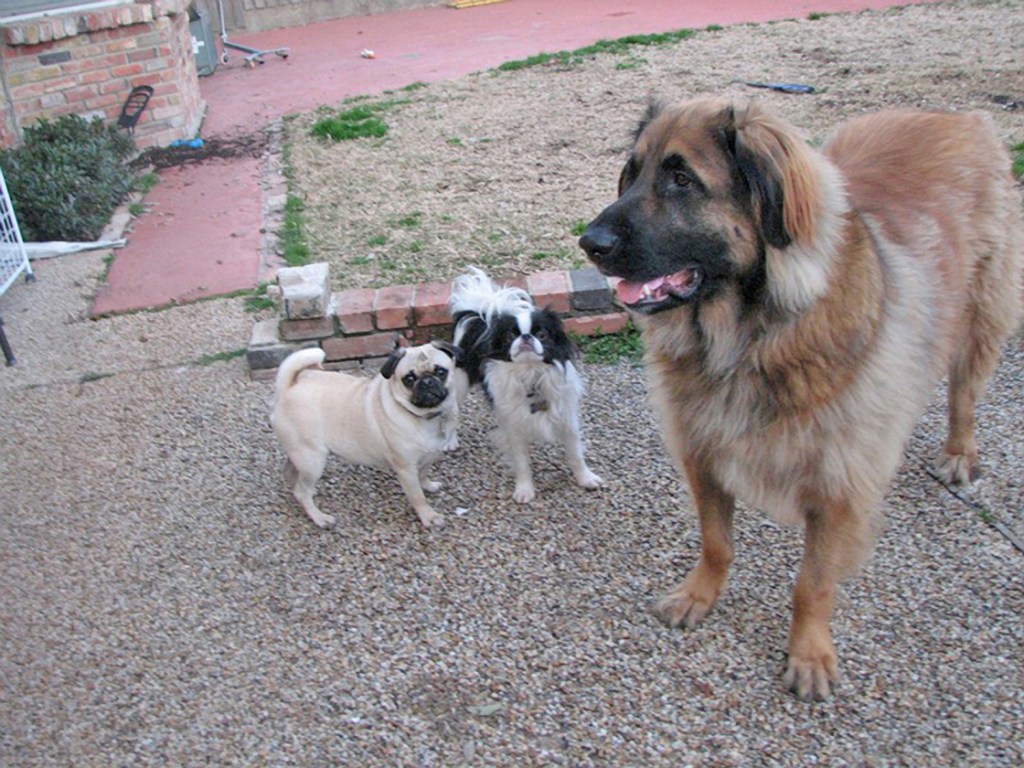
Our Leonberger Bronco with our two small dogs, Daisy the pug and Ryu the Japanese Chin.
As the coyote came closer, I stopped and stared at him. When he was around fifteen feet away, he stopped and stared back at me. Ryu and Daisy were staring at the coyote, too. I could see that they were frightened, but they didn’t bark. Meanwhile, I was calculating how best I could fight the animal. It wasn’t practical to lift both dogs in my arms and try to fight at the same time. So I had to let the dogs stay on the ground. Before I could strategize further, though, the coyote continued on his way and disappeared behind some houses farther down the road. Coyotes are common almost everywhere in the United States, so if you need another reason avoid letting your cats and small dogs run loose, remind yourself of this story.
Daisy getting ready to take Ryu for a walk.
The video below is in regard to an incident that happened here in Dallas two years ago when a two-year-old boy was injured by a coyote.
This two-minute informational video was created by a local news organization after the coyote attack on the two-year-old boy. DFW stands for Dallas Forth Worth.
I should say that I certainly respect the coyotes right to life and I think that they deserve to be treated humanely and with respect. However, they are unafraid of people, they roam our neighborhoods and there are so many of them. You need to be ready to protect your small dogs and cats, and even large dogs. A pack of coyotes can do a lot of damage to a large dog. Don’t let your small dogs and cats run lose and keep your dogs on a leash. You may also want to consider bringing maze with you on your walks.
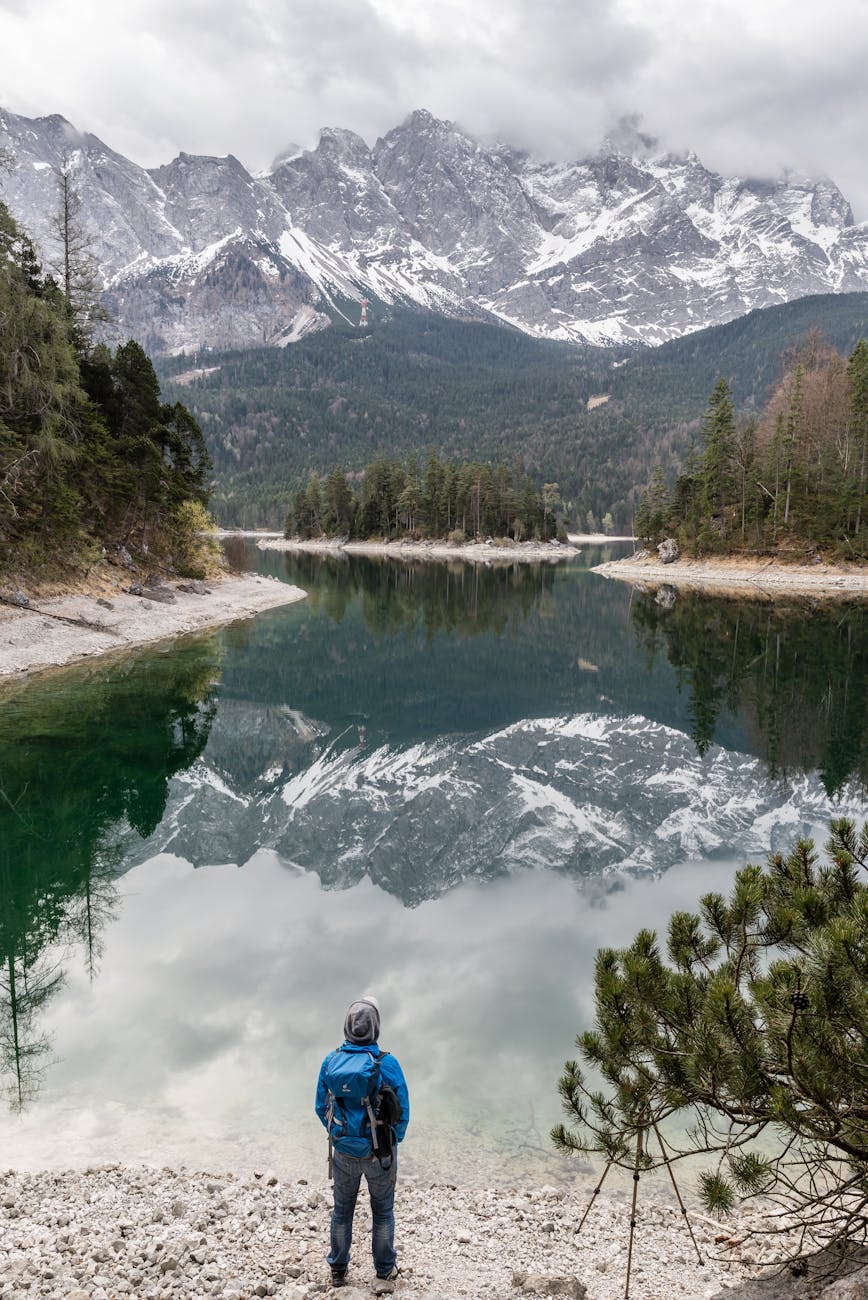
Kevin’s two images reminded me of ski resorts, and I love skiing. I’ve skied in my native country Sweden, in the Alps, as well as the Rocky Mountains. The mountain in one of Kevin’s images above remind of Matterhorn, a mountain in Switzerland, and part of the Alps. Therefore, I decided to write about a couple of adventures that I had in the Alps.
When I was young me and my brother and a friend bought Interrail passes, and we travelled around Europe. I should say that since we lived in Sweden that’s where we started. We visited several countries including Austria (not to be confused with Australia). We stopped in Zell Am Zee to ski on the kitzsteinhorn glacier. It was the end of June, which is a perfect time for glacier skiing. It is warm but you still have snow. We skied in our shorts and t-shirts, and some women skied in their bikinis. The snow was a bit wet, but it was still good skiing.
In the slope we met a Swedish actor and his girlfriend. The Swedish actor was a celebrity in Sweden so to us that was very exciting. We ended up spending the entire day together.
Garmisch-Partenkirchen
My next adventure was more of a misadventure. I was with a group of friends who travelled from Sweden to Garmisch-Partenkirchen in southern Germany for a ski vacation. First of all, we had booked a rather strange youth hostel for our stay and second of all I had a ski accident resulting in amnesia. Having amnesia was a strange experience.
Garmisch-Partenkirchen is a beautiful Bavarian town, and it is one of the most famous German ski resorts. Zugspitze Germany’s highest mountain is nearby Garmisch-Partenkirchen providing for an impressive scenery. I was there with a large group of Swedish friends, and we stayed at a youth hostel. As is typical for a youth hostel men and women were separated. What was a bit unusual were all the loudspeakers.
At 10:00PM on our first evening at the youth hostel the loudspeakers came on and someone started shouting “Achtung! Achtung. Sei jetzt ruhig. Alle Gäste müssen gehen und sich die Zähne putzen. Musik ist verboten. Die Lichter beginnen zu dimmen.” We had to be quiet and go brush our teeth. The lights started dimming and women and men had to go to their quarters. The loudspeaker came on every now and then barking orders at us in German and all windows and doors were locked electronically. Being from Sweden we followed orders, but we were laughing about it. Suddenly new voices started shouting in the loudspeaker. It was younger sounding voices. It was still in German but this time we were told to rebel against the hotel management, we were told to refuse to go to bed, and they started singing fighting songs in German. Then, suddenly the loudspeakers went quiet. The hotel management was back. We all had to go to bed. Well, it was budget lodging after all.
The town of Garmisch-Partenkirchen. Photo by op23 on Pexels.com
The Ski Accident
What happened the next day I do not remember myself, but this is what I have been told. I decided to go down an icy double black diamond slope despite the sign saying that the conditions were dangerous. I fell badly, hit my head (I had no helmet), and I got a severe shoulder displacement. My arm was hanging on my back. I went looking for my skis and tried to put them back on, but some Germans came down to stop me. They were screaming at me and calling me crazy. An ambulance was called, and they sent snowmobiles to pick me up. However, the snowmobiles were unable to get there so they got a pist-machine to get me instead. I had no pain, but I was confused, and I discovered and rediscovered my severe shoulder displacement about 10 times before I got to the hospital. I had no short-term memory, and I had forgotten my friends and most other things.
My memories come back
I remember my friends coming into my room asking me questions such as “what’s my name?”, “do you remember where we are?”. I kind of liked all the attention I got but I understood that something was not right. No one knew whether I would ever get my memory back and going through immigration and customs might be an issue when you don’t remember much. The leader and organizer of the trip was very upset. However, a few days later my memories came back very quickly within just a few hours. It sorts of clicked. I should add that the 2-3 days that followed the accident are still gone. I have to admit I was happier when I couldn’t remember anything. The world is so much better when you don’t remember how bad it is.
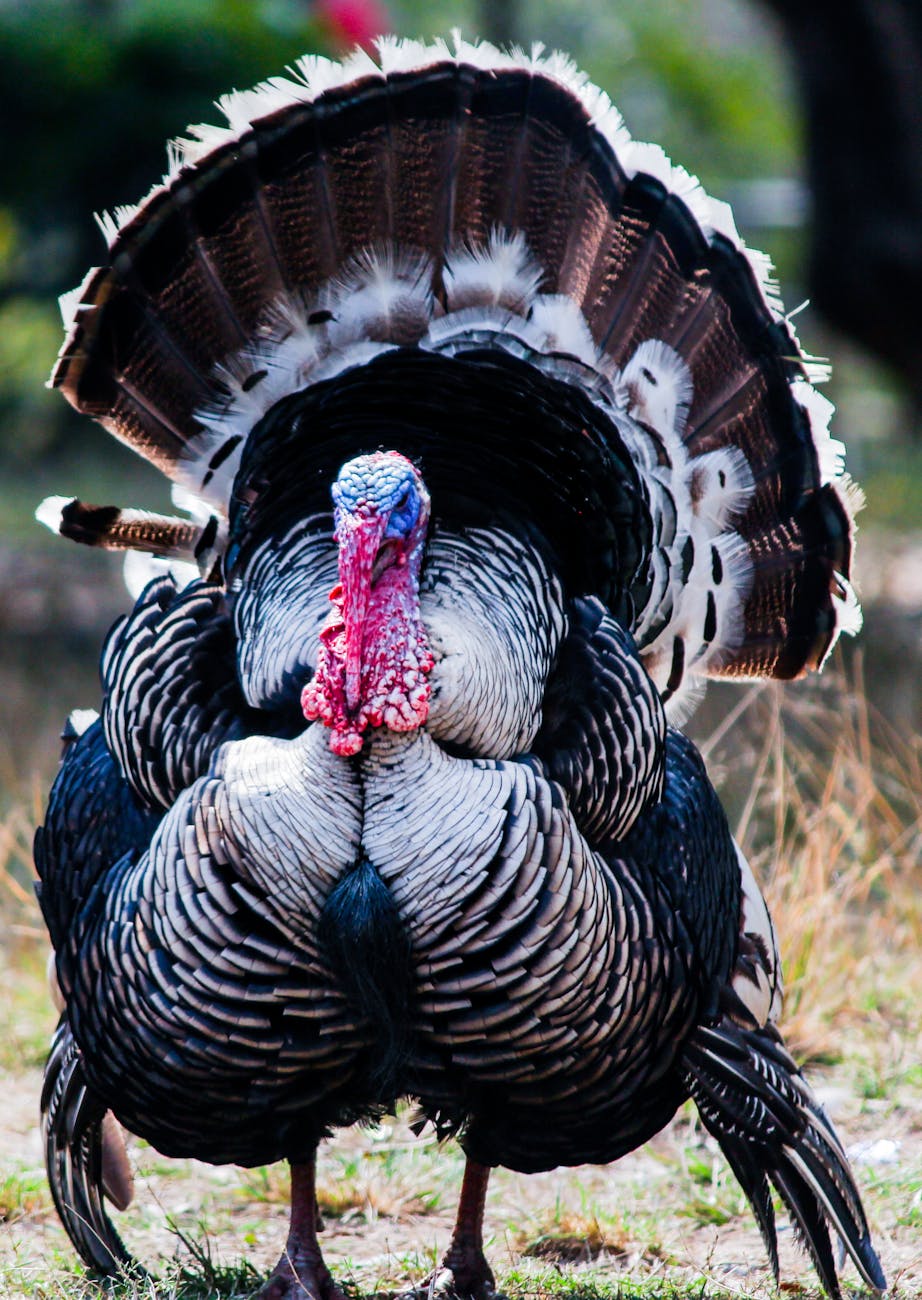
The first time I heard about Thanksgiving was when I came to the United States as an exchange student. Therefore, I may not have an as deep appreciation for turkeys as other Americans. However, I know that Thanksgiving is celebrated on one specific day, the fourth Thursday of November, which is November 28th this year. This means that if you order a turkey, it cannot arrive November 29th. Usually, we buy the turkey at the grocery store, but to save time we decided to buy the entire thanksgiving dinner on-line this year, including the turkey. This turned out to be a very bad idea.
A few weeks ago, my wife ordered a thanksgiving dinner, including the turkey, on-line from William Sonoma. There were two options, immediate delivery or delivery for Thanksgiving. She chose delivery for Thanksgiving. The turkey comes frozen, and it needs three days to thaw, so she assumed that was taken into account. Soon my wife realized that the delivery date was set to November 27th, which wouldn’t work, and they couldn’t change it, so she cancelled it. We were told that before they could cancel the order, they needed approval from the merchant. This was around three weeks ago. However, my wife went ahead and ordered the Thanksgiving dinner for immediate delivery instead with a delivery date of November 22.
November 22 came and went but no turkey, so she called William Sonoma. She was told that the delivery date for the immediate delivery had been changed to November 29, the day after Thanksgiving. By the way, they still had not heard back from the merchant regarding canceling the first order. She made a few more phone calls to William Sonoma but it was clear that the new date was indeed set for November 29 and could not be changed. So today she cancelled that order as well and we went to the store to buy a frozen turkey and the other things you need for Thanksgiving. We don’t know if we are going to end up with three turkeys, two arriving too late for Thanksgiving. It is certainly the last time we order Thanksgiving dinners online and certainly not from William Sonoma.
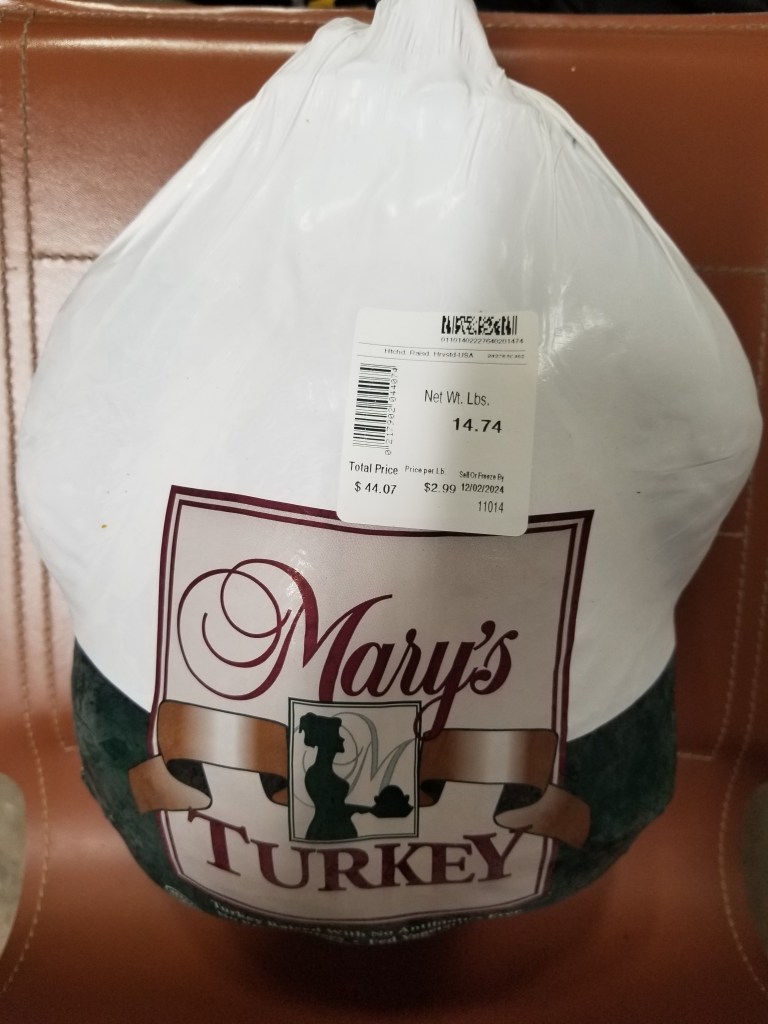
This is the turkey we bought at Central Market here in Dallas today.
In Sweden, my native country, Thanksgiving is not celebrated, and turkey is not a very common dish. However, Turkey (Kalkon in Swedish) has a second meaning, “a fiasco”. For example, a bad movie would be a Turkey. You could say that the William Sonoma Thanksgiving dinner online business is a “Turkey”.
Update
The two William Sonoma Thanksgiving dinners with turkeys arrived this afternoon, in time, which we did not expect. We gave one of the turkey dinners to a friend who happened to be here when the turkeys arrived. We have one extra but we’ll use it for another occasion. In the end it wasn’t so bad. Happy Thanksgiving everyone.
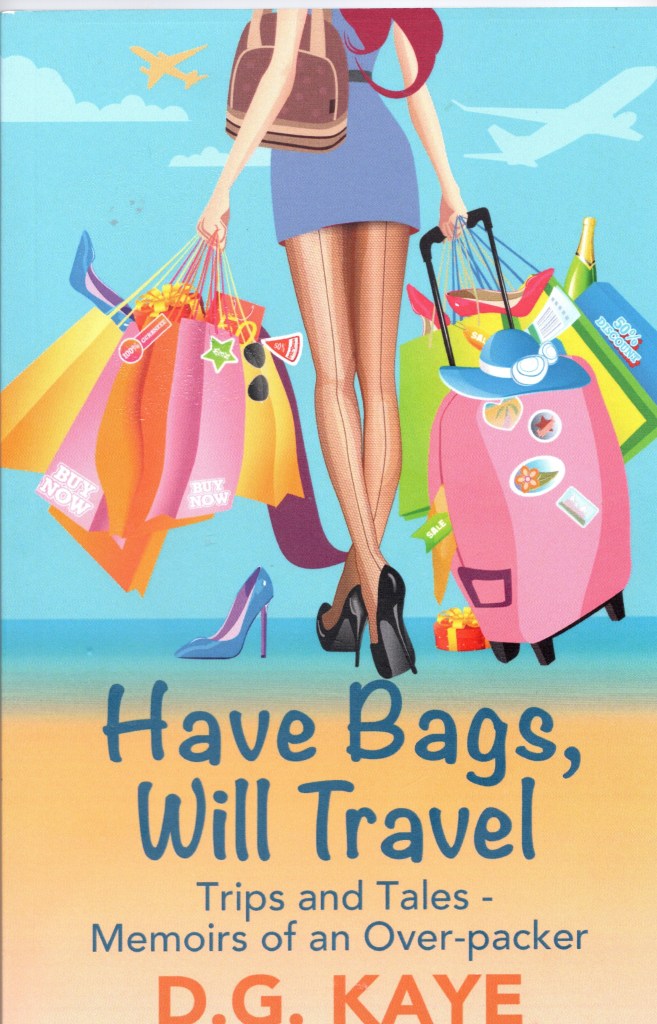
The focus of this blog is Leonbergers but sometimes I post about books that are not about Leonbergers but that I want to promote. Today I would like to promote a hilarious and fun travel memoir by D.G. Kay called “Have Bags Will Travel” (editor Talia Leduc). I bought the paperback version.
Paperback – Publisher : D.G. Kaye (September 18, 2015), ISBN-10 : 0992097495, ISBN-13 : 978-0992097493, 88 pages, Item Weight : 3.35 ounces, Dimensions : 5.06 x 0.2 x 7.81 inches, it cost $8.24 on US Amazon. Click here to order it from Amazon.com.
Kindle – Publisher : D.G. Kaye (September 16, 2015), ASIN : B015HP1R6S, 90 pages, it costs $2.99 on US Amazon. It is free with Kindle Unlimited. Click here to order it from Amazon.com.
Front cover of Have Bags Will Travel. Click on the image to go to the Amazon page for the paperback version of the book.
Amazon’s description of the book
“An honest MUST-READ memoir (psst…it WILL fit in your carry-on tote or purse!) filled with solid advice for the uninitiated and nostalgia for the seasoned traveler. An endearing whirlwind jaunt with the humor, wit, and good ol’ common sense we’ve come to expect from the fiery-haired shopaholic author, D.G. Kaye!”—Deborah A. Bowman, advanced clinical psychological hypnotherapist (ACPH), author of the Denny Ryder Paranormal Crime Series “Travel, shopping, fabulous locations—and an insider tip on where to buy the best-priced designer shoes. What more could a girl want?”—Deborah Jay, author of the epic fantasy The Prince’s Man and Desprite Measures, a Caledonian Sprite urban fantasy D.G. Kaye is back, and as she reflects on some of her more memorable vacations and travel snags, she finds herself constantly struggling to keep one step ahead of the ever-changing guidelines of the airlines—with her overweight luggage in tow.
Her stories alert us to some of the pitfalls of being an obsessive shopper, especially when it comes time for D.G. to bring her treasures home, and remind us of the simpler days when traveling was a breeze. In her quest to keep from tipping the scales, D.G. strives to devise new tricks to fit everything in her suitcases on each trip. Why is she consistently a target for Canada customs on her return journeys? D.G.’s witty tales take us from airports, to travel escapades with best friends, to reflections on how time can change the places we hold dear in our hearts. Her memories will entertain and have you reminiscing about some of your own most treasured journeys—and perhaps make you contemplate revamping your packing strategies.
The author loves to travel, and she loves to shop, especially for shoes. As a result, she overpacks, which leads to complications. In addition, she quite frequently has problems with the Canadian customs. They can see her shopping face and know that she is guilty. She also has problems with security. She might have OCD and suffer from germophobia, which complicates her travelling. How do you survive planes and hotels having germophobia? Well, you need elaborate procedures which may be exhausting to the author but comical to the reader. In the book she claims it is not a disorder but a lifestyle.
This book is a travel memoir with some travel advice, but primarily I think it is comedy. I found myself laughing out loud on several occasions. I’ve traveled to many countries myself, but I usually pack very light, and I don’t do much shopping. I even went on a 3 weeklong business trip to India with only a small carry-on bag. Therefore, I don’t entirely understand why she overpacks so much, but then I don’t need a dozen pair of shoes everywhere I go. Her travel adventures are very entertaining, but I can imagine that being her travel companion would be stressful. It was a fun short book.
Back cover of Have Bags Will Travel. Click on the image to go to the Amazon page for the kindle version of the book.
About the Author
D.G. Kaye was born and resides in Toronto, Canada. She is the author of Conflicted Hearts – A Daughter’s Quest for Solace From Emotional Guilt, Meno-What? – A Memoir, Words We Carry, Have Bags, Will Travel, P.S. I Forgive You, and her newest release – Twenty Years: After “I Do”. Kaye is a nonfiction/memoir writer and writes about her life experiences, matters of the heart and women’s issues.
Kaye writes to inspire others. Her writing encompasses stories taken from events she encountered in her own life, and the lessons that were taken from them. Her sunny outlook on life developed from learning to overcome some of the many obstacles that challenged her. From an emotionally neglected childhood, to growing up with a narcissistic mother, leaving her with a severely deflated self-esteem, D.G. began seeking a path to rise above her issues. When she isn’t writing intimate memoirs, Kaye brings her natural sense of humor into her other works.
D.G. began writing when pen and paper became tools to express her pent-up emotions during a turbulent childhood. Her writing began as notes and cards she wrote for the people she loved and admired when she was afraid to use her voice.
Through the years, Kaye journaled about life, writing about her opinions on people and events and later began writing poetry and health articles for a Canadian magazine as her interest grew in natural healthcare. Kaye became interested in natural healing and remedies after encountering a few serious health issues. Against many odds, D.G. has overcome adversity several times throughout her life.
D.G. began writing books to share her stories and inspiration. Her compassion and life experiences inspire her to write from the heart. She looks for the good and the positive in everything, and believes in paying it forward.
“For every kindness, there should be kindness in return, Wouldn’t that just make the world right?”
D.G.’s Favorite Saying: “Live. Laugh. Love …and don’t forget to breathe!”
When D.G. is not writing, she’s reading. Her favorite genres of reading are: biographies, memoirs, writing and natural health. Kaye loves to read about people who overcome adversity, victories and redemption and believes we have to keep learning–there is always room for improvement! She loves to cook, travel, and play poker (when she gets the chance).
You can find D.G. on social media and her author and blog pages:
It is easy for me to answer the daily prompt “What are your favorite animals?”, it is Canis Lupus Familiaris, or dogs of course, especially Leonberger dogs.
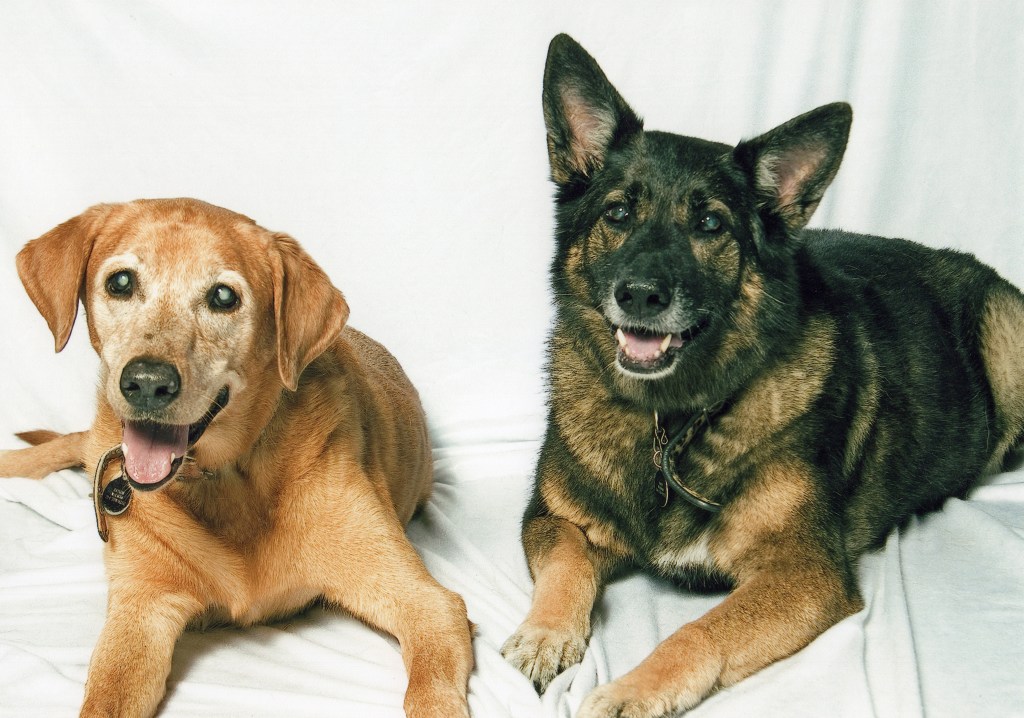
ur Labrador Baylor and German Shepherd Baby. They were both rescues.
Dogs are very social and often quite intelligent. They are loving, loyal, fun, innocent, playful and they can provide protection whether it is physically or just via their barking, which alerts us to the presence of strangers. Dogs provide companionship and encourage physical activity since you need to take them for walks and play with them.
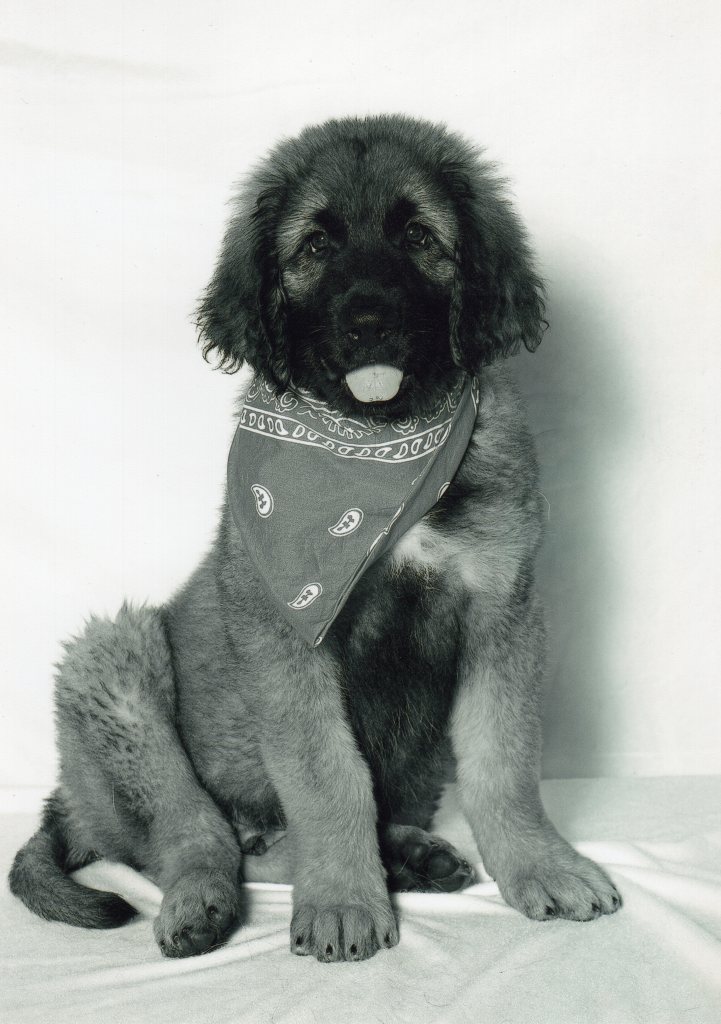
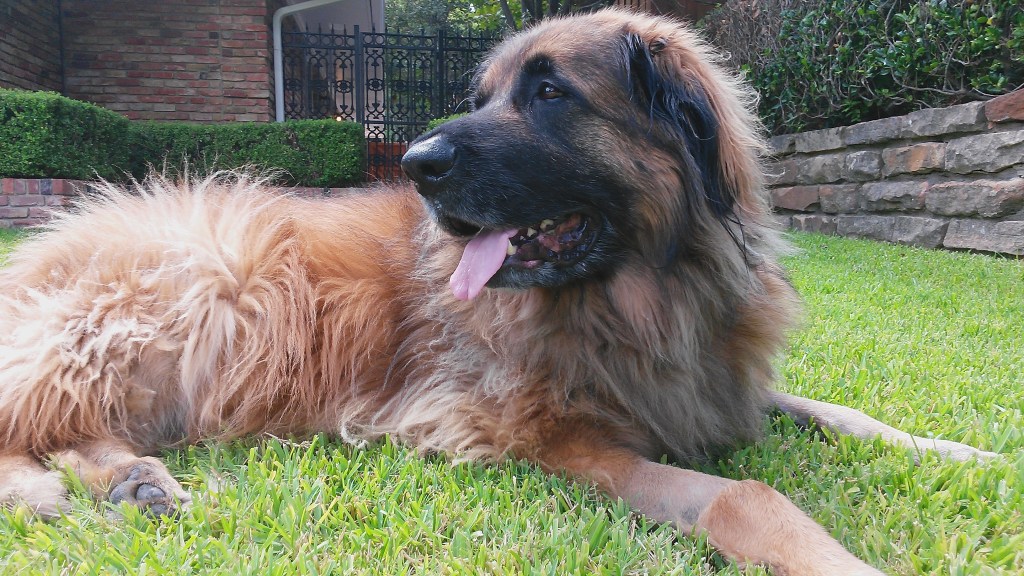
A black and white photo of our Leonberger Bronco at three months old.Our Leonberger Bronco is in the front yard.
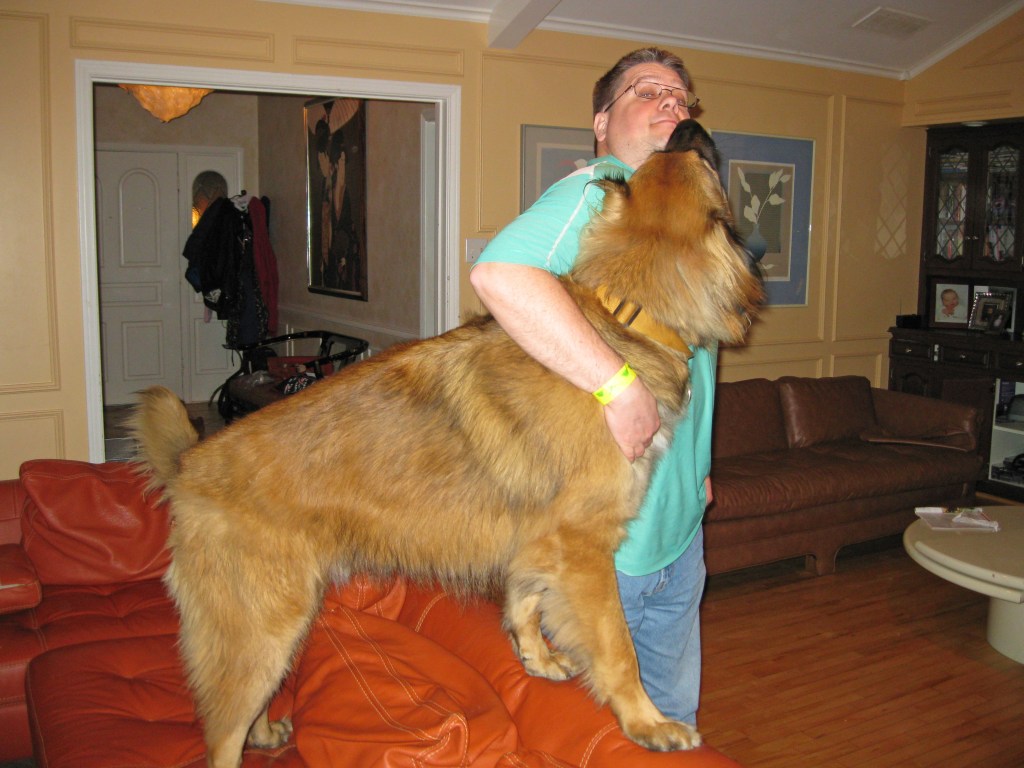
Among dogs my favorite breed is the Leonberger. Leonbergers are confident and brave gentle giants. They are great with children, very social and good companions and they can also be guard dogs. They are not aggressive and were not bred for that purpose, but their size, strength, courage, protective nature and acute senses make it a natural role for them. Our Leonberger Bronco protected the entire neighborhood by chasing off a peeping Tom. Leonbergers are double-coated, and they have webbed paws, so they’re natural swimmers as well. They are sometimes used in water rescue operations. But be careful, they are big, full of energy, and can be rambunctious when they’re young.
Below are various photos of our dogs
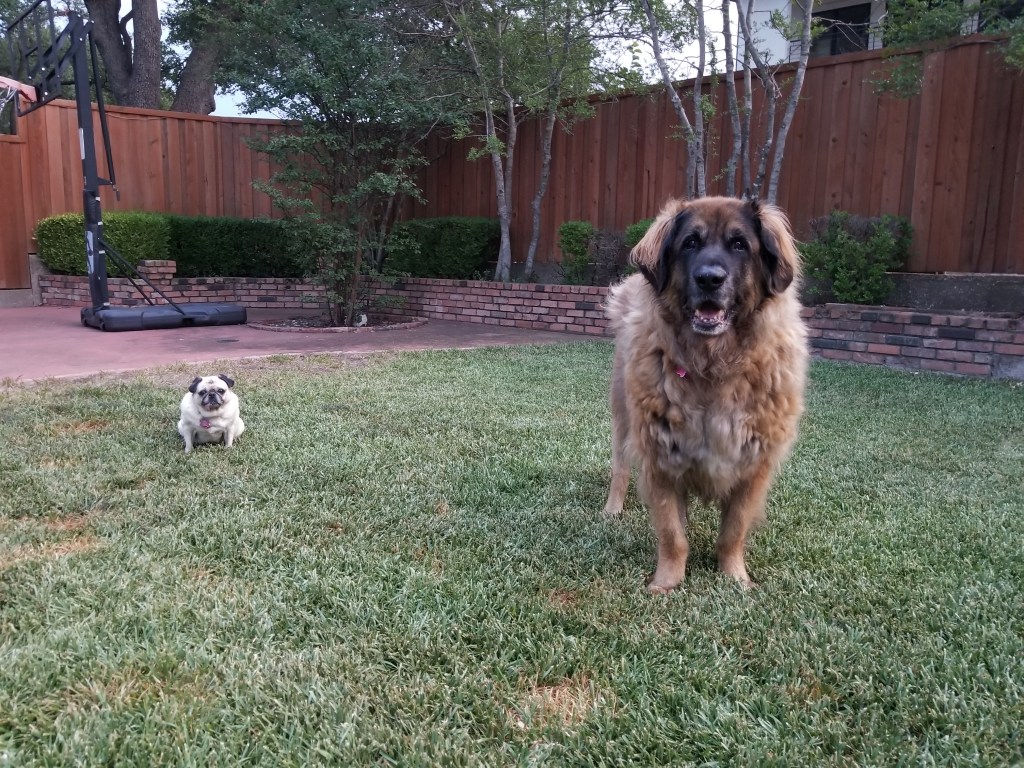
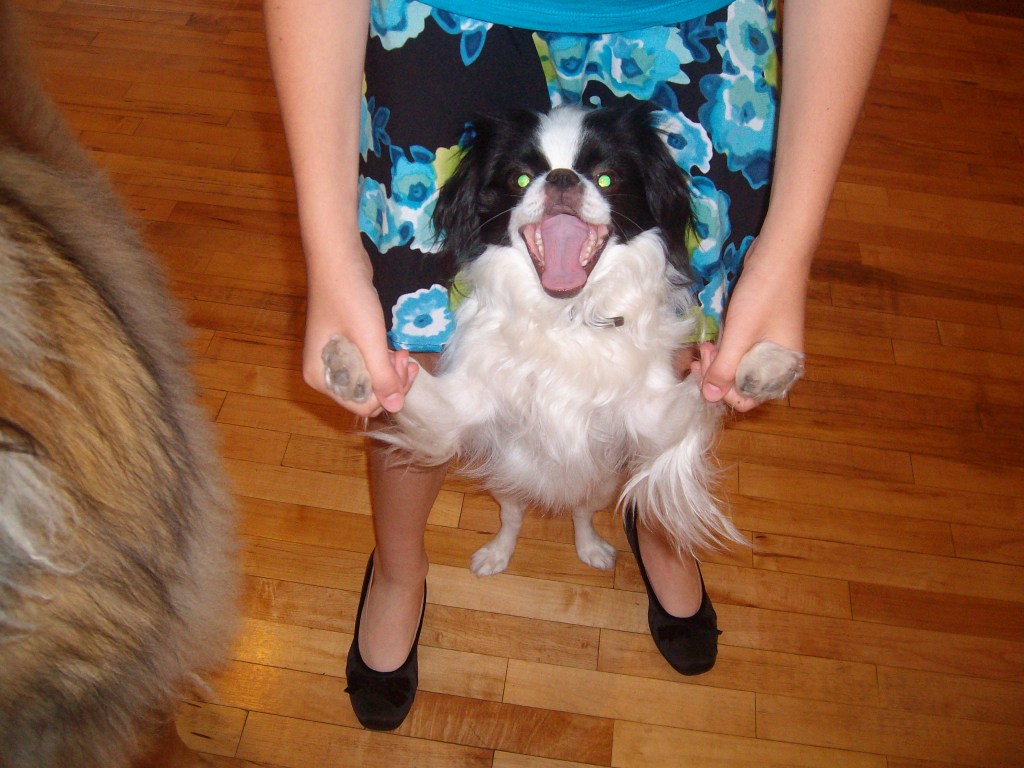
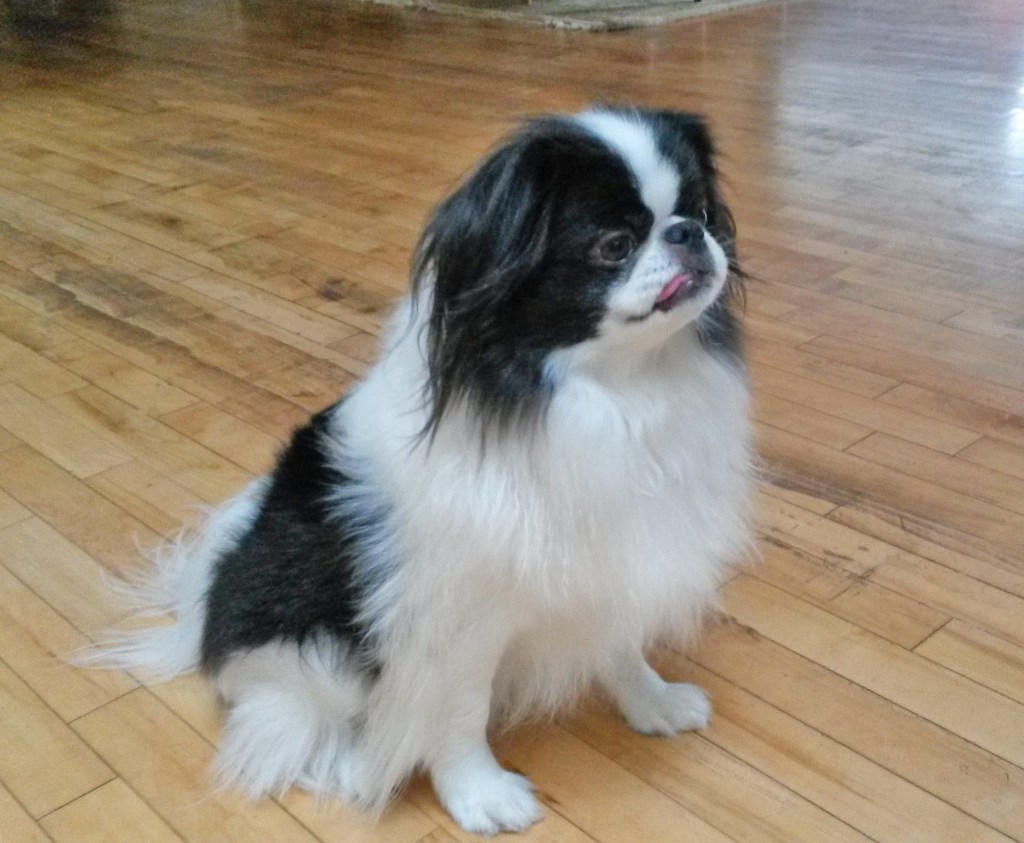
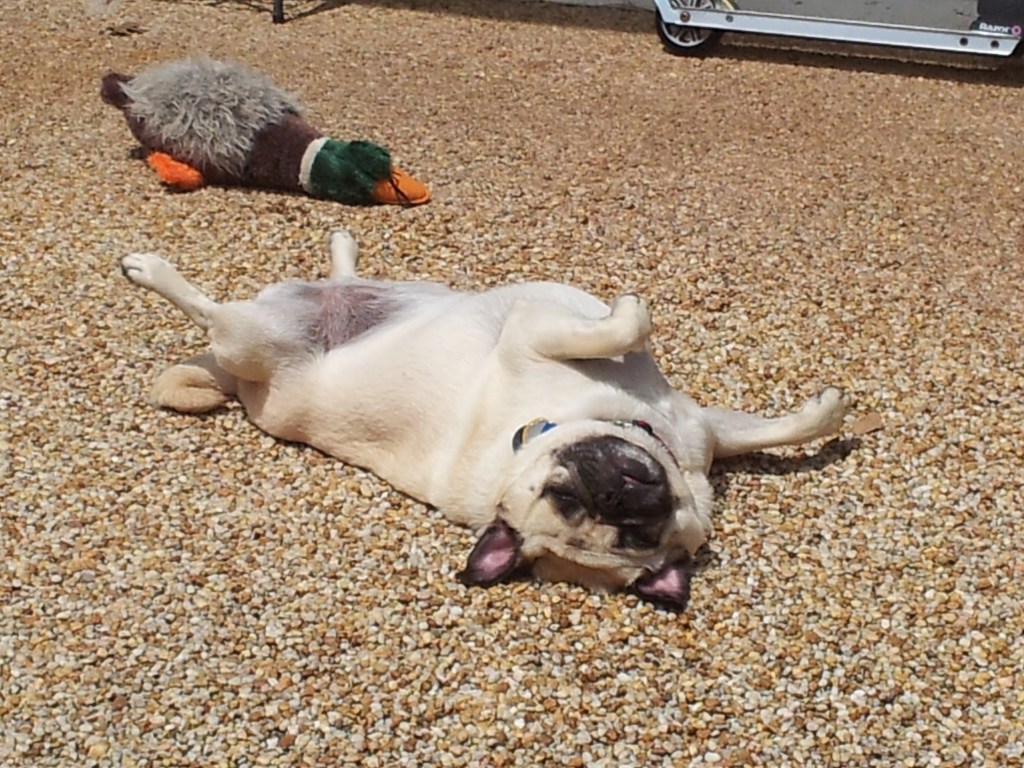
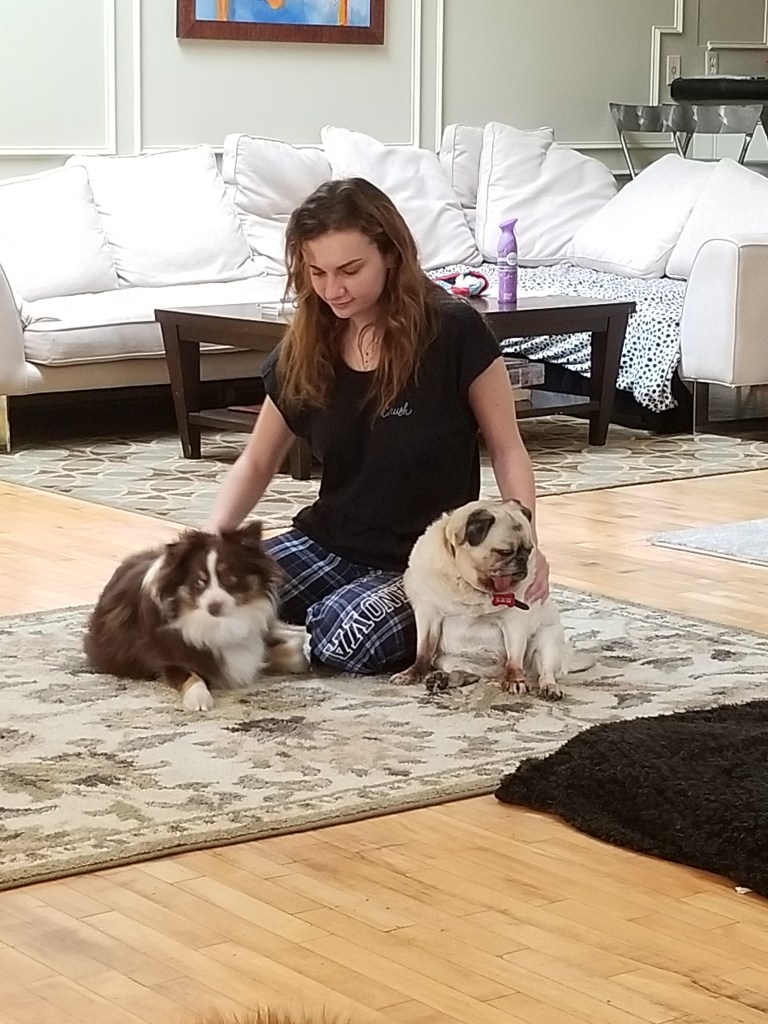
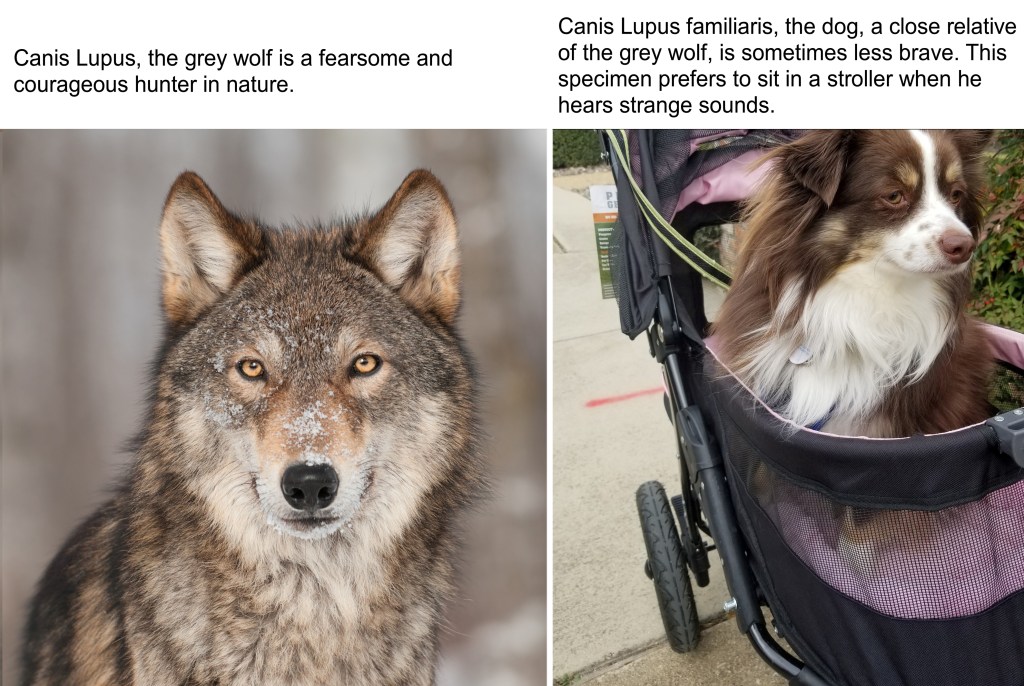
Our Leonberger Bronco and our Pug DaisyOur Japanese Chin Ryu with our daughter who was 9 years old at the time.Our Japanese Chin Ryu.Our pug Daisy loved to sunbath even when it was hot. Here she is catching some rays while lying on our old backyard porch, which had gravel.Our daughter with our pug Daisy and our mini-Australian Shepherd Rollo.A gray wolf on the left. Our mini-Australian Shepherd Rollo sitting in a stroller on the right. Whenever there was a sound that scared him, such as quacking ducks, or someone banging on something, he wanted to sit in Daisy’s stroller.Our Leonberger Bronco and our mini-Australian Shepherd Rollo.
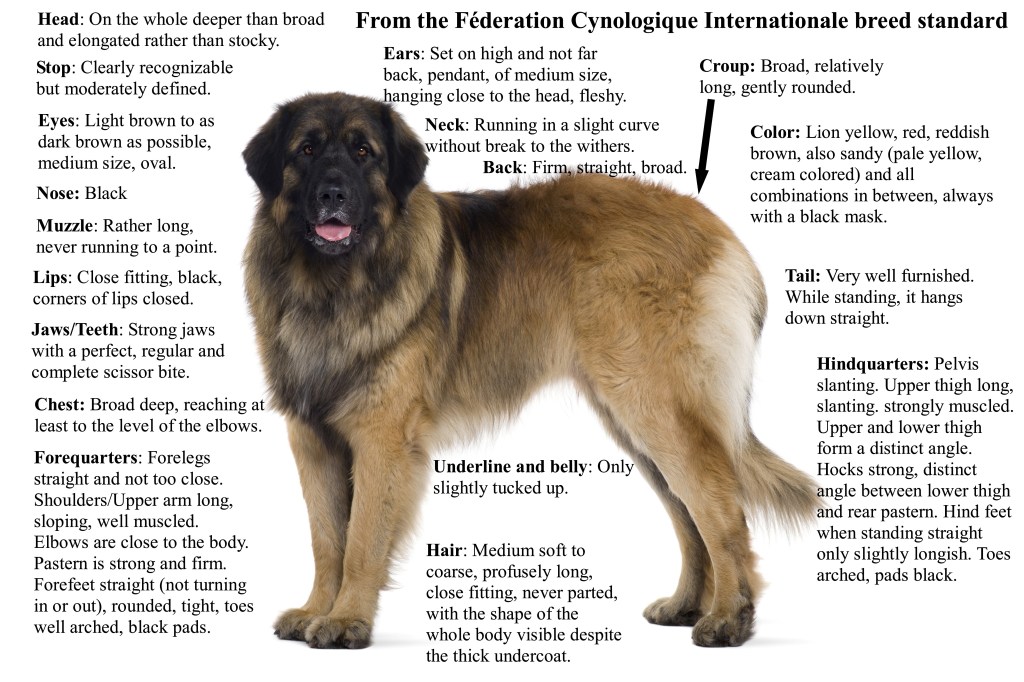
All official dog breeds have a breed standard. If you want to show your dog your dog has to closely match the breed standard. Below is the breed standard for the Leonberger.
The physical breed standard for the Leonberger. There is also one for character/behavior. The AKC / the USA has its own breed standard for the Leonberger but it closely resembles the international one.
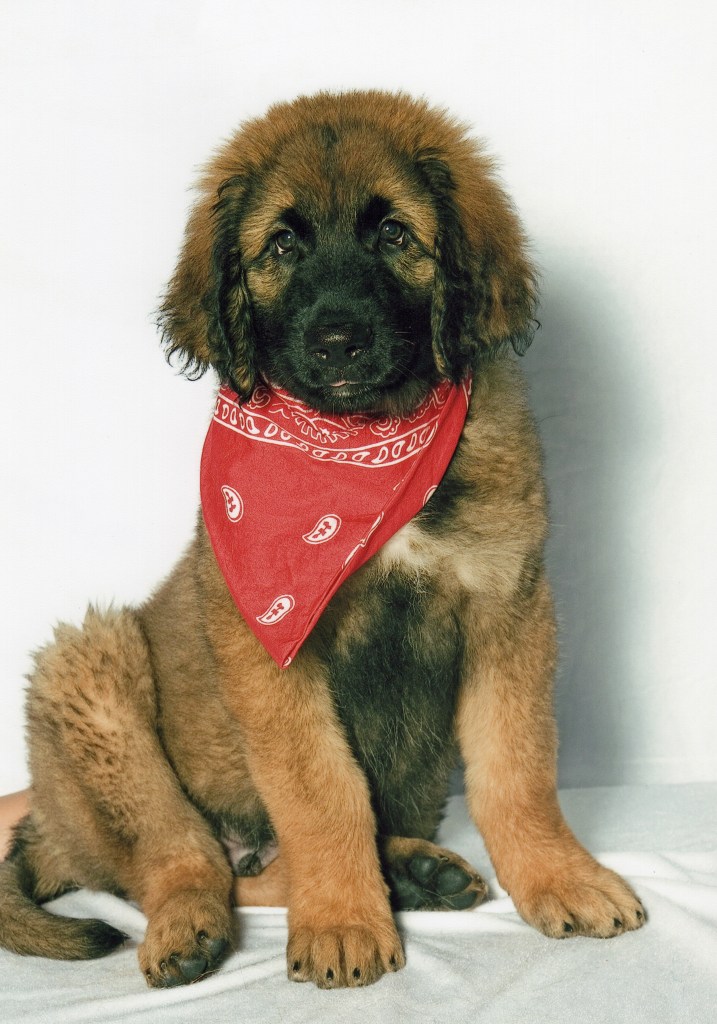
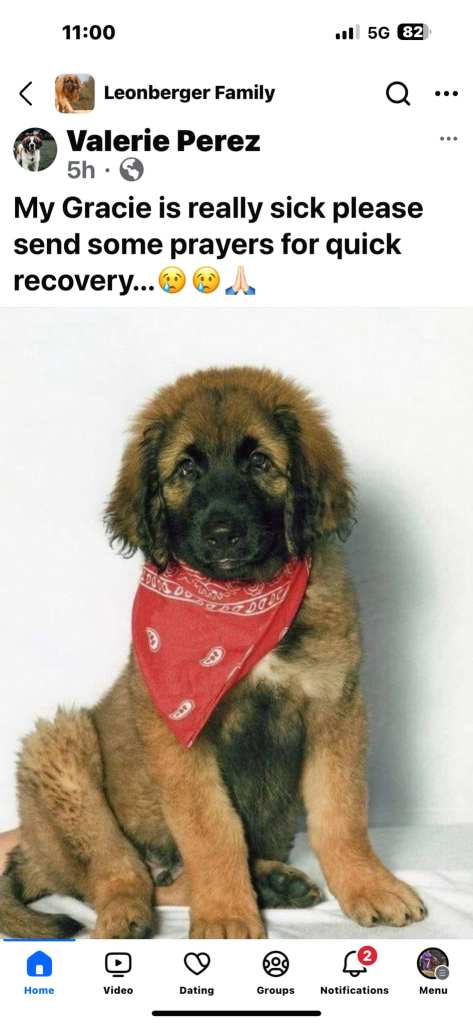
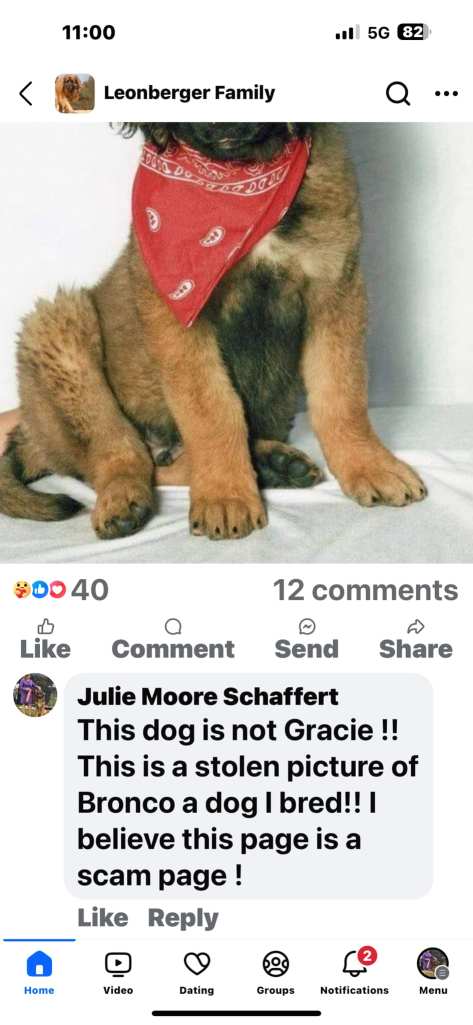
A little bit more than a week ago a photo of our Leonberger Bronco taken when he was three months old was stolen and used without attribution. The thief, Valerie, was the founder and administrator of a new Leonberger Facebook group. In addition, she changed his name and gender. Our breeder (well Bronco’s breeder) Julie Schaffert alerted me to the situation. I was unaware of the existence of this group. Julie knows this photo well since I’ve used it a lot on Facebook and Instagram as well as here. I think the worst part of it was that the thief manipulated the emotions of the members of the group by fabricating a story about the puppy being sick. What a dubious way to attract attention.
Photo of Bronco at three months old. This photo was copied without permission and Bronco’s name and gender were changed.His name was certainly not Gracie, and the story about being sick was fabricated. BTW this kind of emotional manipulation has become ubiquitous. Don’t believe these kinds of claims.This was Julie’s comment.
It is far from the only time I’ve had a dog photo stolen. I was (well still is) a member of a few pug groups and all of them except for one smaller group were photo theft groups. It seemed like the bigger the groups, the worse they were. The founders/administrators of the groups regularly stole the photos posted by the members and then used the Facebook approval feature to prevent the members from complaining about the situation. I had several photos of Daisy stolen.
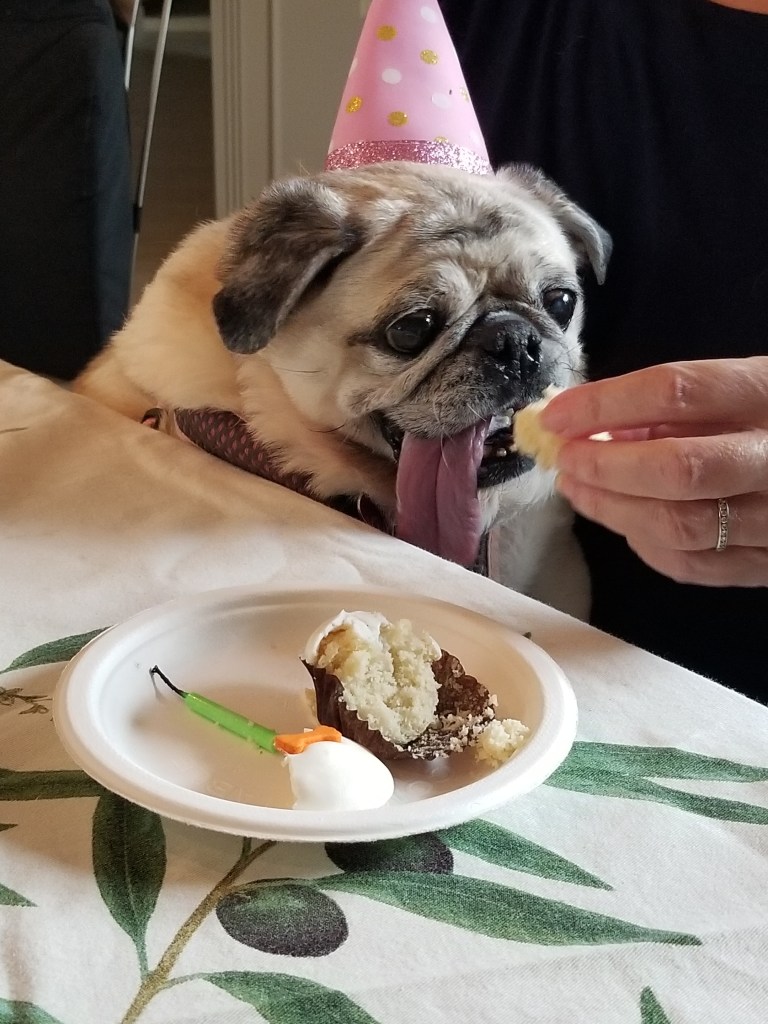
The photo below was stolen dozens of times and passed around to several groups including groups I was not a member of. I accidentally discovered my photos in other pug groups that I was randomly browsing. Her name and gender were often changed, and it was perpetually her birthday for at least several months. She was congratulated thousands of times, which was a silver lining. At first, I played along and just said thank you to all the people congratulating her even though I was not the one who posted the photo. However, that became unsustainable as there were so many congratulations in so many places for so long and then one guy started accusing me of pretending it was my pug. Well, it was my pug. After a while I just gave up on the pug groups. It seemed to be the same problem everywhere.
Photo of Daisy’s 15th birthday. The photo was stolen dozens of times in various pug groups.
So why do people steal dog photos? It seems like in some cases it is for the purpose of selling stuff, but that is not always the case. It seems like some photo thieves just want to grow their groups and become “influencers”. I should say that one of my old on-line friends told me that he had a popular YouTube video downloaded and re-uploaded (stolen) several times. He was making money off that video so in that case it was a matter of theft of money. YouTube took down those videos when he reported them, but naturally he still lost some money.
This seems to be a problem that’s spreading like wildfire on social media. I did not use to see this, but now I see it all the time. Photo theft happens even in the beer groups I help administer. Apparently taking your own photo of a beer can is too much to ask for. Unfortunately, it seems like photo theft has become normalized behavior.
The focus of this blog is Leonbergers but sometimes I post about books that are not about Leonbergers but that I want to promote. Today I would like to promote a very good and uplifting supernatural thriller by Gwen M Plano called “The Soul Whisperer’s Decision”. I bought the paperback version.
Paperback – Publisher : Fresh Ink Group (January 15, 2024), ISBN-10 : 1958922625, ISBN-13 : 978-1958922620, 146 pages, Item Weight : 7.2 ounces, Dimensions : 6 x 0.31 x 9 inches, it cost $16.95 on US Amazon. Click here to order it from Amazon.com.
Hardcover – Publisher : Fresh Ink Group (January 15, 2024), ISBN-10 : 1958922633, ISBN-13 : 978-1958922637, 146 pages, Item Weight : 12.5 ounces, Dimensions : 6 x 0.38 x 9 inches, it cost $25.95 on US Amazon. Click here to order it from Amazon.com.
Kindle – Publisher : Fresh Ink Group (January 15, 2024), ASIN : B0CPGXLD95, 149 pages, it costs $4.99 on US Amazon. Click here to order it from Amazon.com.
Front cover of The Soul Whisperers Decision. Click on the image to go to the Amazon page for the paperback version of the book.
Amazon’s description of the book
Sarah Jameson, a nurse at County Central Hospital, survives an accident that kills her two young children. While comatose, she travels into the heavenly realm where she visits with her precious little ones. She is given a choice – return to her husband, Jack, or remain with her children in their celestial home.
Jack was not in the fated automobile. Though he heard the crash and ran to help, there was nothing he could do. He suffers the loss of his children, fears the potential demise of his wife, and wonders about his own sanity. His struggle with PTSD from his military years has returned and at times, he cannot distinguish between the present and the past.
An accident tragically changed the lives of this young family, but out of sorrow emerges unexpected blessings.
This is my five-star review for The Soul Whisperer’s Decision by Gwen M Plano
A Beautiful Feel-Good Story
A devastating tragedy strikes a happy family. A drunk truck driver runs a red light and smashes into Sarah’s car and kills her two young children as well as her, well sort of. Jack, Sarah’s husband is a veteran from the Afghanistan war, and he already suffers PTSD from what he experienced there, including seeing the Taliban killing children. Jack does not cope very well. Sarah visits a spiritual realm where she is given the choice of staying with her children in the spiritual realm or returning to earth. Because Jack is suffering so badly, she chooses to return to life to help him. Her physical recovery is difficult but from the spiritual realm she acquires a supernatural gift or ability, which brings to mind what Stephen King refers to as “shining”. In other words, she began to shine to use King’s terminology. Thereof the name “soul whisperer”.
The story will take you to a place of deep despair then return you to a place of hope and happiness. Not only does Sarah recover, but she is able to help her family and other people using compassion and her gift and things get better and better, like a happy dream. I think the message is that there is a bigger reality that is beyond the earthly realm, and therefore it is possible to get from a place of darkness and despair and back to happiness if you choose love. The book has a religious angle but not in a way that is exclusive. You don’t choose between religions; you choose between love or not love. The book teaches you that choosing love and forgiveness is the right choice. It was an emotive but hopeful and enjoyable feel-good story that I highly recommend.
Back cover of The Soul Whisperers Decision. Click on the image to go to the Amazon page for the hardcover version of the book.
About the Author
Gwen M. Plano, aka Gwendolyn M. Plano, grew up in Southern California and spent most of her professional life in higher education. She taught and served as an administrator in colleges in Japan, New York, Connecticut, and California. Gwen’s academic background is in theology and counseling. Recently retired, she now lives in the high desert of Arizona, where she writes, gardens, and travels with her husband.
Gwen’s first book is an acclaimed memoir, Letting Go into Perfect Love. Her second book, The Contract between heaven and earth, is a thriller fiction novel, co-authored by John W. Howell. It has received multiple awards and is an Amazon Best Seller. The Choice, the unexpected heroes, is the sequel to The Contract. It is also a thriller, involving the attempt of an unfriendly nation to take over the world. The third book in the series, The Culmination, a new beginning is an action-packed military thriller that spans the globe and involves multiple Heads of State and the threat of World War III. Only love can change the fate of humanity.
When Gwen is not writing, she’s often in the beautiful Red Rocks of Sedona, where she finds inspiration.














 Leonberger Life